| Botanical classification | Poaceae (grasses), subfamily Bambusoideae |
|---|---|
| Average culm density | 600–900 kg/m³ |
| Parallel compressive strength | 40–80 N/mm² (Guadua) |
| Parallel tensile strength | 100–300 N/mm² |
| Longitudinal elastic modulus | 10,000–20,000 N/mm² |
| Growth rate | up to 1 m/day (Moso species) |
| Structural regrowth cycle | 3–5 years (culm mature for construction use) |
| Reference standard | ISO 22156:2021 (bamboo structures) |
Hannover, Expo 2000. Simon Vélez and his Colombian team erect the ZERI Pavilion in three weeks. The structure is a roof spanning over 40 metres, built exclusively with Guadua angustifolia culms — the Andean structural bamboo species — with grout-injected joints at the nodes. No bolted hardware in the main members: the grout enters the culm's hollow interior through holes drilled at the nodes (the transverse diaphragms inside the stem) and forms a rigid plug that anchors threaded rods without crushing the outer fibres. The pavilion is dismantled after the Expo and re-erected in Colombia.
Vélez isn't a structural engineer in the academic sense of the term. Yet his structures withstand Colombian earthquakes — a high-intensity seismic zone — better than many reinforced-concrete buildings in the same area. The reason lies in the material's physics: an exceptional strength-to-weight ratio, high ductility for deformation before failure, energy-dissipation capacity through the culm's visco-elastic behaviour. Bamboo isn't the "poor man's timber" many European architects imagine — it's a structural material with mechanical characteristics comparable to laminated timber, and with a carbon footprint radically lower than any other building material.
Biology and anatomy of the culm
Bamboo isn't a tree: it's a giant grass. The structure of the culm (stem) is fundamentally different from wood: instead of concentric growth rings, the culm is made up of vascular bundles of sclerenchyma fibres embedded in a parenchymal matrix. Fibre density increases from the inside to the outside of the culm: the outer part (dense, green) has mechanical strength 2–3 times higher than the inner part (porous, pale). This distribution is a natural structural optimization — the strongest fibres sit farthest from the neutral axis, exactly where they're needed to resist bending. An engineer who doesn't understand this asymmetry and orients the bamboo the wrong way wastes 60% of the available strength.
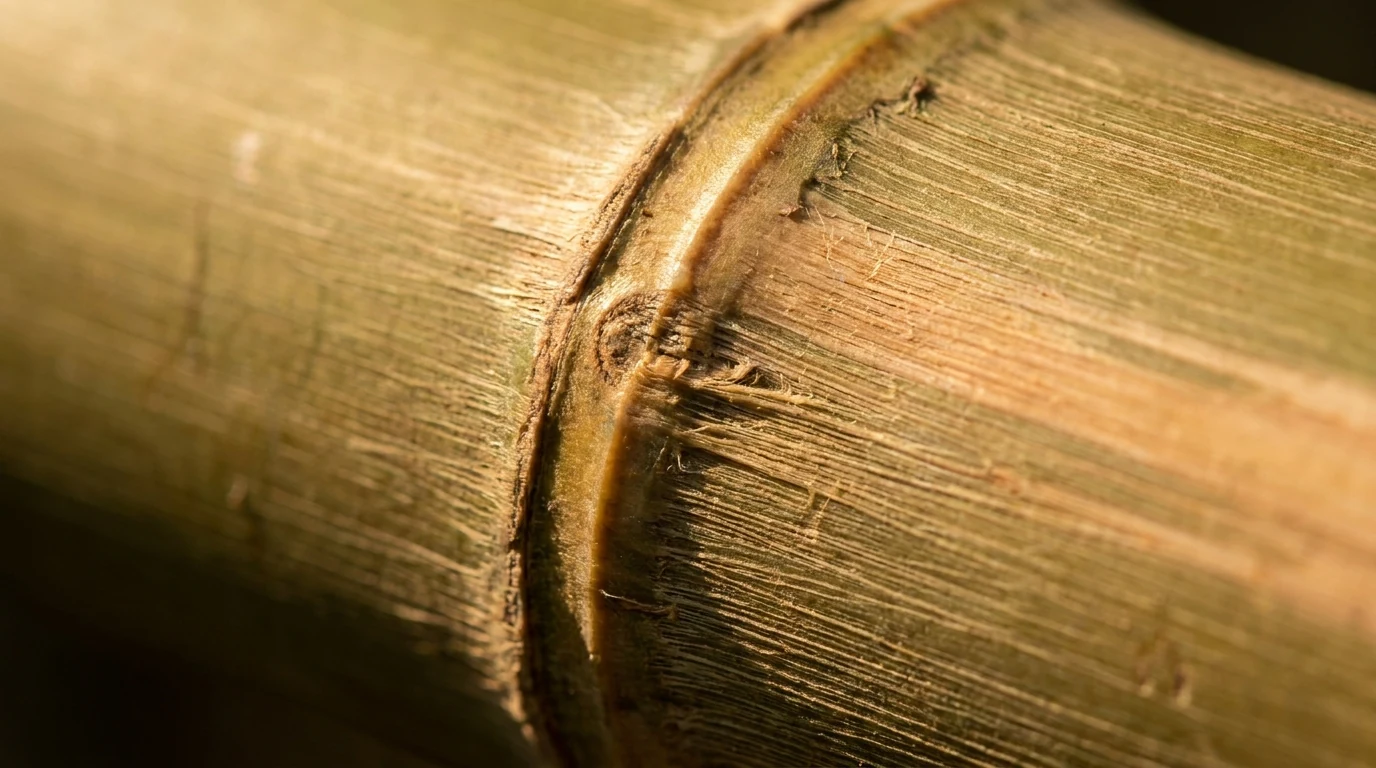
The nodes — the internal transverse septa that punctuate the culm at regular intervals — aren't a decorative element: they're structural reinforcements that prevent local collapse from buckling of the hollow culm's thin walls. The distance between nodes (internode) ranges from 20 to 50 cm depending on the species. Species with short internodes are better suited to compressive stresses; those with long internodes to tensile stresses.
The structural variants
Guadua angustifolia (Colombia, Ecuador)
Guadua is Latin America's structural species par excellence. Culm diameter: 10–20 cm. Wall thickness: 1–3 cm. Maximum height: 25–30 m. Compressive strength parallel to the fibres: 40–80 N/mm² (data from Colombian standard NTC 2010 and TU Delft tests). Tensile strength: 100–200 N/mm². The strength-to-weight ratio exceeds that of S235 steel in tension — a figure that needs careful reading: the comparison only holds for axial tension and only for slender members not subject to buckling. The International Network for Bamboo and Rattan (INBAR) published mechanical characterization data on 4,000 samples in 2022: statistical variability is high (COV = 20–35%), significantly higher than laminated timber (COV = 5–15%). This calls for more conservative safety factors in structural design.
Moso (Phyllostachys edulis, China)
Moso is the Asian species of greatest commercial interest. Diameter: 8–15 cm. Record growth: up to 1 m per day at peak periods (documented via time-lapse in the Anji district, Zhejiang). The mature culm reaches its optimal mechanical properties between 3 and 5 years — Colombian and Chinese growers cut it at year 5 for structural use. Moso's compressive strength is slightly lower than Guadua's (30–60 N/mm²) but availability is far greater: China has 7.2 million hectares of Moso bamboo (FAO 2022 data), producing around 30 million tonnes a year. It's the backbone of the entire laminated and engineered bamboo industry.
Glued laminated bamboo (similar to GLULAM)
Laminated bamboo follows the same logic as glued laminated timber (GLULAM): the culm's fibres are split into strips, planed, dried to 6–8% moisture, bonded with polyurethane or melamine resins and pressed into boards or beams of any size. The advantage over the natural culm: controlled isotropy, no localized defects, reduced mechanical variability (COV = 10–15%), standardized dimensions compatible with CNC systems. The bending strength of laminated Moso bamboo beams is 60–100 N/mm² (EN 408 equivalent) — comparable to timber GLULAM GL28h. The elastic modulus is 10,000–15,000 N/mm².
Engineered bamboo: BambooX and MOSO International
Engineered bamboo systems (EBP, Engineered Bamboo Products) include strand-woven panels (fibrous bamboo hot-pressed to a density of 1,100–1,200 kg/m³, with Brinell hardness higher than oak), LVL panels (Laminated Veneer Lumber in bamboo) and HPC (High-Performance Composite) beams. Strand-woven bamboo's density is nearly double that of natural bamboo: this makes it unsuited to structural use because of excessive weight, but excellent for flooring and cladding requiring high abrasion resistance. The MOSO International brand (NL) certifies its products with an EPD (Environmental Product Declaration) under EN 15804 and ISO 14025, with a declared embodied-carbon value of 0.6 kg CO₂/kg — significantly lower than laminated softwood (0.3–0.5 kg CO₂/kg including biogenic sequestration). The most rigorous product certifications are FSC and PEFC.
Carbonized bamboo
Carbonized bamboo undergoes heat treatment at 150–200°C that caramelizes the sugars present in the fibres, reducing the nutrients available to fungi and wood-boring insects (in particular Dinoderus minutus, a beetle that devastates untreated dried culms). Mechanical strength after carbonization drops 10–20% compared to natural bamboo, but biological durability increases significantly. Carbonization doesn't replace a chemical preservative treatment in environments with constant relative humidity > 75%: in those conditions, a combination of heat treatment + surface waterproofing + a gap from ground moisture is needed.
Textile bamboo (non-structural)
Textile bamboo — fibres mechanically extracted from the culm and spun — has no structural interest but is mentioned because it's often confused with construction bamboo in marketing materials. The textile fibre comes from the culm's pulp, processed either chemically (viscose process) or mechanically (bamboo linen): the final product is a fabric with commercially attractive antibacterial and breathable properties, but with no relation whatsoever to the original culm's mechanical properties. Textile bamboo is never specified for structures.
Long-term behaviour
The main enemy of structural bamboo isn't load, but moisture. Untreated natural bamboo in contact with water and soil degrades from fungal attack within 2–5 years. Fungal spores colonize the parenchyma — the starch-containing cells — and digest their organic matter, leaving the fibres mechanically intact but without a matrix. The culm becomes brittle from loss of internal cohesion even before showing visible signs of decay. The solution: boron-salt treatment by immersion (boron salts diffuse into the parenchyma, replacing the starches as nutrients toxic to fungi), or drying below 15% moisture content and keeping it in that range throughout use. ISO 22157 requires checking culm moisture before installation with a penetration hygrometer.
Creep (viscous deformation under permanent load) is a behaviour bamboo shares with timber, but at greater intensity: a laminated bamboo beam under long-duration permanent load (years) shows deformations 30–50% greater than the immediate elastic ones. The creep coefficient kdef for laminated bamboo is estimated at around 0.80–1.20 (vs. 0.60 for service-class-1 GLULAM) — still to be standardized in European regulation, since ISO 22156 provides indicative values for humid tropical climates, not for the European temperate climate.
| Dimension | Score | Assessment |
|---|---|---|
| 🌿 Environmental | 9/10 | Bamboo sequesters 12 tonnes of CO₂ per hectare per year — 4 times more than an equivalent pine forest (INBAR 2020 data). It regrows in 3–5 years without replanting (the rhizome survives). It needs no pesticides or fertilizers under natural cultivation. The embodied energy of dried culm is 0.5–1.0 GJ/t, against 8–12 GJ/t for laminated timber and 25 GJ/t for steel. The one weak point: boron-salt treatment uses chemicals that require controlled disposal at end of life. |
| ⚖️ Ethics | 6/10 | Production is concentrated in China and Colombia. In China, oversight of working conditions in engineered-bamboo factories is partial — FSC and PEFC certifications are developing but not yet universal. In Colombia (Guadua), grower cooperatives are progressively obtaining fair-trade certifications. Transport from Asia to Europe adds environmental impact and supply-chain complexity. European bamboo (Romania, southern Italy): varieties are available but not yet in commercial structural quantities. |
| 🏘️ Social | 7/10 | In the production areas (Colombia, Indonesia, China), bamboo is the local material par excellence, with strong cultural value and the ability to generate a rural economy. In Europe, technical knowledge is still limited: few professionals have experience with structural bamboo calculations, and few labs offer standardized mechanical characterization testing. ISO 22156:2021 is a first step toward standardization, but a dedicated Eurocode is still missing. |
| 💶 Economic | 6/10 | Low cost in the production areas: a Guadua culm in Colombia costs €0.50–2.00 each. In Europe, imported treated and certified bamboo runs €60–150/m² for cladding systems or simple structures, with higher design costs due to the lack of simplified regulations. Engineered bamboo (laminated panels) is competitive with birch plywood (€40–80/m²). Periodic maintenance (re-impregnation every 5–10 years) is a non-negligible recurring cost. |
| Average score | 7.0/10 |
Historical uses
Traditional Asia (since the Neolithic): Bamboo has been a building material for 7,000 years across Asian cultures. In China, the Zhoubi Suanjing treatise (around 100 BC) describes calculation techniques for bamboo structures. In Indonesia and Vietnam, temples, suspension bridges and pile-supported dwellings in bamboo demonstrate a construction tradition of a high technical level — bamboo bridges reach spans of 20–30 metres with lashed-joint techniques that need no metal hardware. In Japan, bamboo is a protagonist of gardens (fences, water channels, pergolas) but less so of load-bearing structures, out of a cultural preference for timber.
Latin American vernacular architecture (16th–19th c.): Guadua angustifolia is the "vegetable steel" of the Andean region. Colombian quinchada houses use crossed Guadua culms lashed with natural fibres to form walls that showed surprising seismic resistance: in the Quindío earthquake (Colombia, 1999, M 6.2), Guadua dwellings had a 2% collapse rate against 30% for non-compliant reinforced-concrete structures. This finding launched Colombia's national bamboo-construction regulatory programme.
Contemporary and signature architecture (1990–today): Simon Vélez (ZERI Pavilion, Hannover 2000), Kengo Kuma (bamboo used as screen and cladding in numerous Japanese projects), Vo Trong Nghia (Vietnam) — creator of the Wind and Water Bar (2008), the most-published bamboo structure of the last decade. Nghia's project uses geodesic vaults in Phyllostachys pubescens to cover public spaces 12–15 m in diameter. In Europe: ETH Zürich's Bamboo Pavilion (2014) tested CNC laminated-bamboo structural systems for temporary uses.
Reference figures for the project
| Guadua — parallel Rc / parallel Rt | 40–80 N/mm² / 100–300 N/mm² |
|---|---|
| Moso — parallel Rc | 30–60 N/mm² |
| Laminated bamboo — bending Rf | 60–100 N/mm² |
| Longitudinal elastic modulus | 10,000–20,000 N/mm² |
| CO₂ sequestration under cultivation | 12 t CO₂/ha/year (INBAR 2020) |
| Embodied energy, dried culm | 0.5–1.0 GJ/t |
| Equilibrium moisture in service class 1 | < 15% (to be checked with a hygrometer) |
| Cost of treated bamboo in Europe | €60–150/m² |
| Structural standard | ISO 22156:2021 |
Research and the contemporary frontier
The main challenge is European standardization. The absence of an Eurocode dedicated to structural bamboo (unlike timber, EN 1995) means every structural bamboo project in Europe needs a European Technical Assessment (ETA) procedure, or a DTA approach (Document Technique d'Application in France) — both costly and slow. CEN/TC 124 launched a dedicated Working Group in 2023 to standardize test methods and characteristic values for laminated bamboo in the European climate. Results are expected by 2027.
On the materials-research front, the TU Eindhoven group led by Jos Lichtenberg is developing node-joint connections for engineered bamboo inspired by timber-frame systems, targeting CNC producibility and dry assembly. The BambooInEU project (Horizon 2021–2024) characterized 12 bamboo species that can be grown in Mediterranean and continental European climates — Phyllostachys vivax, P. bambusoides, Fargesia robusta — with compressive strength up to 35 N/mm². Not yet competitive with Guadua, but promising for eliminating dependence on Asian imports.