Antoni Gaudí i Cornet was born in 1852 in Reus, Catalonia. As a young man he had rheumatoid arthritis — a painful joint disease that often made him walk rather than sit, and that made him an attentive observer of nature. He studied in Barcelona, worked with his father (a coppersmith), and developed a passion for natural structures — the snail's shell, the veins of a leaf, the human spine — which became the core of his architectural method. It is not a decorative aesthetic: it is a structural investigation. Natural forms are efficient because they have solved the structural problem through millions of years of evolution. Gaudí wants to understand how, and replicate it in architecture.
Gaudí's most famous method is the inverted funicular chain. To design the vaults and arches of the Sagrada Família, he built models in which chains and hanging weights automatically form the shape of minimum tension. Then he photographed the model and inverted the photograph — thereby obtaining the form of minimum compression, that is, the most efficient form for a stone structure. He does not use mathematics to calculate the forms — he uses physics. The result is parabolic arches and hyperboloids that do not exist in historical architecture and that have a structural resistance notably superior to the traditional circular arch.
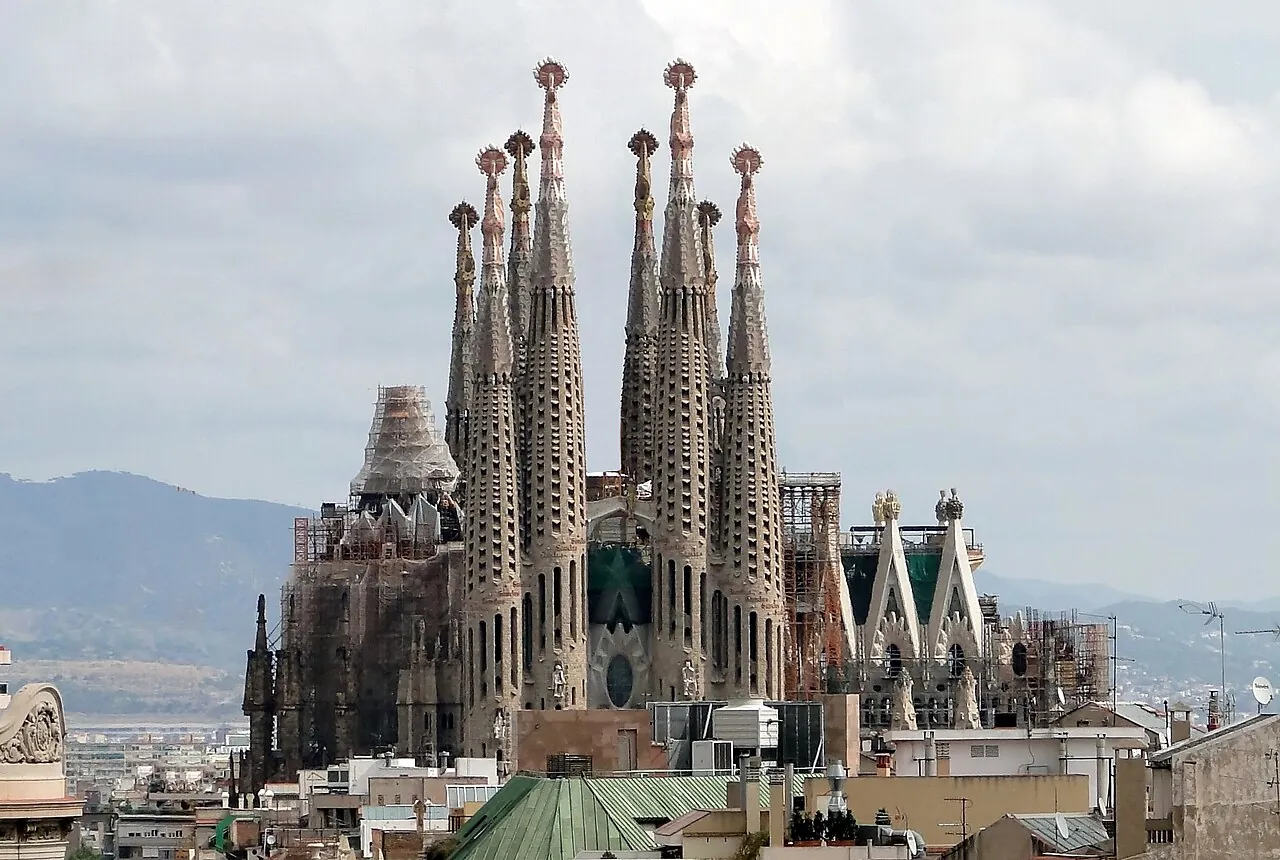
The Sagrada Família
The Sagrada Família is the most complex problem in architecture of the last 142 years. Not because it is technically difficult to build — technology has improved enormously — but because the project is in continuous evolution and never had a complete definitive design. Gaudí worked for 43 years on the cathedral and left plaster models, partial drawings, and verbal instructions to his assistants. In the fire of 1936 during the Spanish Civil War, most of the models and drawings were destroyed. Successors — architects such as Jordi Bonet, Josep Maria Subirachs, Etsuro Sotoo — reconstructed the project from the surviving fragments and from photographs.
The cathedral has three façades: the Nativity (begun by Gaudí, completed in 1935), the Passion (towers completed in 1976, Subirachs's controversial Cubist sculptures from 1987), and the Glory (under construction). It will have 18 towers: 12 for the Apostles (the current towers, up to 107 m), 4 for the Evangelists (125 m), 1 for Mary (138 m), and 1 central tower for Jesus Christ (172.5 m — the tallest, but designed to stay lower than Montjuïc, the hill behind Barcelona, because Gaudí believed no human work should surpass nature).
The trencadís
Trencadís — the cladding technique using fragments of coloured ceramic — is Gaudí's most recognisable visual contribution. Park Güell, the dome of Casa Batlló, the terraces of the Sagrada Família are clad with this technique: irregular fragments of tiles, broken plates, coloured glass, arranged in mosaics that follow the curves of the architectural surfaces. It is not applied decoration: the ceramic cladding is also the finishing surface of the structures, which often have complex three-dimensional forms (paraboloids, hyperboloids) impossible to clad with standard materials. Trencadís solves the construction problem and the aesthetic problem simultaneously.
But let us return to the Sagrada Família. It was partially inaugurated in November 2010 by Pope Benedict XVI, who consecrated it as a basilica. It is the longest building site in the history of modern architecture. The expected completion date fluctuates between 2026 and 2028. Whoever lives long enough will see whether this estimate is realistic.