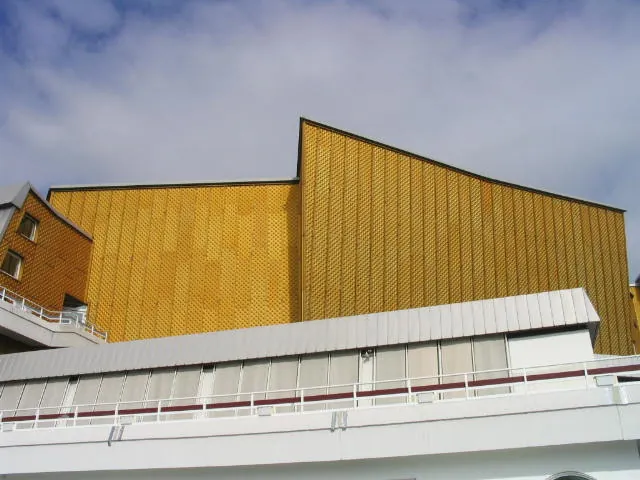
Hans Scharoun was born in 1893 in Bremen and died in 1972 in Berlin. In between, he lived through the Weimar Republic, Nazism (which he survived building almost nothing and drawing imaginary houses in his room), the postwar period, the Cold War, the reconstruction of Berlin. He is an organicist architect — in the European and German sense of the term, different from Wright's American organicism. Scharoun's organicism is urban: the building must respond to the city, to the movement of people, to the specific function in a fluid, non-geometric way. Not form as a rational box — form as a response to the forces of context and program.
The Berlin Philharmonie (competition 1956, construction 1960–1963) is his most important building. The problem of the brief was: how do you design a concert hall for about 2,400 people? The traditional answer is a shoe-box — a rectangular parallelepiped with the stage at one end and the audience at the other. The Boston Symphony Hall, the Concertgebouw in Amsterdam, Carnegie Hall in New York are shoe-boxes. They are acoustically excellent. But Scharoun decides not to start from acoustics — he starts from the democracy of music.
The Weinberg
Scharoun's idea is that the orchestra must stand at the centre of the hall — surrounded by the audience, not faced by it. This is not a new idea (Hanns Hopp had already proposed something similar), but Scharoun realises it in radical form: he arranges the audience in inclined terraces (“Weinberg” — terraces like those of a vineyard) that surround the stage on all four sides. Each block of terraces is inclined toward the centre. The ceiling is a complex structure of panels inclined at different angles, designed by the acoustic engineer Lothar Cremer to diffuse sound evenly throughout the hall.
The problem is simple: surrounding the stage with the audience creates serious acoustic problems. Those sitting behind the orchestra hear the sound from the wrong side — the violins have their soundboards facing the opposite way. Cremer solved the problem with the reflecting ceiling panels and with the irregular shape of the walls, which diffuse the sound so that it arrives from different directions at every seat. The result is extraordinary acoustics — considered among the best in the world — with the characteristic of being “enveloping”: the sound arrives from multiple directions simultaneously, as if one were inside the orchestra.
The legacy of the Weinberg: vineyard halls
Scharoun's Berlin Philharmonie founded a type — the “vineyard hall” — which has become the dominant model of the concert hall in the late twentieth and twenty-first centuries. The Suntory Hall in Tokyo (1986), the Sala de Conciertos of the Auditorio Nacional in Madrid (1988), Gehry's Walt Disney Concert Hall in Los Angeles (2003), Herzog & de Meuron's Elbphilharmonie in Hamburg (2017): all are variants of Scharoun's solution. They do not imitate the external form — they imitate the principle: the audience around the orchestra, the inclined terraces, the acoustic engineering integrated into the architectural form.
The irony is that vineyard halls are not always acoustically superior to traditional shoe-boxes. The Concertgebouw in Amsterdam (1888) — a shoe-box — is still considered acoustically among the best in the world. Acoustics depends on the precise geometry, the materials, the volume, the position of reflecting elements — not only on the arrangement of the audience. Scharoun solved the problem of the democracy of the hall (every seat is good) better than the pure acoustic problem. But he changed the way people think about the relationship between music and architecture — and this has remained.
The Kulturforum and postwar urban planning
The Berlin Philharmonie is part of the Kulturforum — a complex of cultural institutions in postwar West Berlin. The Philharmonie is flanked by the State Library (Scharoun, 1978), Mies van der Rohe's Neue Nationalgalerie (1968), the Gemäldegalerie (Hilmer and Sattler, 1998). It is an exceptional ensemble — and also an example of failed urban planning: these buildings do not form a city, but a scattered museum area without urban life between them. The strategy of building isolated cultural institutions as a response to the loss of the historic centre does not work — it produces islands, not fabric. The external form of the Philharmonie is irreducible to any style: it is not rationalist, not brutalist, it has no main façade. It is a building that does not want to be looked at: it wants to be listened to.