| Base composition | Iron (Fe) + carbon (C) 0.05–2.11% |
|---|---|
| Density | 7,850 kg/m³ |
| Elastic modulus (E) | 210,000 N/mm² |
| Characteristic yield strength fy (S355) | 355 N/mm² |
| Tensile strength fu (S355) | 510 N/mm² |
| Melting temperature | ~1,500 °C |
| Thermal expansion coefficient | 12 × 10⁻⁶ /°C |
| EU reference standard | EN 10025 · Eurocode 3 (EN 1993) |
On March 31, 1889, Gustave Eiffel climbs to the top of his tower. It's 1:30 in the afternoon. Two thousand workers have spent twenty-six months assembling 18,038 pieces of puddled iron with 2.5 million rivets. Paris despises the structure: they call it "the grotesque machine," "a colossal black onion." And yet, in those three hundred meters of exposed metal there is something that had never existed before in architecture: proof that an industrial material can be the structure and the form at once. No cladding, no skin. The material is the message.
What Eiffel uses in 1889 isn't yet steel in the modern technical sense — it's puddled iron, with carbon content still poorly controlled. True steel, produced first with the Bessemer converter and later the electric arc furnace, arrives in the following decades and radically transforms construction possibilities. Today the term "steel" covers a family of alloys with very different mechanical and chemical properties, and confusing them at the design stage is a mistake that gets paid for.
Composition and metallurgy
Steel is an alloy of iron and carbon with C content between 0.05% and 2.11% by weight. Below 0.05% we're talking about pure iron (soft, non-structural); above 2.11% we're in cast-iron territory (brittle in tension). Everything plays out in that narrow window. Carbon concentration determines mechanical strength, but also ductility and weldability: more carbon means more strength and less capacity to deform plastically before fracture.
Structural steels also include small percentages of alloying elements: manganese (Mn) to improve strength, silicon (Si) for deoxidation during melting, sulfur (S) and phosphorus (P) kept under strict thresholds because they weaken the steel. Alloy steels bring in nickel, chromium, molybdenum, vanadium — each with a precise role that modifies the microstructure and in-service behavior.
The structural variants
S235, S275, S355: the carpentry-grade family
These three grades cover 90% of the structural steel used in European construction. The letters "S" stand for "structural," and the number indicates the characteristic yield strength fy in N/mm² at room temperature. S235 is the minimum, economical grade, used for light carpentry, pedestrian footbridges, secondary elements. S275 is the most common compromise in Italy for industrial structures. S355 is the workhorse of long-span structures: 50% stronger than S235, allowing slimmer sections for the same load. All three comply with EN 10025 and Eurocode 3 requirements.
In welded joints, the grade choice affects the process: S355 requires more careful preheating precautions to avoid hydrogen cracking in the heat-affected zone. This isn't an execution detail — it's a design parameter.
S460 and high strength
The S460 grade has a yield strength of 460 N/mm², nearly double that of S235. It allows a 20–30% reduction in the steel weight used compared to S355, with clear advantages for tall structures where self-weight is a critical constraint. The cost per kg is higher, but the material savings often balance it out. The Shard in London (Renzo Piano, 2012, 309 m) uses high-strength steels in its main columns.
The limit: stiffness doesn't scale with strength. The elastic modulus E stays at 210,000 N/mm² for every steel grade, regardless of the yield limit. This means that in structures governed by deformability (deflection, seismic drift), switching to S460 doesn't help — sections still have to be increased.
Cor-Ten and weathering steels
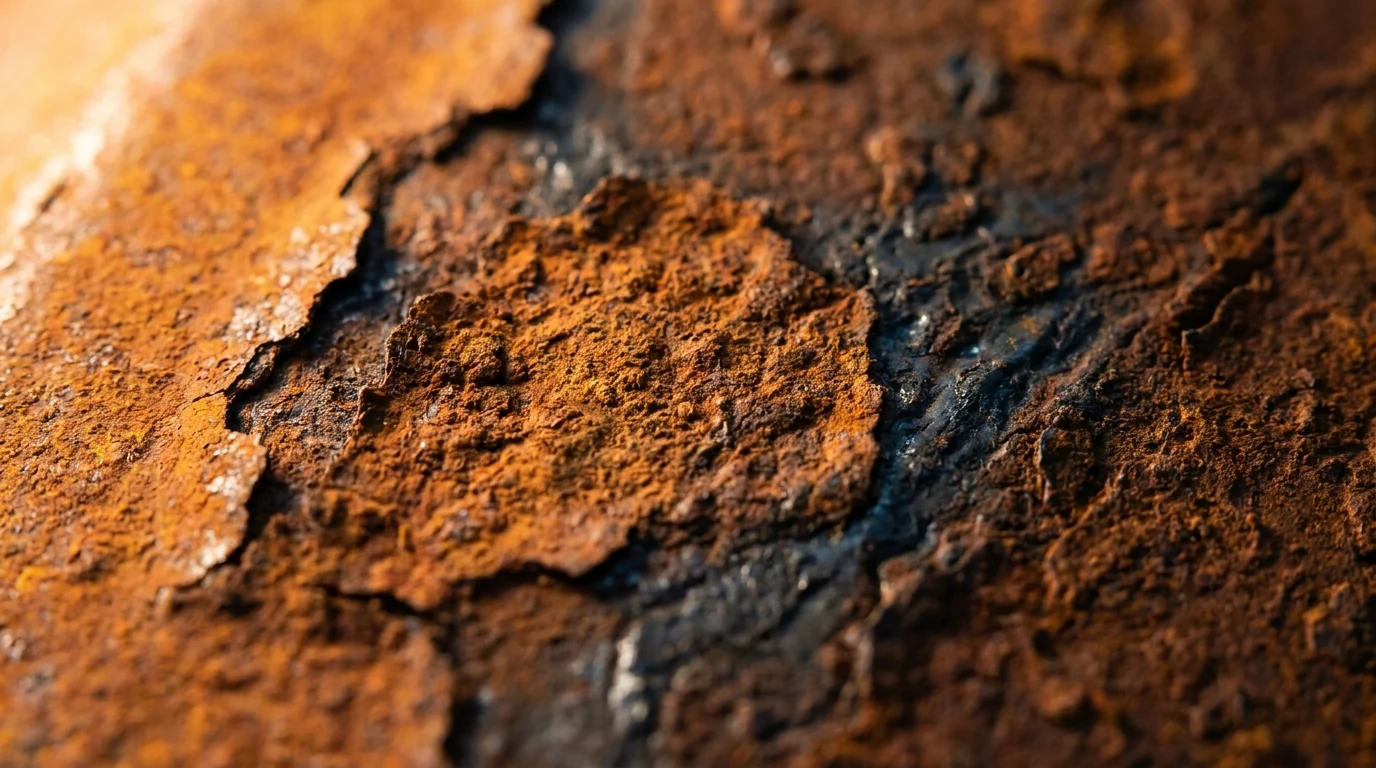
Cor-Ten steel (U.S. Steel's original trade name, today known as weathering steel under EN 10025-5) contains small additions of copper, chromium and phosphorus that change the structure of the rust. Instead of a porous, flaking oxide layer, a compact, adherent patina of stable oxides forms — the "rust that protects." Once established, this patina brings the corrosion rate down to about 0.01–0.03 mm/year, compared with 0.1–0.3 mm/year for ordinary steel.
The condition: the patina only forms in environments with alternating wet and dry cycles. In permanently damp environments (pools, tropical climates) or permanently dry ones (arid zones), the process doesn't work properly. In marine environments with chlorides, the patina doesn't stabilize. The EN grading distinguishes corrosivity classes C1–C5, and Cor-Ten is only suitable for C1–C3. The Musée d'Orsay isn't Cor-Ten. The Thyssen headquarters in Düsseldorf, the Rüdesheim museum, Aires Mateus's Corten House — those are Cor-Ten used correctly.
Stainless steel: 304, 316 and duplex
Stainless steel contains at least 10.5% chromium, which in the presence of oxygen forms a passive film of chromium oxide Cr₂O₃ only a few nanometers thick. It's this film, not a visible layer, that prevents corrosion. Grade AISI 304 (18% Cr, 8% Ni) is the most common: façades, railings, street furniture in non-aggressive environments. Grade AISI 316 adds molybdenum (2–3% Mo), which improves resistance to chloride ions — essential in marine environments or pools. Duplex (EN 1.4462) has a mixed austenitic-ferritic microstructure: nearly double the mechanical strength of 304, better resistance to stress corrosion cracking. Used for structural cables, tensioned façade elements.
Galvanized steel
Hot-dip galvanizing (UNI EN ISO 1461) consists of immersing the steel piece in molten zinc at about 450°C. A coating of Fe-Zn alloys forms, 50–150 μm thick, with anodic protection properties: the zinc corrodes sacrificially, protecting the underlying steel even where it's scratched. Service life in C2 environments (rural) is 50–100 years with no maintenance. In C4-C5 environments (marine, industrial) a duplex system is required: galvanizing plus paint. Galvanizing is the default corrosion protection for exposed structures, fencing, footbridges, secondary carpentry.
Cables and tension wires
Structural cables — used in tensile structures, cable-stayed bridges, strut-braced façades — are made from very-high-strength steel strands (1,570–1,860 N/mm²), roughly five times S355. Production involves cold drawing of high-carbon steel wire rod (0.7–0.8% C), which elongates the grain and increases strength at the expense of ductility. Cables only work in tension: that's the necessary condition for tensile and cable-stayed structures. The designer must ensure the cables stay taut under every load combination, including wind uplift. Relaxation (loss of pretension over time) must be calculated according to EN 1993-1-11.
Composite metal decking
Metal decking (or composite profiled sheeting) consists of thin sheets of galvanized or pre-painted steel cold-formed into a corrugated profile. In the composite floor system, the deck acts as permanent formwork and as the bottom reinforcement for the composite concrete pour. Shear connectors welded to the beams transmit shear forces across the steel-concrete interface, activating composite behavior. The result: floors with structural depths reduced by 30–40% compared with traditional reinforced concrete, and faster construction. It's the standard floor system in mixed steel-concrete skyscrapers.
Behavior over time
Steel doesn't degrade chemically the way concrete does: it has no alkali-silica reaction, doesn't carbonate, doesn't fracture from rebar expansion. Its main problem is electrochemical corrosion in the presence of oxygen and moisture — and fire.
According to Eurocode 3, steel keeps its full yield strength up to about 400°C. At 500°C it retains about 78%, at 600°C 47%, at 700°C just 23%. That's why exposed steel structures requiring REI 60 or higher need intumescent coatings (paints that expand in a fire, thermally insulating the profile), gypsum board cladding or sprayed concrete. Fire design according to EN 1993-1-2 is an integral part of structural design, not an aesthetic add-on.
| Dimension | Score | Assessment |
|---|---|---|
| 🌿 Environmental | 6/10 | Energy-intensive production: 1 kg of primary blast-furnace steel requires ~25 MJ of energy and emits ~1.85 kg CO₂. Electric arc furnace (EAF) steel made from recycled scrap drops to ~0.4 kg CO₂/kg. The recycling rate for construction steel in Europe is >90%, among the highest of any industrial material. |
| ⚖️ Ethics | 7/10 | European and North American production with certified labor standards. Concerns in the iron ore supply chain: extraction in countries with less stringent environmental and social regulations (Brazil, Australia, Ukraine). EAF scrap steel partly solves the problem by removing dependence on mining. |
| 🏘️ Social | 6/10 | European steel industry with strong unionization and high safety standards. Steel construction sites tend to be faster and tidier than cast-in-place concrete. Less local labor during assembly compared with traditional materials. |
| 💶 Economic | 7/10 | Volatile cost per kg (global market), but shorter construction schedules lower indirect costs. Workshop prefabrication ensures high precision and reduces on-site defects. Positive residual value: structural steel is demolished and resold as scrap (around €200/t). |
| Average score | 6.5/10 |
Uses through history
Industrial Revolution (1780–1850): The first structural applications of iron — first puddled, then rolled — appear in the bridges and roofs of English industrial sheds. The Coalbrookdale bridge (1779) is the first bridge made entirely of cast iron. Paris's covered markets of the 1830s–1850s (Baltard, Labrouste with the Bibliothèque Sainte-Geneviève) experiment with exposed iron trusses as an "honest" construction system, an alternative to stone.
Late nineteenth century — the American skyscraper (1880–1910): In Chicago, after the great fire of 1871, reconstruction pushes toward steel frames clad in fireproof terracotta. William Le Baron Jenney's Home Insurance Building (1885) is conventionally regarded as the first skyscraper with a steel frame. Steel makes it possible to empty out the masonry envelope and carry the vertical load to the columns — the modernist free plan is born, twenty years ahead of Le Corbusier.
Structural Modernism (1920–1970): Mies van der Rohe elevates the steel frame to an aesthetic program: the joint detail, the profile section, the relationship between steel and glass become the content of architecture. Farnsworth House (1951) and the Seagram Building (1958) are manifestos. In Europe, the steel structures of the world's fairs — light pavilions, daring roofs — become technical laboratories.
Reference numbers for design
| S235 — fy / fu | 235 / 360 N/mm² |
|---|---|
| S275 — fy / fu | 275 / 430 N/mm² |
| S355 — fy / fu | 355 / 510 N/mm² |
| S460 — fy / fu | 460 / 550 N/mm² |
| Structural cable (strand) — fu | 1,570–1,860 N/mm² |
| Stainless 304 — fy / fu | 210 / 520 N/mm² |
| Strength reduction at 500°C | ~50% (all grades) |
| CO₂ primary steel | ~1.85 kg CO₂/kg |
| CO₂ EAF-scrap steel | ~0.40 kg CO₂/kg |
Research and contemporary frontier
Current research on structural steel moves along three fronts. The first is decarbonizing production: "green" steel made with green hydrogen instead of coke (the DRI-EAF process) can reach emissions below 0.1 kg CO₂/kg. SSAB, with its HYBRIT project, produced the first tonnes of fossil-free steel in 2021; industrial scale-up is expected for 2030–2035. The second front is 3D printing of steel components: MX3D printed Amsterdam's first steel pedestrian bridge in 2021, 12 meters long, with a topologically optimized geometry. The third is Design for Disassembly: bolted joints instead of welded ones, standardized sections, Building Information Modeling for tracking components — all aimed at reusing steel at a building's end of life without having to melt and reprocess it.
In Italy, Renzo Piano Building Workshop's NEST project for Eni's new headquarters in San Donato Milanese uses a high-strength steel exoskeleton that integrates structural function and solar shading. The 20-meter cantilevered beams are S460, with hybrid bolted-welded connections verified using the advanced nonlinear analysis methodology set out in Eurocode 3 Annex C.