| Basic composition | Portland cement + aggregates + water + admixtures |
|---|---|
| Density (reinforced) | 2.400–2.500 kg/m³ |
| Characteristic strength fck (C25/30) | 25 N/mm² (cylinder) / 30 N/mm² (cube) |
| Elastic modulus (Ecm) | 28,000–38,000 N/mm² (C20–C50) |
| Thermal expansion coefficient | 10 × 10⁻⁶ /°C |
| Tensile strength (fctm) | 2.2–4.1 N/mm² (C25–C50) |
| Design service life (EN 206) | 50 years (XC, S2) — 100 years (classes XS, XD) |
| EU reference standard | EN 206 · Eurocode 2 (EN 1992) |
Hadrian has no structural engineer. And yet in 125 AD the dome of the Pantheon is cast in opus caementicium with no metal reinforcement at all, spanning a clear 43.44 meters that no masonry structure had ever reached before. The aggregate is selected with a logic that's recognizable today: tuff and brick at the base, where compressive loads are highest; lightweight volcanic pumice in the upper cap, where reducing weight matters. The water/cement ratio isn't controlled with a refractometer, but the result — two thousand years of structural integrity — is an experimental data point no laboratory can ignore.
Roman opus caementicium isn't Portland concrete: it uses volcanic pozzolan from the Campi Flegrei instead of clinker. The pozzolanic reaction produces aluminous tobermorite, a crystalline phase also found in the cores extracted from the Pantheon in 2023 by Marie Jackson's study (UC Berkeley): this phase doesn't form in modern concretes made with pure Portland, and it gives resistance to seawater that today's concrete struggles to replicate. It's a research lead, not an apology for the past.
Composition and hydration
Concrete is a composite obtained by mixing a hydraulic binder (Portland cement or variants), stone aggregates of varying grain size (sand and gravel, or crushed stone), water, and admixtures. The hydration reaction of Portland clinker — the calcium silicates C₃S and C₂S in contact with water — produces calcium silicate hydrate (C-S-H), the phase that gives mechanical strength, and portlandite Ca(OH)₂, which is responsible for the protective alkalinity (pH 12–13) around the reinforcement.
The key mix-design parameter is the water/cement ratio (w/c): for the same cement content, lowering w/c from 0.60 to 0.40 increases strength by 60–70% and drastically reduces capillary porosity, the main entry route for aggressive agents. Every other consideration — strength, durability, workability, compatibility with the formwork — follows from this one number.
The structural variants
Ordinary concrete C20/25–C30/37
Strength classes C20/25 and C30/37 (the first number is the characteristic cylinder strength in N/mm², the second the cube strength) cover the vast majority of ordinary civil structures: foundations, retaining walls, floor slabs in residential buildings of limited height. The w/c ratio sits between 0.50 and 0.60. Cement content is typically 280–320 kg/m³. It's not structurally interesting, but it's the concrete poured every day, in the millions of cubic meters, around the world.
Reinforced concrete (passive rebar)
Introducing reinforcement in ribbed steel bars (EN 10080, grade B450C with fy = 450 N/mm²) solves the fundamental problem of plain concrete: near-zero tensile strength. Concrete resists compression, steel resists tension. The system works because the thermal expansion coefficients are almost identical (10 vs. 12 × 10⁻⁶ /°C) and because alkaline concrete protects the steel from corrosion. The minimum cover — the distance between the bar's surface and the outer surface — is the most critical durability parameter: EN 1992-1-1 sets it at 25–40 mm depending on exposure class. Insufficient cover is the leading cause of premature deterioration in reinforced-concrete structures.
Prestressed concrete (post-tensioned tendons)
In prestressed concrete, very-high-strength tendons (Y1860S7 strands, fu = 1,860 N/mm²) are tensioned after casting through ducts embedded in the concrete. The tensioning force introduces a compressive prestress into the section that offsets and cancels out the tension from loads. The result: a structural element that works almost entirely in compression, with sections noticeably thinner than ordinary reinforced concrete and no cracking in service. Bridge girders, precast hollow-core slabs, tanks: wherever deformation and cracking need to be controlled over long spans. Relaxation loss in the tendons is on the order of 2–3% after 1,000 hours and must be explicitly calculated per EN 1992-1-1 §3.3.
HPC — High Performance Concrete (w/c < 0.35)
HPC lowers the water/cement ratio below 0.35, replaces part of the clinker with silica fume (microsilica, SiO₂ > 90%, particles 100 times finer than cement), and uses polycarboxylate superplasticizers to maintain workability. Characteristic strengths reach 80–120 N/mm². The microstructure is much denser: total porosity < 8% against 15–20% for ordinary concrete. Durability is drastically higher in aggressive environments (coastal areas, tunnels, bridges subject to freeze-thaw cycling). The Grande Arche de La Défense (Paris, 1989, OTH Ingénierie) uses HPC for the 70-meter girders of its bridge-floor.
UHPC / DUCTAL (up to 250 MPa)
Ultra-High Performance Concrete is the frontier of cementitious composites. Coarse aggregates are eliminated (maximum size < 400 μm), w/c = 0.14–0.20, micro-cut steel fibers are added (2% by volume, L = 13 mm, ø 0.2 mm), and heat treatment at 90°C follows casting. Compressive strengths: 150–250 N/mm². Flexural tensile strength: 20–50 N/mm². The matrix is so dense that the concrete is practically impermeable to water and chlorides. Applications: 20 mm-thick facade panels (impossible in ordinary reinforced concrete), pedestrian footbridges spanning 60–80 m with no conventional reinforcement, thin bridge decks. The Ductal brand belongs to Lafarge; comparable systems: Densit (Aalborg), BSI (Eiffage).
Fair-faced concrete (architectonic concrete)
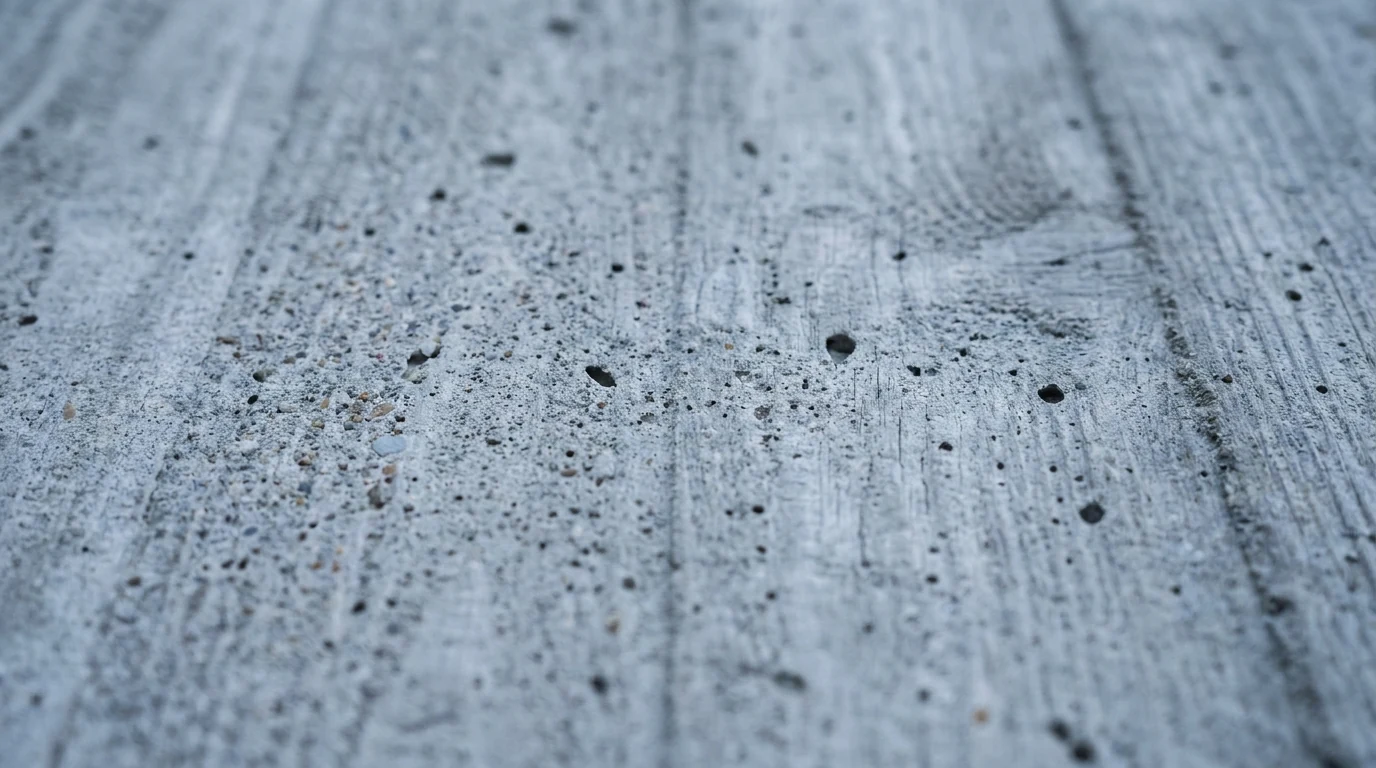
It isn't a strength class: it's an execution specification that turns the formwork into a design tool. The aesthetic result — texture, color, surface porosity — depends on four controllable variables: cement type (white, gray, pigmented), formwork type (steel, beech wood, rubber, foam), surface retarders applied before casting, and the care taken with vibration. Tadao Ando uses gray concrete with CEM I Portland cement, cedar-wood formwork, and meticulous manual vibration: the surface layer, 5–10 mm deep, shows no visible aggregate, and the cement paste is uniform. The result isn't improvised on site — it's controlled through trial pours on sample panels approved by the site management.
Cellular / aerated concrete (AAC)
Autoclaved aerated concrete (AAC, Ytong, Aircrete) is produced by adding aluminum powder to a mix of lime, cement, and very fine sand: the aluminum reacts with the lime, producing hydrogen that expands the mass before it hardens. The finished product has a density of 400–800 kg/m³ (against 2,400 for ordinary concrete) and a thermal conductivity of 0.09–0.21 W/(m·K), comparable to many insulation materials. Compressive strength: 2–8 N/mm² — not structural in the strict sense, but load-bearing for masonry up to 3–4 stories. Excellent workability with woodworking tools. Not used as a primary structural element in structures subject to significant seismic loads without specific verification.
Recycled aggregate concrete (RAC)
Recycled Aggregate Concrete replaces part or all of the natural gravel with demolition aggregate (crushed concrete rubble). EN 12620 and the DM 2018 guidelines (NTC) allow substitution of up to 30% for non-structural concrete and 25% for structural concrete in non-aggressive exposure classes. The technical problem: recycled aggregate carries along old, more porous and absorbent cement paste, which increases water demand and reduces strength by 10–20% compared with mixes using virgin aggregate. Necessary correction: pre-wetting the aggregate, reducing the w/c ratio, and controlling water absorption (WA24 < 10% per EN 1097-6).
Fiber-reinforced concrete FRC (steel, glass, carbon fibers)
Fiber Reinforced Concrete replaces or supplements conventional reinforcement with fibers dispersed through the mass. Steel fibers (dosage 25–80 kg/m³, L/d = 50–80) improve post-cracking toughness: the material doesn't collapse abruptly after the first crack but keeps carrying load up to crack openings of 3.5 mm. Performance parameter: residual flexural strength class fR1/fR3 per EN 14651. Industrial flooring and tunnel linings (precast with FRC shotcrete) are the quantitatively dominant applications. CFRP carbon fibers allow minimal thicknesses (panels of 8–12 mm) but at costs 15–30 times higher than steel. Alkali-resistant glass fibers (AR-glass) are an intermediate alternative, used mainly in GRC facade panels.
3D-printed concrete
3D concrete printing (3DCP) is the most active research front of the past five years. The mix must satisfy contradictory requirements: fluid enough to pass through the nozzle (D50 = 10–12 mm), rigid enough to hold its shape the moment it's deposited, with no formwork. The standard solution uses mixes with a high dosage of metakaolin or silica fume, with retarding and accelerating agents dosed in real time and adjusted as needed. The ICON project in Austin (2021) built homes in 50 mm layers with a Vulcan system; COBOD's BOD2 (Copenhagen, 2022) is Europe's first 3D-printed building. Mechanical strength is anisotropic: vertical (the direction of deposition) is 15–25% lower than horizontal, due to weak adhesion between layers. Reference standard: ISO/ASTM 52939 (still under development). The technology doesn't replace site-cast concrete for structures subject to seismic loads — it's applicable to non-load-bearing walls and free-form shapes.
Behavior over time
Concrete isn't eternal without maintenance. The three main deterioration mechanisms in the Italian environment are: carbonation (atmospheric CO₂ lowers the pH from the alkaline range toward pH 9, removing protection from the reinforcement — the rate is proportional to the square root of time, with carbonation depth typically reaching 20–40 mm after 50 years in an urban setting); chloride attack (in coastal areas, chlorides penetrate by ionic diffusion, triggering pitting corrosion on the reinforcement); alkali-silica reaction (ASR: alkalis in the cement react with reactive silica in the aggregates, producing a hygroscopic gel that swells and cracks the concrete — preventable with cements low in equivalent Na₂O content, < 0.60%).
Service life is designed, not endured. EN 1992-1-1 §4 and EN 206 §6 define the exposure classes (XC for carbonation, XD for de-icing chlorides, XS for marine chlorides, XF for freeze-thaw, XA for chemical attack) and, for each, the minimum requirements for maximum w/c, minimum cement content, and minimum cover. A cover of 40 mm instead of 25 mm — in class XC3 — doubles the estimated service life from 50 to 100 years.
| Dimension | Score | Assessment |
|---|---|---|
| 🌿 Environmental | 4/10 | Portland cement is responsible for 8% of global CO₂ emissions (IEA 2023). Producing 1 kg of clinker emits about 0.9 kg of CO₂ (firing at 1,450°C plus decarbonation of the limestone). One m³ of C25/30 concrete with 300 kg of cement emits about 270 kg of CO₂. Partial mitigations: CEM III/B with 66–80% blast-furnace slag cuts emissions by 60%; geopolymers by 90%. Concrete doesn't recycle easily: crushing recycled aggregate degrades the quality of the new mix. |
| ⚖️ Ethics | 7/10 | European cement supply chains (Heidelberg Materials, Holcim, Buzzi) with certified environmental and safety standards. A concrete problem: river sand is a resource facing critical depletion in Asia and Africa — the UN estimates global sand consumption at 50 billion tonnes/year, with documented illegal extraction in India, Vietnam, and China. In Europe the situation is more regulated but not free of concerns. |
| 🏘️ Social | 7/10 | An economically accessible material (installed cost €80–200/m³), generating local employment for supply, placement, and vibration. Occupational risk: free crystalline silica in cutting and demolition dust causes silicosis (IARC group 1 carcinogen). Concrete workers must use PPE compliant with EN 149. Reinforced concrete has made low-cost housing construction possible across the developing world. |
| 💶 Economic | 8/10 | Very low cost: ready-mix C25/30 concrete at €80–120/m³ delivered on-site in Italy (2025). Installed with reinforcement and formwork: €150–250/m³. High durability with correct maintenance (50–100 years). End-of-life demolition cost is high but not prohibitive. Precast concrete cuts construction time by 30–50% compared with site-cast work. |
| Average score | 6.5/10 |
Historical uses
Roman antiquity (2nd century BC – 5th century AD): Roman opus caementicium uses fired lime, volcanic pozzolan from the Campi Flegrei, and aggregates of various kinds (crushed brick, pumice, tuff). It isn't Portland, but it's functional concrete. The Pantheon (125 AD), with its 43.44 m dome span, is the absolute masterpiece: a structure no other material of the era would have made possible. The Baths of Caracalla, the Basilica of Maxentius, concrete harbors like Caesarea Maritima — imperial Rome is built on cast concrete.
The birth of reinforced concrete (1860–1930): Joseph Monier (1867) patents flowerpots made of ferro-cement; François Hennebique perfects the frame system in 1892. Auguste Perret brings fair-faced reinforced concrete to the rue Franklin apartment building in Paris (1903), then to the reconstruction of Le Havre after 1945 — the first historic center built in fair-faced reinforced concrete, today a UNESCO World Heritage site. Le Corbusier systematizes the theory: the five points, Dom-ino, the pilotis — all of it depends on reinforced concrete as the liberator of the floor plan.
Brutalism and experimentation (1950–1980): Concrete becomes an aesthetic language in its own right. Le Corbusier at Chandigarh and the Unité d'Habitation uses fair-faced concrete with rough-timber formwork. Paul Rudolph, with Yale's Art and Architecture Building (1963), uses a bush-hammered concrete with a fluted surface. BBPR in Milan, Kenzo Tange's master plan for Tokyo Bay, the English universities of the 1960s — béton brut is the material of an entire generation of architects.
Reference numbers for the project
| C20/25 — fck / Ecm | 20 N/mm² / 29.962 N/mm² |
|---|---|
| C25/30 — fck / Ecm | 25 N/mm² / 31.476 N/mm² |
| C30/37 — fck / Ecm | 30 N/mm² / 32.837 N/mm² |
| C50/60 — fck / Ecm | 50 N/mm² / 37.278 N/mm² |
| HPC — fck | 80–120 N/mm² |
| UHPC/DUCTAL — fck | 150–250 N/mm² |
| CO₂ per m³ of C25/30 concrete (CEM I) | ~270 kg CO₂/m³ |
| CO₂ per m³ of C25/30 concrete (CEM III/B) | ~100 kg CO₂/m³ |
| Cost of ready-mix C25/30 concrete | €80–120/m³ (Italy, 2025) |
Research and the contemporary frontier
The most urgent front is decarbonizing clinker. There are three paths, all under industrial development. LC3 cements (Limestone Calcined Clay Cement) replace 50% of the clinker with clay calcined at low temperature (750°C vs. clinker's 1,450°C): emissions drop by 40% with comparable mechanical performance. Belite cements (BCSA) polymerize at lower temperatures and produce 10–15% less CO₂. Geopolymers — alkali-activated aluminosilicates — eliminate clinker almost entirely: emissions drop by up to 90%, but long-term durability and regulatory standardization are still in progress (no harmonized EN standard for structural geopolymers as of 2025).
On the performance front, UHPC with hybrid fibers (steel + PVA) allows conventional passive reinforcement to be eliminated in thin elements: 15 mm panels for the curtain walls of large buildings, bridge decks with thicknesses reduced by 70% compared with prestressed reinforced concrete. Research at the LCPC (Laboratoire Central des Ponts et Chaussées) on self-compacting concrete (SCC) with active silica nanoparticles is producing cementitious matrices with total porosity < 3%.