| Category | Experimental, bio-based or functionalised materials |
|---|---|
| Density (range across the whole family) | 3–800 kg/m³ (aerogel 150 → bio-bricks 1,600 kg/m³) |
| Thermal conductivity (range) | 0.013–0.11 W/(m·K) depending on material |
| Typical technology readiness level (TRL) | 4–7 out of 9 (prototype → first pilot plants) |
| Reference EU standard | No harmonised EN for most of them (2026) — case-by-case ETA route |
| Indicative cost | 2–10× the conventional equivalent |
In 2014, in the courtyard of MoMA PS1 in New York, a twelve-metre tower stood for a summer, built from bricks that just weeks earlier had been a living fungus growing inside a mould. By the end of the season the tower was dismantled and the bricks — fully biodegradable — became compost for the neighbourhood's community gardens. In the same decade, in Rotterdam and other Dutch infrastructure sites, engineers injected dormant bacterial spores into concrete panels to make them self-seal when they crack. These are two very different answers to the same question: what happens when you stop treating building matter as inert, and start treating it as something that grows, reacts, repairs itself, or returns to the earth it came from.
This chapter doesn't cover glue-laminated timber or CLT — bio-based materials that are mature by now, with harmonised standards and building sites worldwide, already covered in the chapter on wood. Here we're talking about what still sits, for the most part, between the lab and the first pilot site: materials that in some cases have already proven themselves at real scale, and in others remain technically solid but commercially immature promises. The distinction between the two categories, in every section, is the most important point.
A premise: what makes a building material "innovative"
The materials in this chapter share a trait that sets them clearly apart from concrete, steel or brick: most still lack a harmonised European standard (hEN) defining their tests, performance classes and CE marking. To be used on a regular building site, they almost always have to go through the European Technical Assessment (ETA) route, issued case by case by a technical assessment body based on a bespoke European Assessment Document (EAD) — a slower, more expensive path than standard certification, and one of the reasons large-scale adoption still lags behind the material's own scientific maturity. The second common trait is the source: almost all of them derive from living organisms (fungi, bacteria, algae, fibrous plants) or from processes that mimic biological mechanisms, in direct continuity with the biomimicry intuition — the subject of the first in-depth piece at the bottom of this page.
The seven families
Mycelium — fungal composites
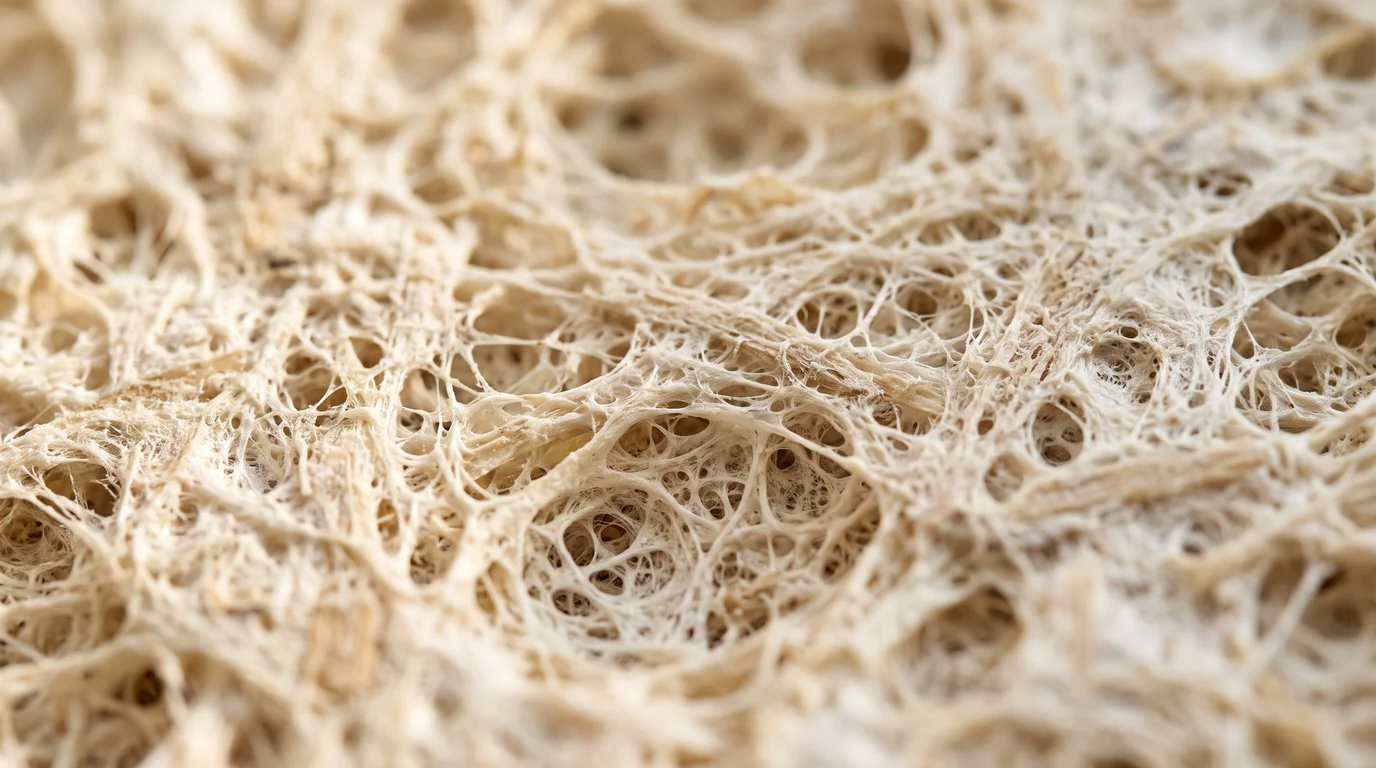
Mycelium is the network of filaments (hyphae) with which a fungus grows through the substrate it feeds on. Companies such as Ecovative Design (United States, founded in 2007) have patented a process that harnesses this growth as a construction technique: fungal spores are inoculated into agricultural waste (corn stalks, straw, wood chips) inside a mould; over 5-14 days the mycelium colonises the whole substrate, binding its fibres into a solid mass that replicates the mould's shape; once growth is complete, the block is dried or baked at low temperature (60-120°C for a few hours) to stop growth and sterilise the material, preventing further decomposition. The result has a density of 100-300 kg/m³, modest compressive strength (0.1-1.2 N/mm², against 20-30 N/mm² for a fired brick) and thermal conductivity of 0.03-0.07 W/(m·K), comparable to many cellulose insulants. So it isn't a structural material: its real field of use is thermal/acoustic insulation, non-load-bearing panels and packaging (where Ecovative has been selling it in place of polystyrene for years). It's fully compostable at end of life.
Bioplastics and biocomposites — from hemp to algae
This label covers heterogeneous families united by the renewable origin of the polymer or fibre. The most mature case is hempcrete (hemp shiv bound with lime), with a density of 275-450 kg/m³ and thermal conductivity of 0.06-0.11 W/(m·K): non-structural (used as infill on a load-bearing timber frame), but with a net negative carbon balance — hemp sequesters more CO₂ while growing than the lime in the binder emits, for an estimated balance of around -110 kg CO₂ per m³. More experimental is the use of algae bioreactors in façades: the BIQ House in Hamburg (2013, Arup, SSC and Colt International) integrates glazed panels that host a microalgae culture, which produce biomass to be harvested for bioenergy while, at the same time, shading and regulating the building's internal temperature — an envelope that is both a solar screen and a small energy-generation plant.
Self-healing concrete
Developed mainly by Henk Jonkers's group at TU Delft from the mid-2000s onward, self-healing concrete incorporates spores of alkaliphilic bacteria (Bacillus pseudofirmus or B. cohnii, able to stay dormant for decades in concrete's strongly alkaline environment — pH 12-13) encapsulated in expanded clay granules together with calcium lactate as a nutrient. When a crack opens and water gets in, the spores germinate, metabolise the calcium lactate and produce calcite (CaCO₃), which precipitates and seals cracks up to 0.8 mm wide in around three weeks. The commercial product Basilisk applies it both as an additive for new pours and as a repair mortar. It's the subject of the in-depth technical piece at the bottom of the page.
Aerogel — the lightest insulant there is
Silica aerogel, first synthesised by Samuel Kistler in 1931, is a solid with porosity up to 99%: a silica gel dried through supercritical drying, which removes the liquid without collapsing the nanometre-scale porous structure. The result has a record thermal conductivity — 0.013-0.015 W/(m·K), lower than still air itself thanks to the Knudsen effect on the nanometre-sized pores — and a typical density of around 150 kg/m³ for commercial insulating felts (Aspen Aerogel's Spaceloft is the market benchmark). A felt just 10 mm of aerogel thick has the thermal resistance of 40-50 mm of mineral wool: the reason it's the material of choice in the energy retrofit of listed historic buildings, where the available thickness is the tightest constraint. There are also translucent aerogel granules embedded in cellular-polycarbonate panels (Kalwall systems) for skylights and façades that need to insulate while also diffusing natural light.
Phase-change materials (PCM)
Phase Change Materials store and release latent heat through a state change (solid-liquid) at a controlled temperature, typically paraffins or hydrated salts microencapsulated in polymer shells a few microns across and built into plasterboard sheets or suspended ceilings (products such as BASF's Micronal or DuPont's Energain). The melting point can be tuned between 18°C and 28°C at the manufacturing stage; the latent heat stored is on the order of 100-200 kJ/kg. In a lightweight, low-thermal-mass building (a timber or steel structure, which normally lacks concrete's inertia to dampen daily temperature swings), a PCM panel introduces a "chemical" thermal mass that melts as it absorbs excess daytime heat and solidifies releasing it at night, cutting peak indoor temperatures without adding structural weight.
Bacterially-grown bio-bricks
BioMASON (founded in 2012 by Ginger Krieg Dosier, North Carolina) makes bricks by precipitating calcium carbonate between grains of sand through a bacterium, Sporosarcina pasteurii, able to induce mineral precipitation (MICP, Microbially Induced Calcite Precipitation) at room temperature in a few days, instead of the roughly 1,000°C firing a traditional brick requires. The energy and emissions saving compared with a fired brick is on the order of 90%, because the entire kiln-firing process is eliminated — the most energy-intensive stage of conventional brick production. The commercial product (Biolith paving) is today a small-scale industrial reality at one plant in North Carolina, not yet at a scale comparable to global brick production.
3D-printed rammed earth
The Crane WASP printer (the Italian company WASP, Massa Lombarda) built the Gaia project in 2018, a single-storey house printed in rammed earth mixed with rice straw and husk, materials sourced within a one-kilometre radius of the site, with a declared material cost under 1,000 euros. In 2021 the same system, working with Mario Cucinella's studio, produced TECLA, a house printed entirely in rammed earth from the site itself near Ravenna, with around 200 hours of printing. Unlike 3D-printed concrete (covered in the chapter on concrete), here the material isn't an industrial binder but the local soil itself — as close as construction logic can get to a zero-kilometre circular economy.
Durability and long-term behaviour: the real Achilles' heel
The limitation common to almost this whole family of materials isn't lab performance — often already solid — but long-term durability data, simply because most of them haven't existed long enough to generate it. Untreated mycelium is sensitive to prolonged moisture and needs protection or geometries that keep water away; the fire behaviour of biocomposites has to be assessed case by case, without the established classifications available for wood or brick. Self-healing concrete and MICP bio-bricks, being essentially minerals, largely share the durability of traditional cementitious or stone materials — their innovation lies in the process, not in the finished product's chemistry. Silica aerogel, being inert and inorganic, has intrinsically high durability but a production cost (supercritical drying) still high compared with traditional insulants. In general, a designer choosing one of these materials today is usually doing so for a low-risk, reversible application — a temporary pavilion, a non-structural panel, a cladding — not yet for the primary structure of a building meant to last fifty years.
| Dimension | Score | Assessment |
|---|---|---|
| 🌿 Environmental | 7/10 | Mycelium, hempcrete and MICP bio-bricks have very low or negative carbon footprints, and drastically cut process energy (no 1,000°C firing for bio-bricks). Aerogel, by contrast, requires energy-intensive supercritical drying: the family's overall environmental balance is therefore mixed, not uniformly positive. Complete Environmental Product Declarations (EPDs) are still lacking for most of them, because production volumes are too small to generate robust LCA data. |
| ⚖️ Ethics | 6/10 | Young supply chains concentrated in a handful of startups (Ecovative, BioMASON, WASP), often with high production transparency because it's part of their commercial story — but also a real risk of greenwashing: claims like "carbon negative" or "fully compostable" are sometimes true only at lab or prototype scale, not yet verified at real building-site scale. |
| 🏘️ Social | 6/10 | Uses still concentrated in exhibition pavilions, academic prototypes and a handful of pilot sites: accessibility for the average designer or client is low today. Positive potential in the medium term — a bio-based and bacterial supply chain can generate new skills and small-scale local manufacturing, but the widespread social benefit isn't yet measurable at a significant scale. |
| 💶 Economic | 5/10 | Costs still 2-10 times higher than the conventional equivalent due to the lack of industrial economies of scale, with the partial exception of hempcrete and rammed-earth printing (near-free source material, but process and skilled labour weigh heavily). The lack of harmonised standards adds case-by-case certification costs (ETA) that discourage adoption outside experimental or research-funded contexts. |
| Average score | 6/10 |
Real-world uses: from early prototypes to pilot sites
2013 — BIQ House, Hamburg: the world's first residential building with a working algae-bioreactor façade, developed by Arup together with SSC and Colt International for the IBA Hamburg international exhibition. It shows at real scale, not just in the lab, that an envelope can produce energy biomass while shading the building.
2014 — Hy-Fi, MoMA PS1, New York: the studio The Living (David Benjamin), winner of MoMA's Young Architects Program, builds a roughly 12-metre tower with Ecovative mycelium bricks, topped with a reflective-film capital to channel light into the structure. By the end of summer the tower is dismantled and composted: no residual waste, a fully closed loop. It's the case study of the dedicated in-depth piece at the bottom of the page.
2015-present — Self-healing concrete trials in the Netherlands: following the basic research at TU Delft, experimental panels and cycle paths with bio-based concrete have been laid in several Dutch municipalities as a real-world test bed, not a laboratory one, to measure self-sealing effectiveness over time.
2018 and 2021 — Gaia and TECLA, WASP, Italy: two generations of the same 3D rammed-earth printing technology, the second (TECLA, with Mario Cucinella Architects) taken to a level of finish and liveability markedly higher than the first, just three years apart — a sign of how quickly this family of technologies is maturing.
Reference numbers for design
| Mycelium (Ecovative) — density / conductivity | 100-300 kg/m³ / 0.03-0.07 W/(m·K) |
|---|---|
| Hempcrete — density / conductivity | 275-450 kg/m³ / 0.06-0.11 W/(m·K) |
| Aerogel Spaceloft — density / conductivity | ~150 kg/m³ / 0.013-0.015 W/(m·K) |
| Self-healing concrete — self-sealing | cracks up to 0.8 mm in ~3 weeks |
| Microencapsulated PCM — latent heat / melting range | 100-200 kJ/kg / 18-28 °C |
| MICP bio-bricks (BioMASON) — energy saving vs fired brick | ~90% (no 1,000 °C firing) |
| 3D rammed-earth printing (TECLA) — print time | ~200 hours |
Research and the current frontier
The most likely direction over the next ten years isn't the wholesale replacement of conventional materials, but targeted hybridisation: mycelium and aerogel in insulation packages where thermal performance justifies the premium cost; self-healing concrete in infrastructure with very high maintenance costs (tunnels, bridges, marine works) where the lifecycle maintenance saving offsets the initial premium; 3D-printed rammed earth for emergency and low-cost housing in areas with limited access to cement and steel. The bottleneck is almost never the materials science, already solid for many of these technologies, but regulatory standardisation and industrial scale — the same two factors that took a century to mature for reinforced concrete, and that here are being compressed into a handful of decades.