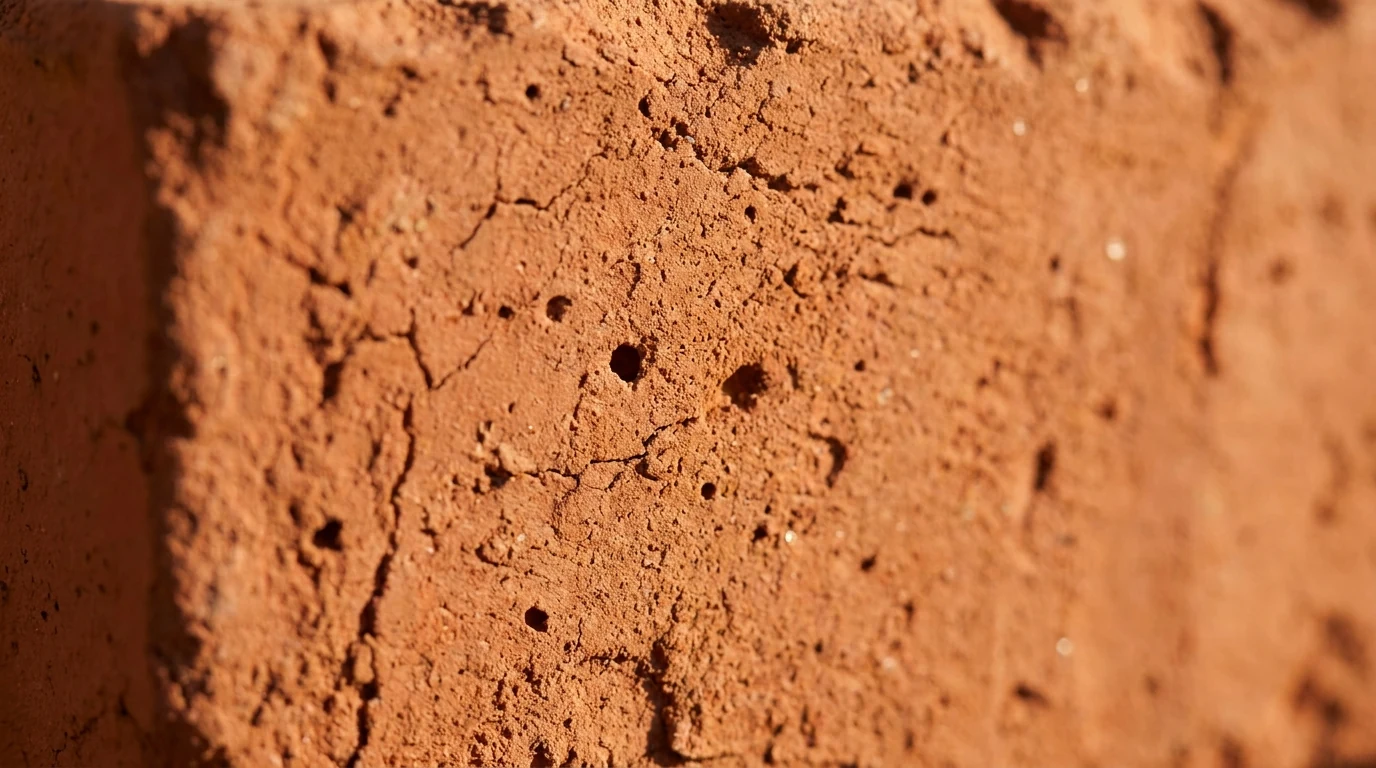
| Raw material | Clay (illite, kaolinite, montmorillonite) |
|---|---|
| Firing temperature | 900–1,100 °C |
| Compressive strength (solid) | 15–50 N/mm² |
| Compressive strength (hollow) | 3–15 N/mm² |
| Density (solid) | 1,800–2,000 kg/m³ |
| Density (hollow thermal block) | 650–900 kg/m³ |
| Thermal conductivity λ (solid) | 0.6–1.0 W/m·K |
| Thermal conductivity λ (thermal block) | 0.09–0.14 W/m·K |
| Reference EU standard | EN 771-1 · Eurocode 6 (EN 1996) |
Sainte-Cécile Cathedral in Albi, in the south of France, is the largest Gothic brick monument in the world. Built between 1282 and 1480, 78 metres tall to the spire, with exterior walls as smooth as a fortress — because it was one, in the thick of the Cathar wars. Everything in brick: arches, vaults, piers, bell tower. No cut stone, no structural metal element. Brick alone has carried that load for seven hundred years.
Sainte-Cécile is one of the extreme cases of a material that has never stopped being relevant. Today, in Italy, brick is still the construction system of choice for the vertical envelope in nearly all residential buildings: hollow blocks for exterior infill walls, load-bearing blocks wherever seismic codes and sizing allow it. Brick's supposed crisis — announced more than once with the arrival of precast concrete, steel, composite panels — never actually came.
Composition and manufacturing process
Brick is a ceramic product: raw clay shaped, dried and fired in a kiln. Clay is a composite material of phyllosilicate minerals (mainly illite, kaolinite, montmorillonite) that develop workable plasticity in the presence of water. During firing between 900 and 1,100°C, the clay minerals decompose and reorganise into a vitreous matrix and new crystalline phases (mullite, amorphous silica) that give mechanical strength and chemical stability.
Brick quality depends on three variables: the clay's composition (calcium carbonate content, soluble salts, organic content), the geometry of the perforations (which determines the mechanical and thermal properties), and the firing cycle. The white efflorescence on face bricks is soluble salts migrating to the surface as water evaporates — a defect of poorly selected clay or insufficient firing.
The variants
Solid brick
Solid brick (UNI EN 771-1, perforation ≤15%) has a compressive strength of 15–50 N/mm² and density of 1,800–2,000 kg/m³. It's the brick of historic load-bearing masonry, used in every pre-1930 building and much post-war construction. Mechanical strength is excellent, but thermal properties are poor: λ = 0.6–1.0 W/m·K requires substantial thicknesses to meet modern thermal requirements. In Italy, under UNI 10349, a 38 cm solid-brick wall in climate zone E has a U-value of around 1.2 W/m²K — well above the limits of Ministerial Decree 26/06/2015 (U ≤ 0.29 W/m²K for exterior walls in zone E). Solid brick today is used mainly for historic masonry, building restoration, and decorative face-brick bands.
Hollow and semi-solid brick
Hollow brick (perforation 15–45%) is the workhorse of contemporary infill walls. The perforations reduce density and improve thermal transmittance thanks to the still air trapped in the cells. Compressive strength 5–15 N/mm². Not suitable for load-bearing masonry without structural verification: the perforations reduce the resisting area and increase vulnerability to out-of-plane actions. The semi-solid brick (perforation 15–25%) is a compromise: better than solid brick thermally, stronger than hollow brick.
Face brick
Face brick is a solid or semi-solid brick with dimensional and surface quality control: reduced dimensional tolerances (±1–2 mm), no efflorescence, uniform colour. It isn't a category defined by mechanical properties — it's a category defined by use in place: the brick surface stays exposed, with no plaster. That changes the requirements: the joint's texture (flush, tuckpointed, recessed, raised) becomes an architectural design choice. Colour depends on the clay's composition: yellow (low iron), red (iron oxide Fe₂O₃ in an oxidising atmosphere), dark brown (firing in a reducing atmosphere). Specialised brickworks produce face bricks in dozens of formats and tones.
Wood-chip thermal block
The thermal block (marketed as POROTON, Unipor, Wienerberger Porotherm) is produced by adding wood chips, sawdust or polystyrene to the clay mix, which burn off during firing, leaving micropores. The result: density 650–900 kg/m³, thermal conductivity λ = 0.09–0.14 W/m·K. A 45 cm thermal block with this conductivity reaches U ≈ 0.22 W/m²K with no external insulation — below the legal limit for zone E. It's the thermally insulating masonry block par excellence in the Italian market, with over 50% of new-construction infill walls. Mechanical strength is reduced (3–5 N/mm²): not a load-bearing block in seismic zones without specific verification.
Floor tiles and brick for floor slabs
Floor tiles (or hollow blocks) are perforated brick elements used as composite infill blocks in mixed brick-concrete floor slabs (so-called "brick-and-concrete" slabs). The system: reinforced or prestressed concrete joists interspersed with brick blocks, topped with a concrete slab. The brick doesn't carry load in the strict sense — it acts as permanent formwork and can contribute partially to the compressive strength of the composite slab. Brick-and-concrete floor slabs are the most widespread solution in Italy for intermediate floors in reinforced-concrete buildings up to 5–6 storeys.
Architectural terracotta and cotto tile
Architectural terracotta — tiles, cornices, capitals, facade panels — is produced with more refined clays, at more precise firing temperatures (1,000–1,050°C). Glazed (with a coating of vitreous compounds) or unglazed. Glazed terracotta has high impermeability and resists freeze-thaw cycling. Cotto tile (terracotta flooring) has variable porosity: industrial extruded cotto is denser and more abrasion-resistant; artisanal Tuscan or Umbrian cotto has higher porosity and requires oil or wax treatments to protect it from moisture. Water absorption resistance (EN 539-1) is the deciding parameter for outdoor use.
Behaviour over time
Well-fired brick is among the most durable materials in architecture. Firing removes all bound water and chemically transforms the minerals: there's no significant shrinkage after laying, no chemical degradation under normal conditions. The bricks of the Colosseum (70–80 AD) are still measurable and identifiable. Roman opus testaceum masonry (flat bricks interspersed with mortar layers) has held up better than Roman concrete because brick doesn't absorb chlorides the way concrete does.
There are two main long-term issues: efflorescence (salts crystallising on the surface, often unsightly but rarely structural) and freeze-thaw in alpine areas. When water penetrates a porous brick and freezes, the 9% volumetric expansion can spall the surface. Bricks for frost-exposed uses must have exposure class F1 or F2 under EN 771-1, with a water absorption coefficient below 8–12%.
| Dimension | Score | Assessment |
|---|---|---|
| 🌿 Environmental | 6/10 | Production at ~0.2–0.4 kg CO₂/kg — lower than steel, higher than wood. Firing at 900–1,100°C requires significant energy (around 2,500 kJ/kg). Raw material is abundant and local. Brick isn't recyclable as its original material after demolition, but bricks can be salvaged and reused intact (a historic practice). Not hazardous in landfill. |
| ⚖️ Ethics | 8/10 | Almost entirely local supply chain in Italy: brickworks are distributed capillary across the country. No critical extractive-supply-chain elements. Artisanal Tuscan and Umbrian production with a centuries-old tradition and strong local identity. The construction worker who lays bricks has a recognisable, well-paid trade. |
| 🏘️ Social | 9/10 | Brick is the "people's" material: recognisable, warm, human. Brick facades are perceived as friendlier than exposed concrete. The high thermal mass of solid brick provides summer comfort without air conditioning (thermal inertia). The hands-on work of a brick site keeps traditional craft skills alive. |
| 💶 Economic | 8/10 | Contained, stable cost (hollow infill brick costs €80–180/m² installed). No dependence on global supply chains. Useful life over 100 years with no structural maintenance. Reclaimed brick has positive market value. |
| Average score | 7.75/10 |
Uses through history
Mesopotamia and Ancient Egypt (4000 BC – 500 AD): Sun-dried mud bricks (adobe) are attested at Uruk and Jericho as early as 4000 BC. Fired bricks appear in Mesopotamia around 3000 BC — expensive to produce (they require fuel) and so reserved for monuments. The Great Ziggurat of Ur (2100 BC) is built of fired brick. In Ancient Egypt fired bricks are used mainly for foundations and structures in contact with moisture.
Rome and Byzantium (300 BC – 1500 AD): Rome industrialises brick production: stamps pressed into the bricks identify the figlina (workshop), the owner, and sometimes the consular year. Roman bricks are thin (3–4 cm) and large-format — used in opus testaceum, as facing on concrete constructions, in aqueducts. Byzantium develops the technique of brick vaults with bricks laid fan-wise, without centring, layering thick mortar beds that support the next course as it's laid: a technique still visible in the domes of Hagia Sophia.
The nineteenth century and modernism (1800–1970): English neo-Gothic architecture (Pugin, Ruskin, the Arts and Crafts movement) rediscovers face brick as an expression of constructional honesty. In Italy, the Lombard realism of Luca Beltrami and the Milanese school use face brick for new banks, stations, apartment buildings. The twentieth century brings brick into modernity with Alvar Aalto (Villa Mairea, 1939), Frank Lloyd Wright (Prairie School buildings), and in Italy Ignazio Gardella with the Casa alle Zattere in Venice (1958): face brick as a skin sensitive to water and light.
Reference numbers for design
| Solid — strength / density | 15–50 N/mm² / 1,800–2,000 kg/m³ |
|---|---|
| Hollow — strength / density | 5–15 N/mm² / 1,100–1,500 kg/m³ |
| Thermal block — strength / density | 3–5 N/mm² / 650–900 kg/m³ |
| λ solid / λ thermal block | 0.6–1.0 / 0.09–0.14 W/m·K |
| U-value, 45 cm thermal-block wall | ~0.22 W/m²K (no external insulation) |
| Volumetric heat capacity | 1,500–1,800 kJ/m³K (solid) |
| Embodied CO₂ | ~0.20–0.35 kg CO₂/kg |
Research and the contemporary frontier
Research on brick moves along three directions. The first is extreme-passive-performance brick: Wienerberger's Poroton T8+ block reaches λ = 0.07 W/m·K with an optimised multi-chamber geometry, enabling single-leaf walls with no external insulation and U = 0.15 W/m²K. The second direction is 3D printing in raw clay: the American startup ICON and the European WASP project print structures in rammed earth or natural-fibre-reinforced clay, reducing site waste and opening up geometric possibilities unthinkable with manual laying. The third is decarbonising firing: trials with high-efficiency electric kilns or green-hydrogen combustion could cut process emissions by 70–80% by 2035.
In Italy, the BRICK research project by ENI Rewind studies reusing demolition brick as aggregate for new building products. Bricks recovered from pre-1945 demolitions in Milan — nearly all high-quality solid brick — still have compressive strengths above 20 N/mm² and could be fed directly back into the construction cycle, but current regulation on demolition materials classifies them as waste, not as a product.