| Copper (Cu) — density | 8,900 kg/m³ |
|---|---|
| Zinc-titanium — density | 7,200 kg/m³ |
| Aluminium (Al) — density | 2,700 kg/m³ |
| Titanium (Ti) — density | 4,510 kg/m³ |
| Typical roofing sheet thicknesses | 0.5–1.0 mm (copper, zinc) / 0.7–1.5 mm (Al) |
| Copper lifespan in urban settings | > 100 years (stable patina) |
| Zinc-titanium C3 lifespan | 80–100 years |
In 1997, Frank Gehry opened the Guggenheim in Bilbao. 33,000 sheets of commercially pure titanium, 0.38 mm thick, hand-shaped over curved formers in a workshop in Spain. No sheet is identical to any other — every panel is a unique geometric solution for that precise portion of the surface. Titanium had been chosen for its ability to capture the shifting light of the Basque sky: unlike stainless steel, which reflects specularly, titanium oxidised at the surface scatters light with a golden iridescence that varies with the angle of the sun.
The Guggenheim in Bilbao isn't just a work of architecture: it's proof that non-ferrous metal, used as envelope, isn't a neutral cladding — it's an actor in form and perception. Understanding the different non-ferrous metals means understanding how the envelope changes over time, responds to its environment and decides the character of a building.
Copper: the metal that turns green
Natural copper with spontaneous patina
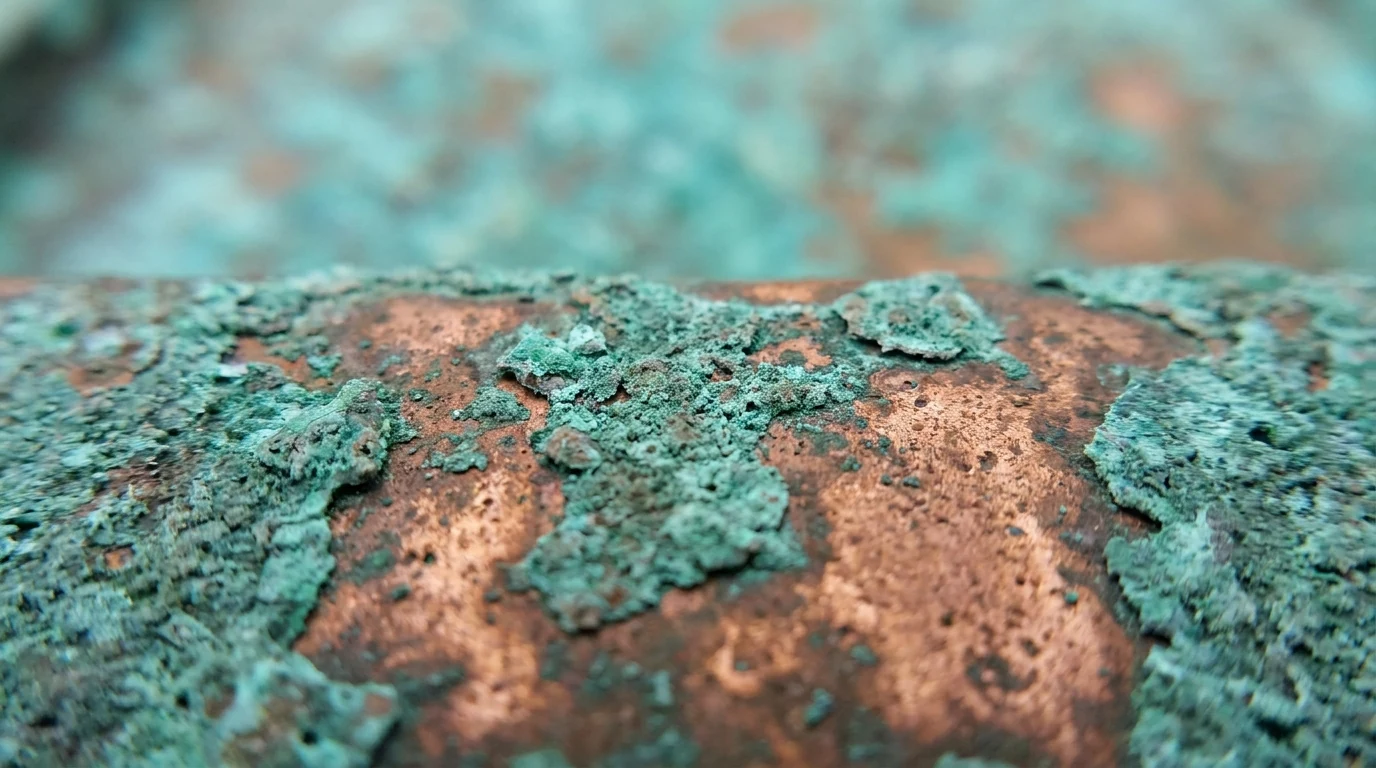
Pure copper (EN 1179, Cu-DHP: phosphorus-deoxidised copper, 99.9% purity) is one of the oldest roofing metals in European architecture. When first laid, copper is a bright pink-orange. Within a few weeks it develops a brown layer of cuprous oxide (Cu₂O), then cupric oxide (CuO). Over the years, in environments with atmospheric pollution (SO₂, CO₂, humidity), the characteristic green patina forms: basic copper carbonate Cu₂(OH)₂CO₃ (malachite), with possible sulphates in polluted environments. The transition from brown to green takes 5 to 30 years depending on the environment — decades in clean rural settings, just years in post-industrial cities. The patina is copper's own protection system: it's stable, adherent, and decreasingly permeable. Once settled, corrosion proceeds at 0.001–0.002 mm/year — practically nil.
Laying copper requires attention to thermal expansion: an expansion coefficient of 17 × 10⁻⁶ /°C, among the highest of architectural metals. A 10-metre copper roof expands by 17 mm between -20°C and +80°C (a 100°C swing). The floating-clip installation system (standing seam or raised double-lock seam) must absorb this movement. Electro-galvanic incompatibility with galvanised steel is a well-known problem: copper accelerates the corrosion of zinc on direct contact — the two must be separated with plastic or bituminous tape, or the runoff rule must be followed (never letting copper runoff water flow onto zinc or iron).
Pre-patinated copper
Pre-patinated copper (KME Tecu Patina, Aurubis Nordic Green, Corotop Bronce) is produced with industrial processes that accelerate patina formation: acid baths, electrochemical treatments, or controlled atmospheric processes in a salt-spray chamber. The result is a uniform green or brown patina from the moment of installation. The aesthetic advantage is obvious: no "ugly" transition period from pink to green, no surface unevenness in the early stages. The limit: the industrially preformed patina doesn't have the same tonal complexity as a spontaneous one, and it matures over time in a slightly different way. Installation details are identical to natural copper.
VMZINC zinc-titanium
Zinc-titanium (an alloy of Zn + 0.06–0.20% Ti + 0.06–0.10% Cu, EN 988) is produced by Nyrstar (under the VMZINC brand) and by Rheinzink. Adding titanium increases mechanical strength and reduces thermal creep compared with pure zinc. At the surface, zinc-titanium develops a patina of basic zinc carbonate (hydrozincite, Zn₅(CO₃)₂(OH)₆) that protects it from corrosion. The natural patina is blue-grey in the first weeks, then evolves into a uniform light grey over the first 2–3 years.
VMZINC offers a range of pre-treated finishes: QUARTZ-ZINC (accelerated uniform grey patina), ANTHRA-ZINC (dark anthracite grey with controlled oxidation), PIGMENTO (colours applied before patina formation). The standard thickness for flat and pitched roofs is 0.7–1.0 mm. The cost is lower than copper (around €35–45/m² for the sheet), with comparable lifespan in non-aggressive environments. In marine environments with chlorides, zinc-titanium is less resistant than copper and requires compatibility checks.
Anodised aluminium
Architectural aluminium (3xxx series alloys for roofing, 5xxx series for marine environments, 6xxx series for structural extruded profiles) is the non-ferrous metal used in the greatest volume in the construction industry. Its lightness (2,700 kg/m³ vs. copper's 8,900) and natural corrosion resistance (a passive alumina Al₂O₃ film that forms spontaneously) make it versatile. Anodising (an electrochemical process in sulphuric acid) thickens and hardens this film: thicknesses of 10–25 μm for architectural uses, up to 50 μm for aggressive environments. The colour can be natural (silver-grey), or obtained by colouring during the anodising stage (black, bronze, gold, champagne). Anodised colour lasts 30–50 years outdoors with the right alloy and thickness.
In quality windows and doors (EN 14351-1), class 20 anodised aluminium profiles (20 μm) are the standard choice for urban environments. Marine environments require class 25 (25 μm) with a 5005 or 5050 alloy low in copper content, which doesn't develop pitting in the presence of chlorides. Powder coating (Qualicoat Class 1 and 2, GSB) is the alternative to anodising: a layer of epoxy or polyester paint applied as powder and cured at 180°C, with a thickness of 60–80 μm. Standard Qualicoat Class 1 lifespan: 10 years with no intervention. Qualicoat Class 2 (primer + topcoat): 20–25 years.
ACM composite aluminium
The aluminium composite panel (ACM: Aluminium Composite Material, e.g. Alucobond, Reynobond, Alpolic) is made from two sheets of painted aluminium (0.3–0.5 mm thick) bonded to a polyethylene or fire-retardant polyethylene (FR) core. The result: large-format flat panels (up to 1.5 × 5 m), extremely light (3–7 kg/m²), with a uniform, precise surface finish. It's the dominant material in the ventilated facades of large commercial buildings over the past twenty years, thanks to its quality-to-price ratio. Its main limit is fire: standard PE (non-FR) cores are combustible and have contributed to serious facade fires, including Grenfell Tower in London (2017). Post-Grenfell European regulations now require, in tall buildings, ACM with a class A2-s1,d0 (non-combustible) FR core — an additional cost of 20–30% compared with standard ACM.
Architectural bronze
Architectural bronze (a Cu-Sn alloy with 5–10% tin, or more often architectural brass, Cu-Zn with 15–40% zinc) is a luxury material in the contemporary envelope. Its density is similar to copper's (8,800 kg/m³), while its cost is higher. It's used for high-value detail elements: handles, frames, door cladding, plaques, sculptural facade elements. In sheet form for cladding, it's used in applications where the warm golden-bronze colour is part of the architectural programme. The Four Seasons Hotel in Punta del Este (Uruguay) uses bronze cladding for its entrance pavilion. Bronze develops a brownish-black patina similar to copper's, but with warmer tones. It isn't industrially pre-patinated as often as copper.
Titanium: the Guggenheim's metal
Commercially pure titanium (Grade 1 and Grade 2, ASTM B265) is the most corrosion-resistant metal used in architecture: the TiO₂ titanium oxide film that forms at the surface is impermeable, stable, and regenerates itself automatically if scratched. In marine environments with chlorides, where 316 stainless steel risks pitting, titanium is unassailable. The projected lifespan of the Guggenheim's panels exceeds 100 years with no maintenance. Price is the limit: titanium costs €40–80/kg against €2–4/kg for aluminium. The 600 kg/m² of roofing (a myth — the sheets are 0.38 mm thick, weighing around 1.7 kg/m²) added to the Guggenheim's 24,000 m² of facade come to about 40 tonnes of titanium, for a material cost alone of more than a million dollars (1996). It works only for clients with extraordinary budgets and ambitions of century-long permanence.
Behaviour over time
Every non-ferrous metal has its own ageing kinematics: copper is at its best after twenty years, once the patina is mature and uniform. Zinc-titanium reaches its final grey in 2–3 years and then stabilises. Anodised aluminium is uniform from the moment it's installed, but slowly loses its lustre (dulling) over the years — the 25 μm class is more resistant. Titanium doesn't change over time: its appearance at a hundred years old will be practically identical to the day it was installed, barring a slight surface oxidation that can shift the iridescent hues.
The critical parameter for all non-ferrous metals in the envelope is water management: seams, upstands, ridges, and joints with other materials must all be designed to avoid pooling. Copper runoff water flowing over aluminium (or zinc) cladding creates a selective galvanic corrosion that can destroy the less noble metal within a few years. Electrolytic compatibility between materials is a check to make at the level of executive detailing, not concept.
| Dimension | Score | Assessment |
|---|---|---|
| 🌿 Environmental | 7/10 | High variability by metal: primary aluminium from bauxite is very energy-intensive (15 kWh/kg); secondary aluminium from scrap needs only 0.7 kWh/kg. Europe's aluminium recycling rate is >95%. Mined copper: ~3 kg CO₂/kg; recycled copper: ~0.3 kg CO₂/kg. Titanium is the most energy-intensive (Kroll process: 35–50 kWh/kg) but its very long service life offsets the initial impact. |
| ⚖️ Ethics | 5/10 | Critical extraction supply chains: 40% of world copper mining is concentrated in Chile and Peru, with significant environmental impacts and historical conflicts with indigenous communities (the Las Bambas mine, Peru). Bauxite aluminium: Guinea, Australia, Indonesia. Guinean bauxite has a record of environmental conflicts. Zinc: the main mining countries are China, Peru, India. No non-ferrous metal is free of extractive concerns. |
| 🏘️ Social | 7/10 | Copper and zinc cladding gives buildings character and identity over time: they age recognisably and speak of history. The copper roofs of historic churches and civic buildings are part of Europe's cultural landscape. Titanium is a materially undemocratic material: it remains the preserve of major clients. |
| 💶 Economic | 5/10 | High installation costs (copper: €80–180/m²; zinc: €60–140/m²; titanium: €300–600/m²), but a maintenance-free life cycle. The scrap value of copper and aluminium at the end of a building's life is significant (copper: €6–8/kg; aluminium: €1–1.5/kg). Over 100 years, copper's LCC (Life Cycle Cost) can prove competitive against painted claddings that need redoing every 10–15 years. |
| Average score | 6.0/10 |
Uses through history
Antiquity and the Middle Ages — copper and bronze (3000 BC – 1500): Copper is the first metal worked by humans for architectural uses: the gutters of the Karnak temple (1350 BC) are copper. In medieval Europe, copper is used for the roofing of the great cathedrals: the green copper spires of Speyer Cathedral (11th c.) and Chartres (12th c.) are among the oldest surviving examples. The abundance of copper in the Bohemian and Tyrolean mines fuelled central European ecclesiastical and civic architecture for centuries. Bronze — more precious and costly — was reserved for monumental doors: the doors of San Zeno in Verona (11th c.), Ghiberti's doors for the Florence Baptistery (1425–1452).
The nineteenth century and Rationalism (1800–1950): The industrialisation of copper rolling makes the material economically accessible for the roofing of bourgeois buildings. The copper roofs of the late-nineteenth-century neoclassical villas of Lombardy and Piedmont are a constant feature of the built landscape. Aluminium — discovered as a pure metal in 1827 by Wöhler — was initially more precious than gold: the pinnacle of the Washington Monument (1884) is clad in aluminium as a rare, prestigious metal. With the Hall-Héroult process (1886), electrolysis slashes the cost and aluminium becomes an industrial commodity by 1900.
High-tech and the contemporary period (1970–today): The high-tech architecture of the 1970s–80s (Foster, Rogers, Piano) uses extruded aluminium as a language: exposed profiles, industrial details, silver-grey facades. The Pompidou (1977) and Lloyd's of London (1986) are manifestos in steel and aluminium. The 1990s bring zinc-titanium to the facades of European institutional buildings (Paris, Berlin, Zurich). Bilbao's titanium provocation (1997) opens a season of sculpture-architecture in which non-ferrous metal cladding is the vehicle for the most radical formal expression.
Reference figures for the project
| Copper — density / λ / expansion coeff. | 8,900 kg/m³ / 385 W/mK / 17×10⁻⁶ |
|---|---|
| Zinc-titanium — density / expansion coeff. | 7,200 kg/m³ / 22×10⁻⁶ /°C |
| Aluminium — density / expansion coeff. | 2,700 kg/m³ / 23×10⁻⁶ /°C |
| Titanium — density / corrosion resistance | 4,510 kg/m³ / highest of all |
| Standard roofing sheet thickness | Cu/Zn: 0.6–0.8 mm / Al: 0.7–1.0 mm |
| Indicative sheet cost (€/m², installation incl.) | Zn: 80–130 / Cu: 120–200 / Ti: 400–700 |
| CO₂, primary / secondary copper | ~3.0 / ~0.3 kg CO₂/kg |
| CO₂, primary / secondary aluminium | ~11.0 / ~0.6 kg CO₂/kg |
Research and the contemporary frontier
The most active frontier concerns controlled surface treatments and photocatalytic materials. ALPOLIC FR aluminium with photocatalytic coating (nanometric TiO₂) has self-cleaning surfaces: UV light breaks down deposited organic pollutants, reducing the need for cleaning. Copper can be treated to have a uniform artificial green patina straight from manufacture, but the most interesting research is aimed at copper with micro-textured finishes that alter its optical properties. 3D printability of non-ferrous metals — already mature for titanium in aerospace — is starting to appear in architecture for complex connection and node elements (Zaha Hadid Architects has used 3D-printed aluminium nodes in several recent projects). In Italy, the Bottega Ghianda workshop in Milan works on cast-bronze cladding with traditional textures reworked in a contemporary key for the facades of luxury residential buildings.