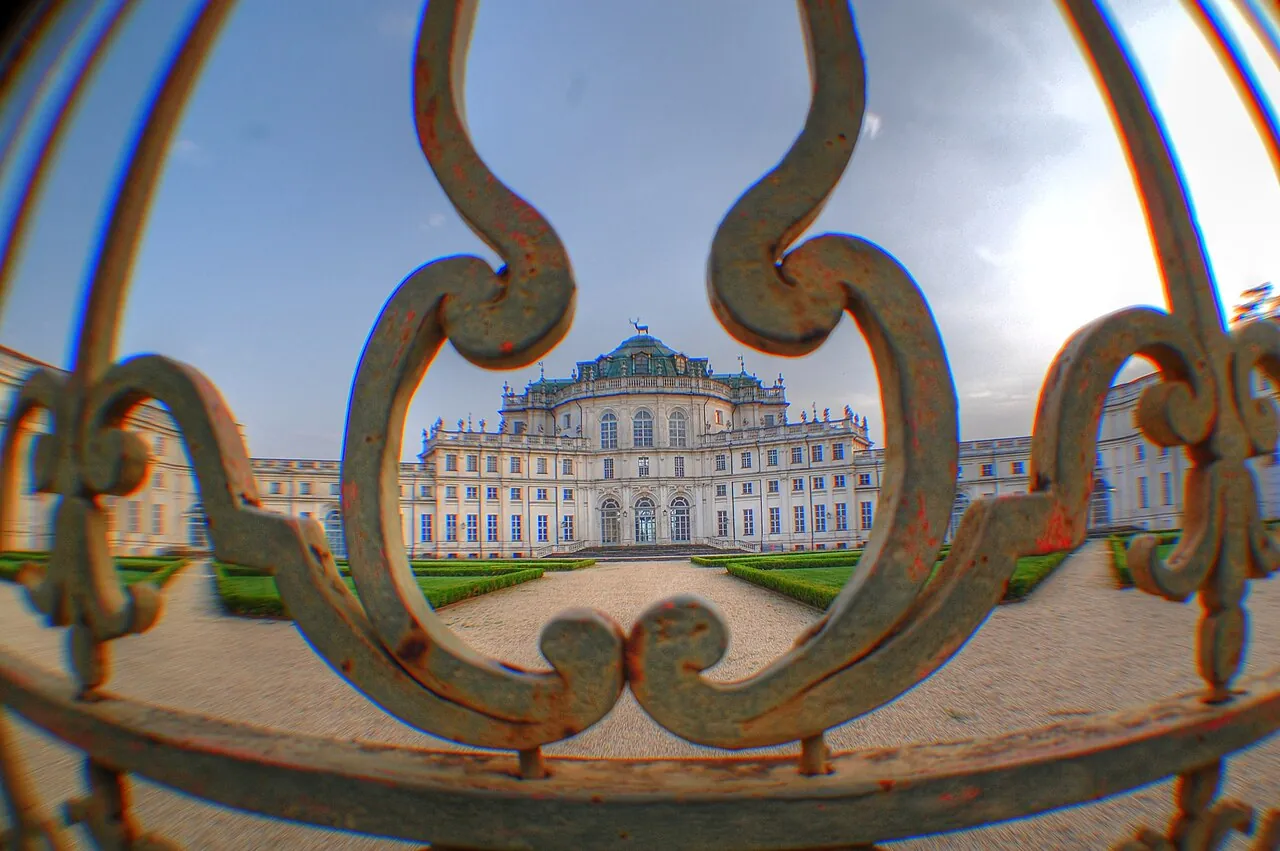
Filippo Juvara is the Bernini of Northern Italy. Not in temperament — Bernini was exuberant, theatrical, competitive; Juvara is more systematic, more learned in the sense of an architectural theorist. But in role: both were court architects of absolute trust to their sovereign, who transformed the capital of their patron into an architectural stage of European standing. Bernini transformed Rome for the papacy. Juvara transformed Turin for the Savoy.
Turin in the eighteenth century is a capital under construction. The Savoy — a peripheral house that became important thanks to its strategic position between France and Italy — wanted a capital that would demonstrate their legitimacy to royal rank (they became Kings of Sardinia in 1713). Juvara designed the Basilica of Superga on the hills above Turin (1717–1731), the Stupinigi hunting lodge (1729), Palazzo Madama, and the Royal Palace. It is an urban-architectural programme of regal dimensions — literally.
The Saint Andrew's cross plan
The Stupinigi hunting lodge has a plan with no precedent in the history of Italian architecture. The core is an oval hall covered by a dome — the focal point of the building, visible from outside through the dome's profile and the bronze stag on top. From the hall radiate four diagonal wings — the Saint Andrew's cross — each with royal apartments, reception rooms, kitchens. The wings form 45° angles with each other, creating a building that opens toward the four quadrants of the surrounding landscape.
This star shape — unusual for a residence — has a functional reason: hunting. The building stands at the centre of a hunting wood (now largely gone), and the four wings open toward the tree-lined avenues from which the hunters set out. The plan is the map of the hunting routes. Architecture and landscape are designed together.
The central hall
The central hall of the lodge is one of the most elegant spaces in Italian Baroque. It is oval in shape, 17 metres high, lit by tall windows and an oculus in the dome. The decoration is Rococo — lighter than Roman Baroque: white and gilded stuccoes, frescoes by Carle Van Loo and Giovanni Battista Crosato, mirrors, marbles. There is nothing heavy or dark here — it is all lightness, colour, movement. We are in the heart of the eighteenth century, and the Baroque has grown lighter.
But let us return to the structure. The hall's octagonal dome is supported by four piers — a structural solution that recalls Gothic cathedrals, not Roman Baroque. Juvara had studied Borromini closely — whose bold geometry he admired — and here uses structural elements Borromini would have approved of: the unconventional form, the light from above, the effect of lightness achieved with heavy materials. Turin Baroque is more intellectual and less theatrical than the Roman kind.
The comparison with Versailles
Versailles (1682) and Stupinigi (1729) are two different answers to the same problem: how to build a royal palace that demonstrates absolute power. Versailles uses perfect axial symmetry, the monumentality of scale, the subjection of the landscape to a rigorous geometry. Stupinigi uses lightness, variety of forms, openness toward the landscape instead of control over it. Versailles is a declaration of power. Stupinigi is a gesture of elegance. The Savoy — another eighteenth-century European court — chose elegance over grandiosity. It is not an aesthetic choice: it is a political one. The Europe of 1729 is not that of 1682 — absolute monarchy must justify itself differently.