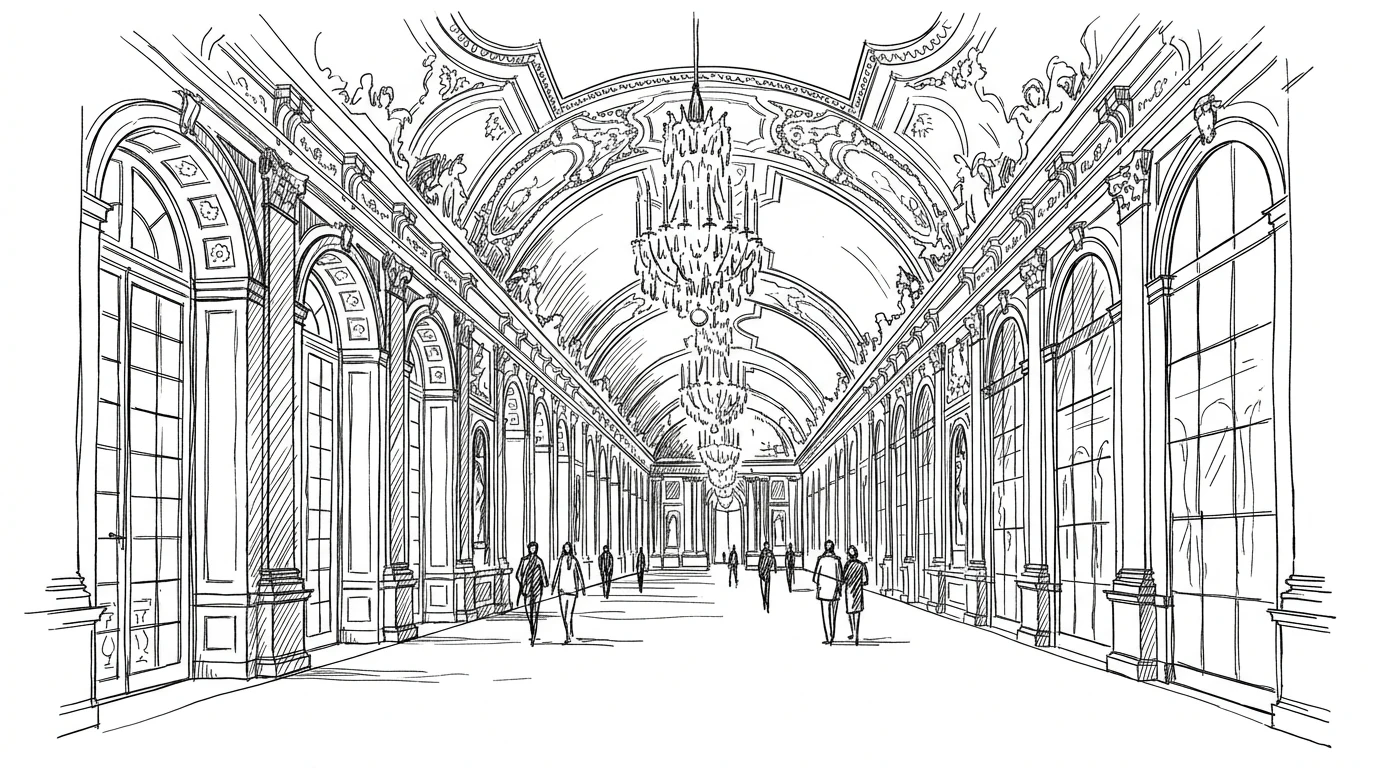
On May 6, 1682, Louis XIV signed the order officially moving the seat of government and the royal court from Paris to Versailles. It was not a sudden decision: construction at Versailles had already been underway for twenty years. Louis had been working on it since 1661, when he was twenty-three and had just taken personal control of the government after the death of Mazarin. The first thing he did with power was build. The second was build even more. Over the course of his reign — 54 years of effective rule, the longest in modern European history — Versailles absorbed a significant share of French state revenues.
But let's return to the fundamental question: why Versailles? The chateau Louis inherited at Versailles was a small hunting lodge belonging to his father, Louis XIII — an inconvenient spot, on a windy hill, with marshy ground and water that was difficult to bring in. It had no logistical advantage over Paris or Fontainebleau. Louis chose Versailles precisely because it was nothing — because it could become whatever he decided to make of it. It was a blank canvas far enough from Paris to be out of the crowd's immediate reach, close enough to remain accessible. And large enough to hold the entire aristocracy of France.
Jules Hardouin-Mansart and the Hall of Mirrors
The principal architect of Versailles in its definitive form is Jules Hardouin-Mansart, nephew of the great François Mansart. Hardouin-Mansart transformed Le Vau's original chateau — a villa of brick and stone — into a gigantic palace by adding the side wings (the north wing and south wing, each 500 meters long) and building the Galerie des Glaces, the Hall of Mirrors, inaugurated in 1684. The gallery is 73 meters long and 10 meters wide, with 17 arched windows on the terrace side and 17 mirrors facing them. It was the largest mirrored space ever built at the time.
The problem is simple: mirrors at Versailles were luxury of the highest order. France produced mirrors of lower quality than Venetian ones; Colbert, Louis XIV's minister, organized the industrial espionage needed to import the know-how from Murano and establish it in France — creating the Manufacture de Saint-Gobain. The Hall of Mirrors is also a manifesto of French manufacturing industry.
André Le Nôtre and the garden as geometry of power
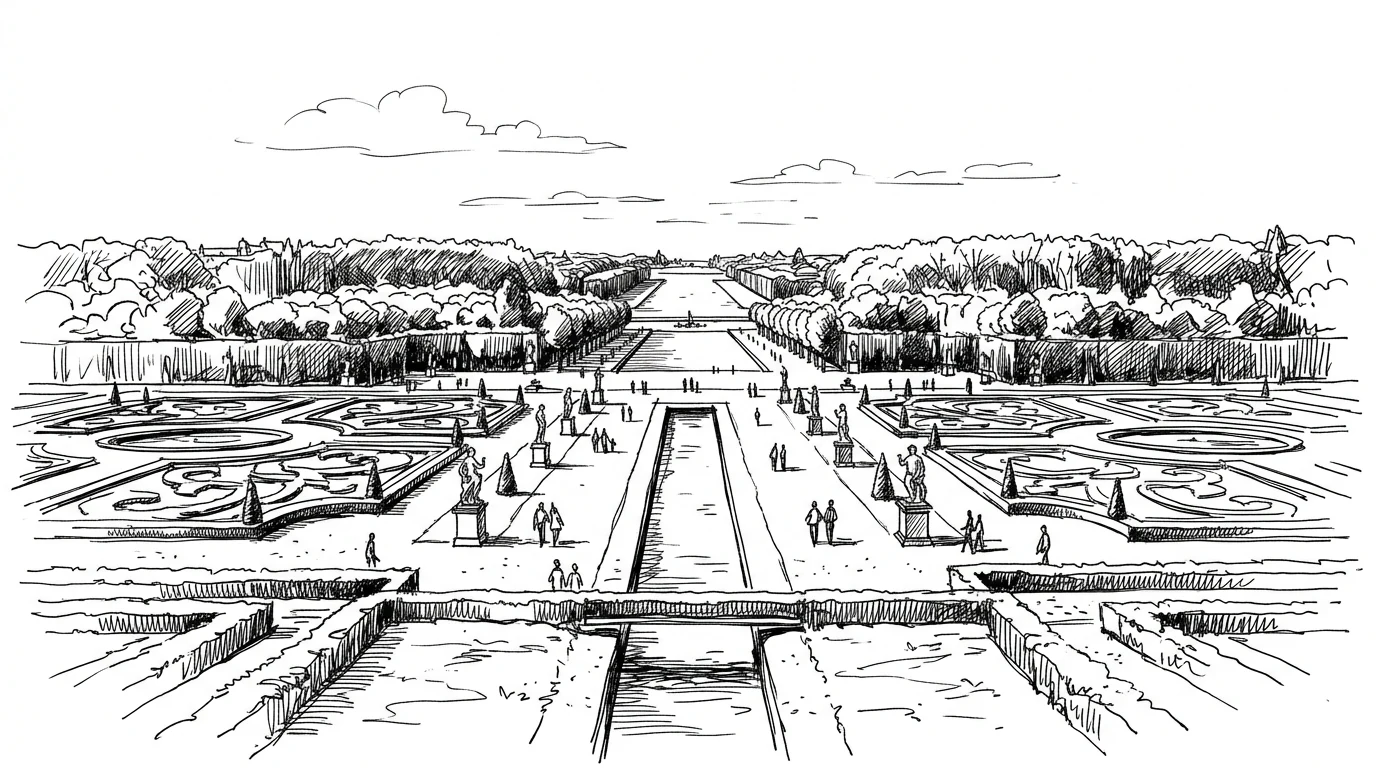
The garden of Versailles, designed by André Le Nôtre, is as vast as the palace is long — about 800 hectares of paths, fountains, woods and formal flowerbeds arranged around a central axis that points toward the setting sun. It is not a garden for strolling: it is a garden for being seen while strolling. The central axis stretches to the horizon — literally, it vanishes into the distance with no visible limit. It is an assertion of dominance over the land with no precedent in the history of the European garden.
Le Nôtre invented what is called the "French formal garden" — later distinguished from the "English landscape garden" of the 18th century. The difference is exactly this: the French garden imposes geometry on nature; the English garden simulates disordered nature according to aesthetic criteria. Both are cultural products, both require constant work to maintain. But the French garden declares itself as such: it is an act of will visible in the symmetry, the axis, the formal pruning of the hedges.
The legacy of the Versailles model
Versailles became the model for European royal palaces of the 17th and 18th centuries — not because European sovereigns wanted to copy Louis XIV (though they often did), but because the model answered a shared political problem: how to represent absolute power through architecture. Schönbrunn in Vienna, Sanssouci in Potsdam, the Royal Palace of Caserta (Luigi Vanvitelli, 1752), the Royal Palace of Madrid: all derive from the same compositional matrix — a main axis, side wings, a formal garden extending the axis toward the horizon.
The Royal Palace of Caserta is the most direct Italian case: Vanvitelli designed, for Charles of Bourbon, King of the Two Sicilies, a palace that surpasses Versailles in size (1,200 rooms, 47,000 m² of surface area) but explicitly references it in every compositional choice. The difference is that Caserta never functioned like Versailles: the court never permanently moved there from Naples, and the palace played a representative role rather than a political-functional one.