Felice Peretti becomes Sixtus V in 1585 at age 64 — already old by the standards of the time — and knows he doesn't have much time. He comes from a poor family from the Marche, was a strict Franciscan, and waited decades to reach the papacy. Once he arrives, he works with an urgency that astonishes everyone: he wants to reform Rome both spiritually and physically, and he knows time is limited. He enlists Domenico Fontana as chief architect — a Lombard engineer capable of executing rapidly on a grand scale — and launches one of the fastest and most ambitious urban planning programs a European city has ever undergone.
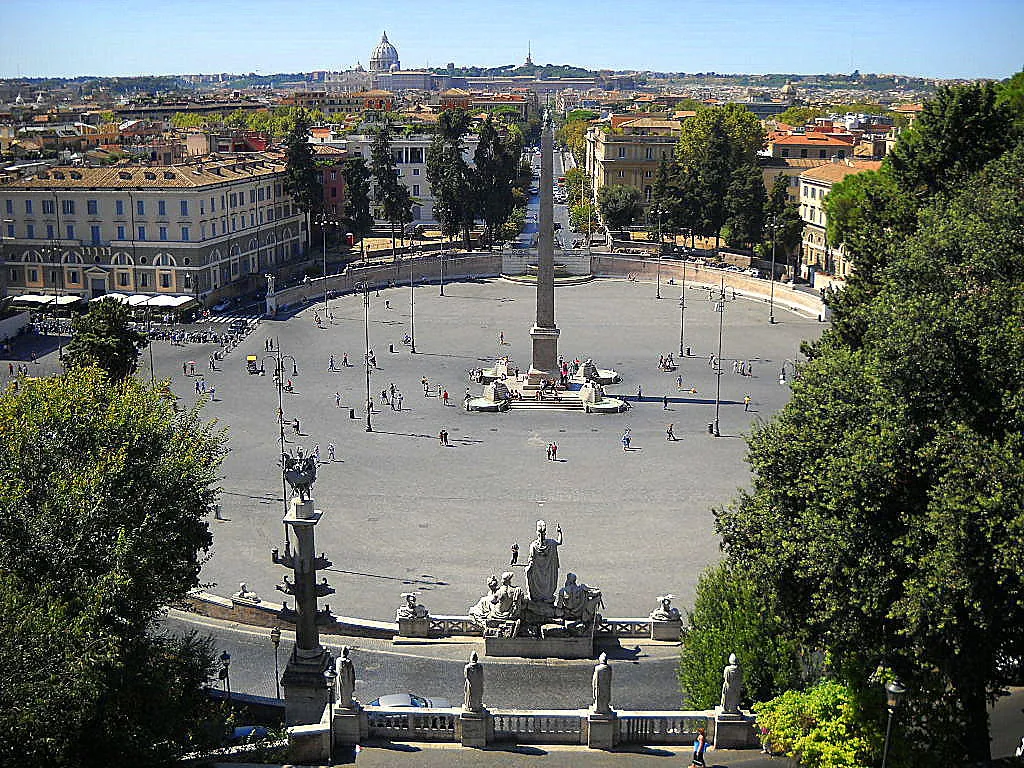
Before Sixtus V, medieval and Renaissance Rome was labyrinthine — winding streets, dense districts, no direct connection between the great religious hubs. Jubilee pilgrims had to find their way around a city with no clear street system. Sixtus V has a simple vision: lay out straight streets connecting the seven principal basilicas. Not streets that follow the topography or property lines: streets that cut straight through everything. The cost in demolitions is enormous — entire medieval districts are torn down — but the result is a system of straight avenues with obelisks at the intersections as landmarks visible from afar.
Moving the obelisk
Sixtus V's most famous gesture — and Domenico Fontana's — is the moving of the Egyptian obelisk to St. Peter's Square in 1586. The obelisk was already in Rome, in Nero's Circus, but lay on the ground on the south side of the basilica. Moving it to St. Peter's Square — upright, in the center of the square — required an unprecedented engineering machine. Fontana builds a structure of timber and ropes powered by 900 men and 75 horses. On September 10, 1586, the obelisk is raised and set upright before 100,000 spectators. The pope had ordered absolute silence — anyone who spoke would be hanged. When the obelisk is finally upright, the crowd bursts into acclamation. Fontana is made a nobleman.
That was Sixtus V's method: public spectacle as a communication of papal power. The relocated obelisk says: Rome dominates history — it took the symbol of Egyptian power and put it at the service of the Christian cross. The bronze crown atop the obelisk carries relics of the Cross. The world's oldest power has been baptized.
The Acqua Felice and water as infrastructure
Sixtus V's plan is not just streets. In 1587 the Acqua Felice aqueduct is completed — the first aqueduct built in Rome since the fall of the Roman Empire, a thousand years earlier. It carries water from the Castelli Romani (43 km away) to Rome's eastern hills — the Quirinale, the Esquiline, the Celio — which in antiquity were densely inhabited but had remained largely abandoned in the Middle Ages precisely for lack of water. With the aqueduct, the eastern hills can be inhabited again. Fontana designs the aqueduct with the same logic he uses for the streets: linear, efficient, serving the plan. At the terminal fountains — the Mostra dell'Acqua Felice, still standing near Santa Maria degli Angeli — the waters are celebrated with statues of prophets and the Moses by Pietro Bresciano (often attributed to Michelangelo, but it is by Bresciano).
The Acqua Felice changes Rome's urban geography. Before Sixtus V, all urban life was concentrated in the low-lying districts near the Tiber, where wells and springs still existed. After 1587, the hills become buildable. Villas, palazzi, churches begin to rise on the Esquiline and the Celio. The Rome we know today — with its great ecclesiastical and palatial complexes on the hills — is in part a direct consequence of Sixtus V's aqueduct.
The model for the centuries to come
Sixtus V's plan is the prototype of European axial urbanism. Haussmann in Paris (1850–1870), Vienna's Ringstrasse (1857), the grands travaux of Rome as capital (1870–1900): all use the same logic — long straight streets, with obelisks or monuments at the intersections, cutting through the pre-existing urban fabric. The difference is that Sixtus V does it in five years with sixteenth-century tools; Haussmann takes twenty years with nineteenth-century resources.
Sixtus V's plan is not a plan of expansion — it is a plan of connection. It does not create new districts: it creates axes of connection between existing hubs. The areas alongside the new streets often remain agricultural for centuries. The straight Sistine street is a structure for passing through, not an axis of real-estate development — and this sets it apart from nineteenth-century urbanism. Sixtus V wants pilgrims to move between the basilicas, not palazzi to grow along the avenues. It is a religious logic, not a speculative one. The modern city has forgotten this distinction.