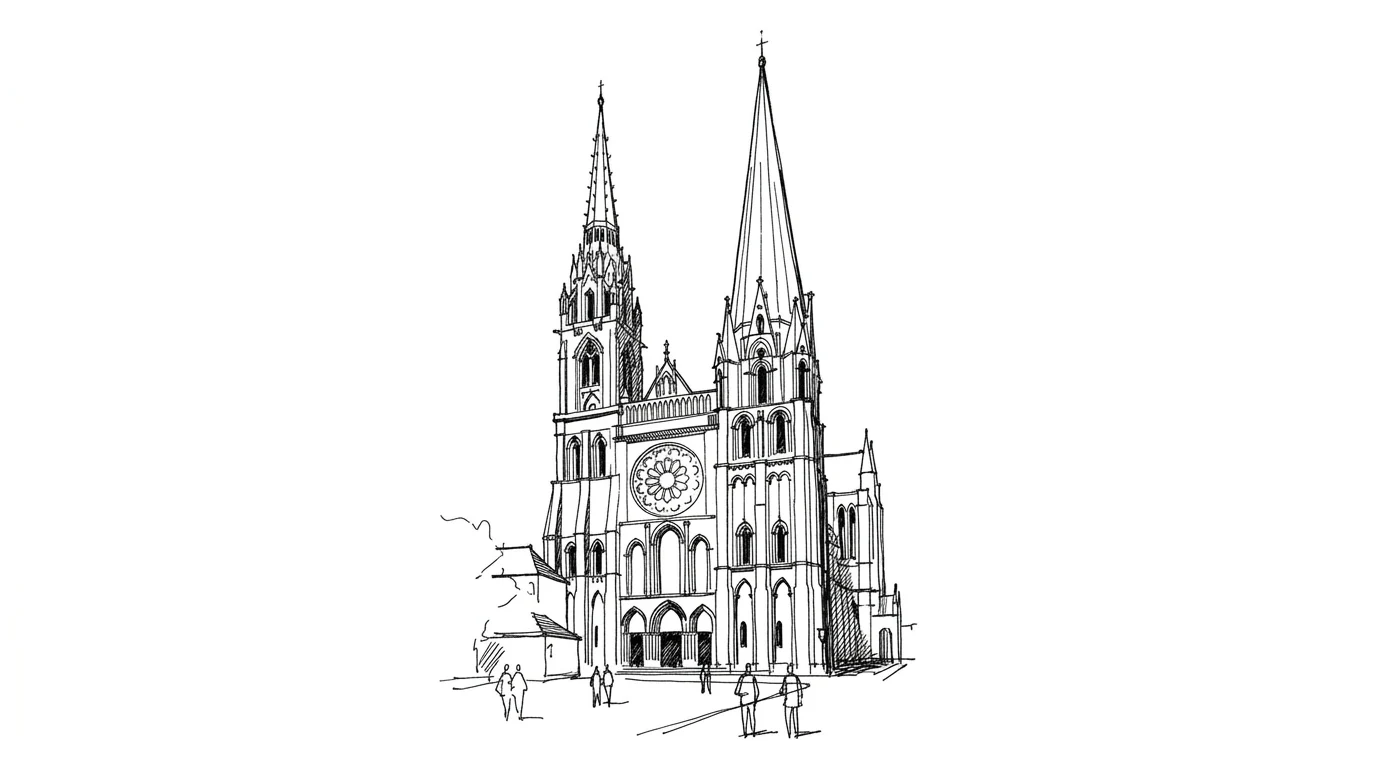
On June 10, 1194, a fire devastated the Romanesque cathedral of Chartres. What the townspeople feared most was not the loss of the building — it was the loss of the city's most precious relic: the Sancta Camisia, the tunic tradition attributed to the Virgin Mary. After the fire, when the smoke cleared, the priests guarding the relic emerged unharmed from below ground. They had survived in the crypt with the tunic. Bishop Renaud de Mouçon read this as a divine sign: the Virgin wanted a new cathedral. The money to build it came from across France.
What was built between roughly 1194 and 1220 is, technically, the most influential Gothic building ever constructed. Not the tallest — Amiens is taller. Not the oldest — Saint-Denis predates it by half a century. But the most complete, the most coherent, and the one that established the canon of classic Gothic that every subsequent medieval architect would take as a model.
The design with no designer
We don't know who designed Chartres. No documentation names a master builder responsible for the construction. There are mentions of individual craftsmen — a mason here, a carpenter there — but no name matching the figure we would today call an architect. This doesn't mean no one made the design decisions: it means that in the 12th and 13th centuries the concept of intellectual authorship of a work was not yet systematically recorded, or that the records have been lost.
The question isn't merely historical. It says something important about the nature of Gothic as a building process. A Romanesque cathedral could be the project of a single master builder working with local labor. A Gothic cathedral of that scale required different specialists — glaziers, sculptors, stone cutters, carpenters for the centering — who came from different regions and worked on different parts of the building. The "design" was distributed across many areas of expertise, coordinated by someone whose name we don't always know.
The blue of Chartres
The stained glass of Chartres has a color — a specific blue — that has never been replicated exactly anywhere else. Not because the recipe was secret: it's that the raw materials used by 12th- and 13th-century glaziers came from specific geological sources, with chemical compositions that vary from quarry to quarry. Medieval glass is not a standardized industrial product: it's a craft composition that changes every time the source of the sand or the dyes changes.
The blue of Chartres is produced from cobalt oxide mixed with copper. The exact proportion, the firing temperature, the origin of the materials: all of this affects the final result. Twelfth-century glaziers had no manual — they had experience passed down orally and local supplies. When those supplies changed, or when masters passed the technique on to disciples in different places, the result changed. The blue of Chartres is unrepeatable because it is the product of a combination of specific historical and geographic factors, not a formula.
The labyrinth
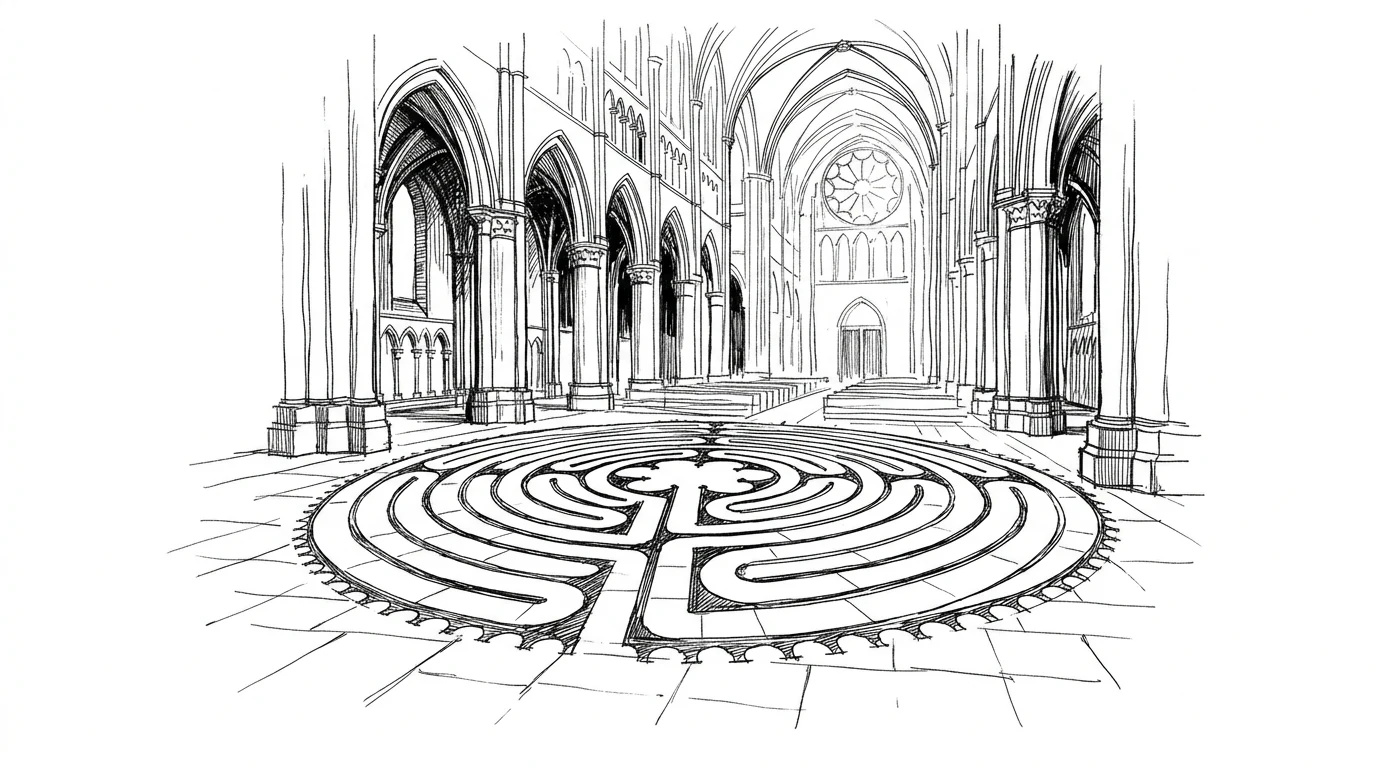
Set into the floor of the central nave of Chartres is a circular labyrinth 12.88 meters in diameter, with a path of about 260 meters leading to the center without ever encountering forks or dead ends — not a labyrinth in the modern sense, but a single-path maze. We don't know for certain what it was for. The hypotheses vary: a symbolic penitential path (walking it on one's knees substituted for the pilgrimage to Jerusalem), an astronomical-calendrical element, a cosmological symbol of the complexity of the path toward God.
What we do know is that most medieval labyrinths in Gothic cathedrals were destroyed in the 18th and 19th centuries — considered superstitious or simply in the way. Chartres still has its own intact, almost always hidden by rows of chairs. When the chairs are removed — a few times a year — the labyrinth reappears on the grey-white floor like something that belongs to no modern architectural tradition. It is one of the most mysterious elements of one of the most studied buildings in history.
Sculpture as encyclopedia
The more than four thousand figures carved on the portals of Chartres — angels, prophets, kings, queens, biblical scenes, allegories of the liberal arts and the seasons — are not ornament: they are a text. In the Middle Ages the vast majority of the population was illiterate. The sculpture and painting of places of worship were the main way the Church communicated doctrine. Every figure has a precise meaning, a precise place in the overall iconographic program. Reading the facade of a Gothic cathedral was, for a medieval worshipper, like reading a page of text is for us.
The iconographic program of Chartres covers the history of salvation from the Old Testament to the Apocalypse, with particular attention to the Marian cult — consistent with the cathedral's function as the seat of the Virgin's relic. The figures of the royal portal (the main portal, the only one to survive the 1194 fire) are among the oldest surviving Gothic sculptures, and stand out for a static, almost otherworldly quality: the bodies are rigid, columnar, the faces serene and devoid of individual expression. This is not the sculptors' technical incapacity: it is a theological choice. The sacred figure has no individual psychology — it is an idea, not a person.
What remains
Chartres still stands, on a hill in the Beauce, visible for dozens of kilometers in every direction before the plain gives way to the town. It has not suffered the damage that struck Notre-Dame in Paris (2019 fire), or Reims (1914 bombardments), or Amiens. The 12th- and 13th-century stained glass was dismantled and put in safekeeping during the Second World War — the only original Gothic stained glass preserved in this quantity anywhere in Europe.
Every year, hundreds of thousands of visitors enter the cathedral, photograph it, buy an illustrated book on the symbolism of the stained glass, and leave without necessarily understanding much more than when they came in. Which is exactly the opposite of what is commonly believed: the medieval building was not meant to be understood alone, with a guidebook or an audio guide. It was meant to be read with someone who could explain the code — a priest, a catechist, a friar. Without the code, it remains what it is even so: one of the most extraordinary interior spaces the human hand has ever built.