In 1140, Abbot Suger of Saint-Denis, near Paris, opened the choir of his newly rebuilt abbey and used a word that had never before been used in architecture: lux nova — new light. He was not describing an aesthetic quality. He was describing a theological program. Suger was convinced, following the Christian Neoplatonism of Dionysius the Areopagite, that material light was a reflection of divine light — that the more luminous a building was, the closer it came to God. Architecture as a machine for turning light into theology.
The problem was that he did not know how to build what he wanted. He needed the walls to disappear and be replaced by glass. But the walls carried the vaults. Removing the walls meant bringing down the roof. The architects — who at that time were not yet called architects but magistri operis, master builders — had to find a way to carry the weight of the vaults without using the walls. The result of this technical search is Gothic.
The problem of lateral thrust
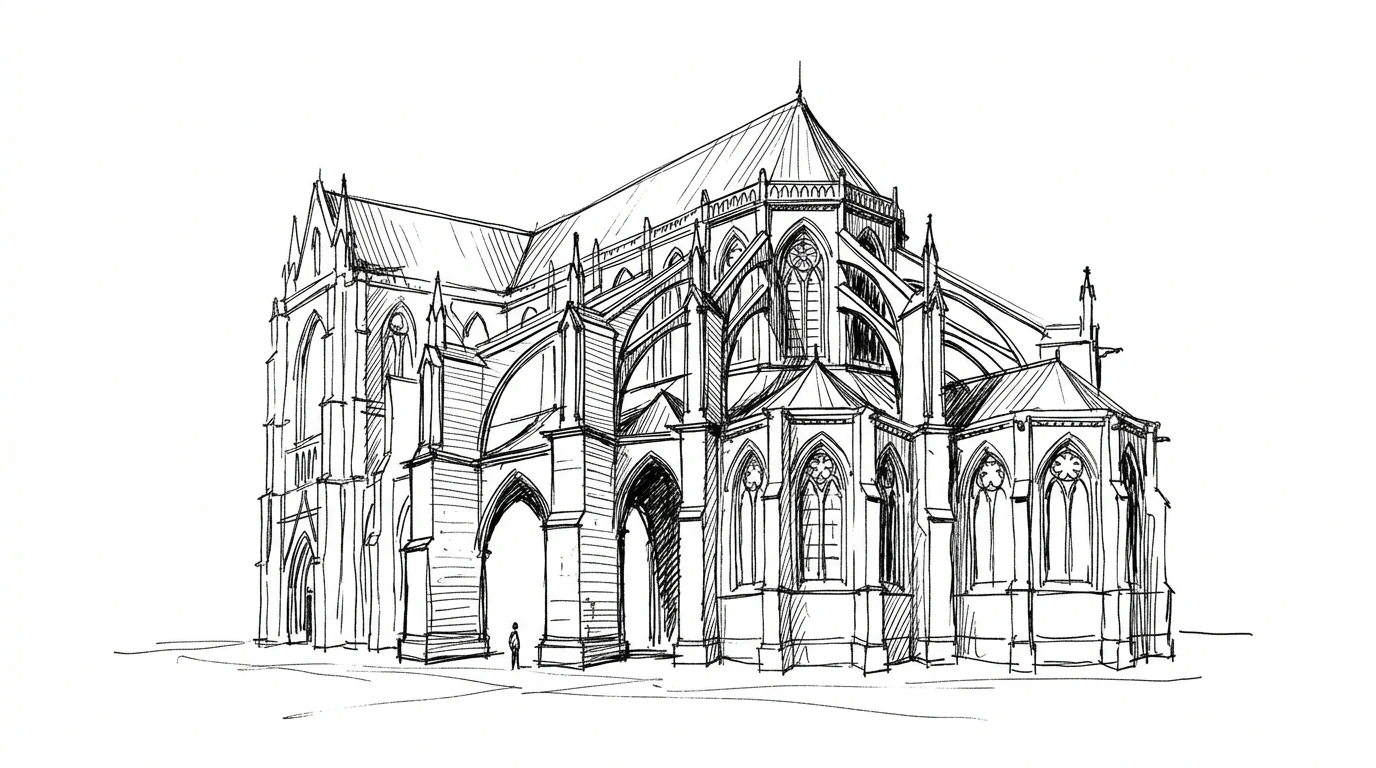
A barrel vault, like that of the Romanesque, pushes laterally on the walls that support it. If the walls are thick and massive, they resist. But if you want to open the walls with large windows, the walls weaken, can no longer withstand the thrust, and the vault collapses. Gothic solves this problem by removing the thrust from the walls and carrying it outside the building with flying buttresses — inclined arches that start at the top of the walls and discharge the force onto external buttresses, massive piers outside the nave.
The result is paradoxical: the Gothic cathedral is stronger than the Romanesque cathedral despite having much thinner walls, because it has externalized the counter-thrust system. The interior is free. The walls can be replaced by stained glass windows. Suger's new light becomes buildable.
Three inventions that change everything
Gothic is not a single invention: it is the result of three technical innovations that, used together, produce something qualitatively different from anything that existed before.
The first is the pointed arch. A semicircular arch has a fixed height determined by the width of the opening: if the opening is four meters wide, the arch at its center will be two meters high. A pointed arch can be taller than half its width — you can vary the height independently of the width. This makes it possible to align the tops of arches of different widths, something impossible with the Romanesque arch. It is the solution to the problem of rib vaults over rectangular bays.
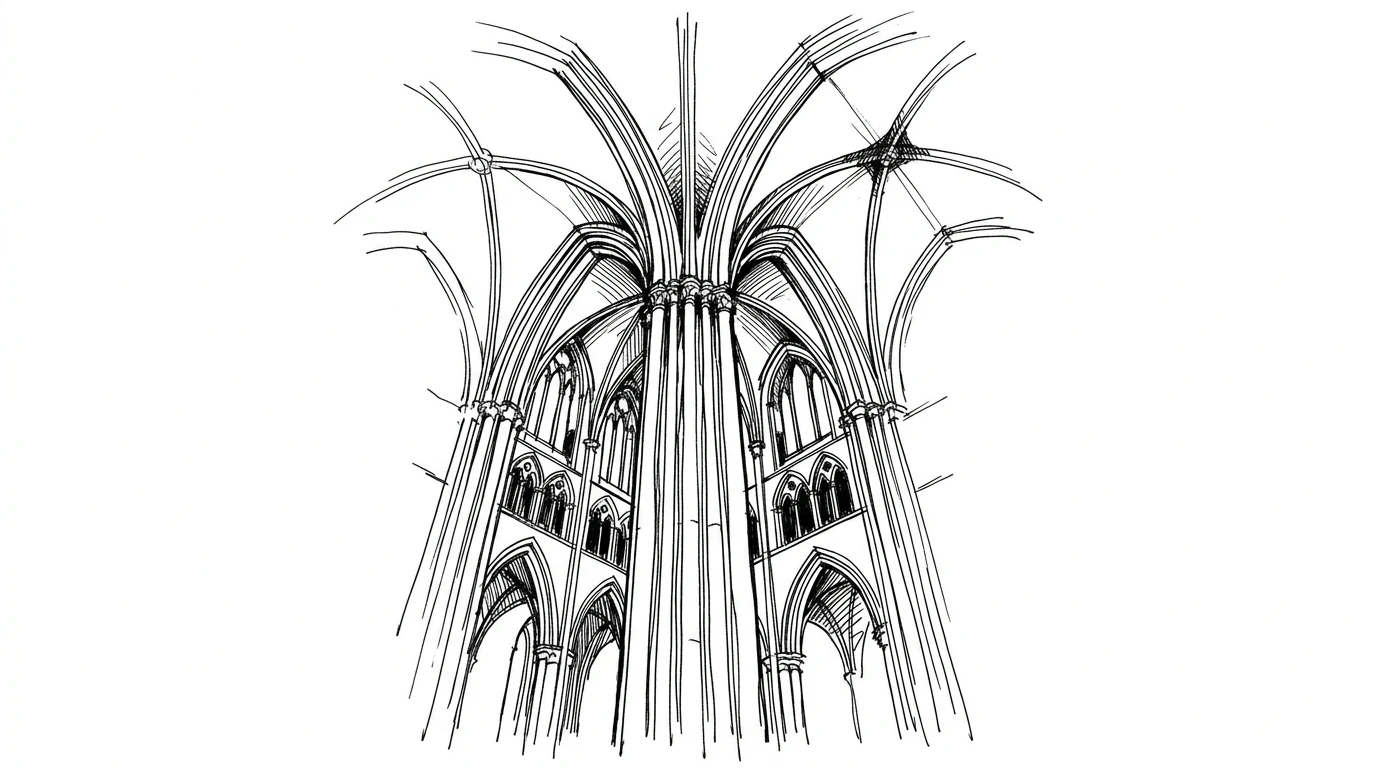
The second is the rib. Instead of building a vault as a continuous surface, it is built as a skeleton of stone arches (the ribs) filled between the ribs with lighter material. The ribs carry the weight; the webs between the ribs are almost structurally irrelevant. This enormously reduces the mass of the vault and therefore also the thrusts on the walls.
The third is the clustered pier — a pier made up of several slender colonnettes grouped around a central core. Each colonnette corresponds to a rib of the vault above, creating a visual continuity between the ground and the roof: the forces descend along visible lines, from roof to floor, through the building. It is not merely aesthetic — it tells something true about how the structure works.
The building site as a collective work
A Gothic cathedral required anywhere from fifty years to two centuries to build. No one who began the work saw the final result. Master builders succeeded one another: one began the foundations, another built the naves, a third added the façade, a fourth completed the towers — often centuries later. The result is that many Gothic cathedrals are stylistically incoherent: parts built in different eras reflect the evolution of Gothic, from the early Gothic of Saint-Denis to the Flamboyant Gothic of the late fifteenth century.
Chartres, which has two towers of different heights (the north tower being taller, completed in the sixteenth century), is the most famous example of this accumulation. The north tower is in mature Gothic style; the south tower, built three centuries earlier, is in early Gothic. They have stood side by side for eight hundred years. The people of Chartres find them perfectly normal. Tourists wonder why no one fixed the problem. The answer is that it is not a problem: it is the visible history of the building.
The end of Gothic and the reason for the Renaissance
Gothic does not end because someone decides it is ugly. It ends because the religious and political drive that sustained it runs out, and because Italian humanism proposes an alternative founded on different values — mathematical proportion, the human body as a measure, reference to ancient Rome instead of medieval mysticism. Brunelleschi goes to Rome to study the Pantheon and brings back to Florence something that is not Gothic: it is classical. Not because Gothic is wrong, but because fifteenth-century Florence wants to feel itself the heir of Rome, not of Paris.
Gothic survives in England until the eighteenth century, and in the nineteenth the Gothic Revival brings it back to life across Europe as a style for churches, universities and parliament buildings. But it is a citational Gothic — it uses the forms without the original structural reasons. Neo-Gothic cathedrals often have concrete walls faced with carved stone. The flying buttresses are decorative. Suger's new light has turned into a historical quotation.
The problem is simple: when a form loses its link to the function that generated it, it becomes costume. Authentic Gothic worked because every element had a precise structural reason. Neo-Gothic is theater. The difference shows — if you know what you are looking at.