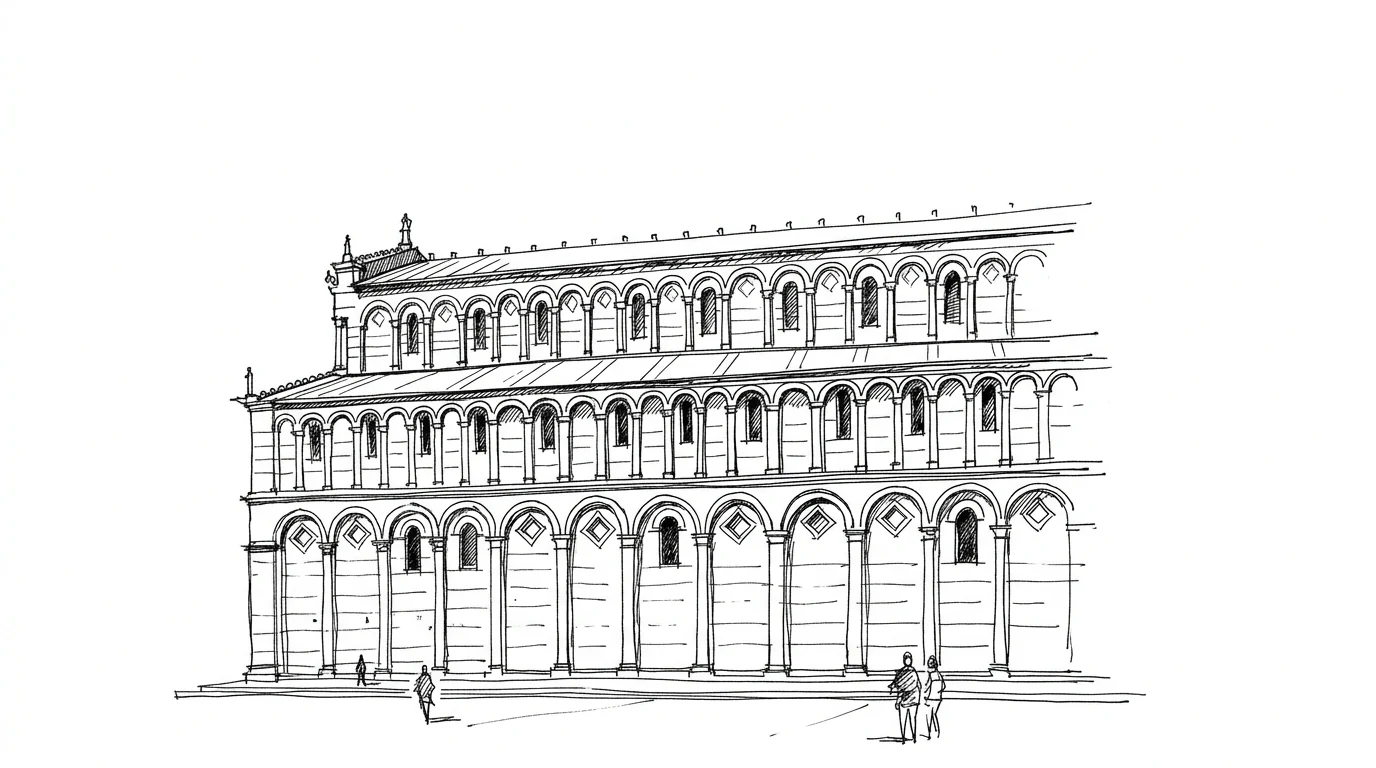
Around the year 1000, churches began to be built in stone across Europe on a scale never seen before. The monk Rodulfus Glaber wrote around 1003: "It was as if the world had shaken off the dust of old age and were clothing itself everywhere in a white mantle of churches." The image is powerful and probably exaggerated — not every church of the year 1000 was new — but it captures something real: after the Carolingian period and the Viking, Norman, and Magyar invasions, Christian Europe entered a phase of political stabilization that allowed large-scale architectural investment.
The term "Romanesque" was coined in the 19th century — like almost all the names given to historical periods of architecture. The architects who built the cathedrals of Pisa, Worms, Santiago de Compostela, and Durham did not call themselves "Romanesque": they simply built the way building was done, with the techniques available, responding to liturgical requirements and the availability of materials. "Romanesque" deliberately means "in the Roman style": its main features — round arches, columns with carved capitals, barrel vaults — derive from Roman architecture, filtered through centuries of local building practice.
The wall as structure
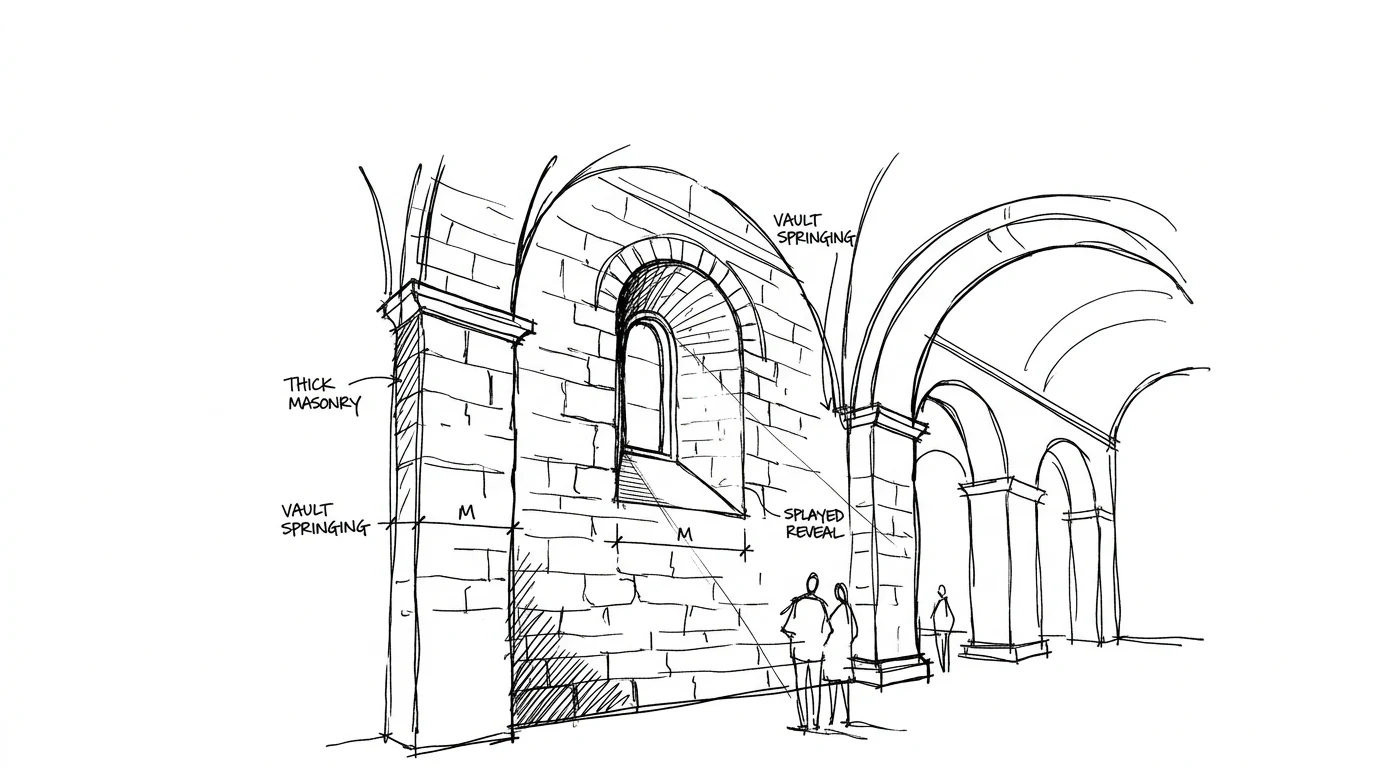
The Romanesque building system is based on the massive load-bearing wall. The stone vault — a barrel vault in the central nave — pushes laterally against the walls that support it. The heavier the vault, the thicker the walls must be to resist the thrust. Thick walls do not allow large windows. Small windows mean little light. The logic is coherent: every structural decision leads to the next.
This does not mean Romanesque builders were not seeking more sophisticated solutions. The groin vault — two barrel vaults intersecting at right angles — was already in use in the late Romanesque period to reduce thrust and open up space between the walls. But the structural constraints of the load-bearing wall system were real and difficult to overcome without a qualitative technological leap. That leap is the Gothic: not an improvement on Romanesque, but a technologically different solution to the same problem.
Romanesque light
Romanesque spaces are dark compared to Gothic cathedrals — but they are not dark in an absolute sense. They are dark in a specific way: the windows are small and set high, light enters obliquely, and the thick walls create deep window reveals that diffuse light differently from a flat surface. The effect is of a light that seems to emerge from the walls rather than come from outside — an effect many Romanesque churches still produce for attentive observers.
Romanesque darkness is not a technical failure: it is a choice reflecting a theology different from the Gothic one. If Suger, at Saint-Denis, wants material light to be a reflection of divine light — more light, closer to God — the Benedictine tradition that inspires most Romanesque churches has a different idea: the divine dwells in shadow, in silence, in withdrawal from the world. The church is a place of separation from the sensible, not exaltation of the sensible. Abundant light distracts; darkness concentrates the mind.
Romanesque in Italy
Italian Romanesque differs from its northern European counterpart in structural ways: it uses marble as an external cladding (two-tone in Pisa and Siena, polychrome in Florence), keeps more horizontal proportions, and integrates elements of the late antique tradition with greater continuity. Pisa Cathedral, with its facade of blind arcades and its stacked open loggias, does not resemble Durham Cathedral or Worms Cathedral — it shares with them only the principle of the massive load-bearing wall and the round arch, but translates them into a completely different formal language.
In Italy, Gothic arrives later and with less force than elsewhere — probably because the Romanesque tradition was rich enough, and the different climate and light conditions made the need for large windows less urgent. Italian Gothic cathedrals are more massive, less soaring, with thicker walls and smaller windows than their northern European counterparts. They are Gothic in their ribbing and pointed arches, but Romanesque in the monumentality of their mass.