Raphael the architect is the great forgotten figure of Renaissance architectural history. The painter is well known — the School of Athens, the Transfiguration, the portraits. The architect is less known — the villas, Palazzo Pandolfini, the church of Sant'Eligio degli Orefici. And the designer of the new St. Peter's is known least of all — Raphael never had time to build it, but he left it in drawings and in a letter to the pope that is one of the most important texts on Renaissance architecture.
The problem is not Raphael's competence — it is time. When he dies in 1520 at 37, of a fever (probably typhoid), St. Peter's was still nearly at a standstill — Bramante had built the four crossing piers and little else. Raphael had changed the plan from a Greek-cross layout (Bramante) to a Latin-cross layout (better suited to Roman Christian liturgy), and had begun construction of the naves. Michelangelo, who succeeds him 26 years later as chief architect, will change the design once again — returning to the Greek-cross plan. The history of St. Peter's is the history of three geniuses who never agree on what to build.
Villa Madama
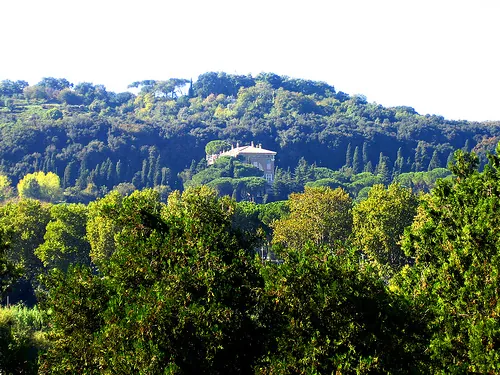
Villa Madama, designed by Raphael for Cardinal Giulio de' Medici (the future Pope Clement VII) in 1516, was left unfinished — only about a third of the original design was built. What exists — the loggia with frescoes by Giovanni da Udine and Giulio Romano, the circular garden, the fishpond — is enough to grasp the grandeur of the project. Raphael drew inspiration from Hadrian's Villa at Tivoli: a complex of buildings freely arranged in the landscape, connected by covered and open pathways, with interior and exterior spaces alternating.
The loggia of Villa Madama is one of the finest architectural spaces of the Roman Renaissance — three great arches with cross vaulting, decorated with stucco and frescoes in grotesque style (grotesques had just been rediscovered in Nero's Domus Aurea, excavated in those very years). The decorative program is sophisticated: mythological themes, imaginary landscapes, allegorical figures — all integrated with the architecture into a whole that cannot be separated. The decoration is architecture.
The Chigi Chapel and Raphael's architectural-pictorial training
The Chigi Chapel in Santa Maria del Popolo (Rome, 1513–1516) — commissioned by Agostino Chigi, the richest banker in Rome — is Raphael's first major architectural work and already shows his distinctive approach: painting and architecture as a single project. The chapel has a Greek-cross plan topped by an octagonal dome, frescoed by Raphael himself with figures of angels and planets. The dome's mosaics — designed by Raphael but executed by Venetian craftsmen — depict the sky and the constellations. The floor is an opus sectile of colored marble in precise geometries. The walls have niches with pyramid sculptures (inspired by Roman funerary monuments) — an unusual funerary type that Raphael recovers from antiquity.
The essential point is this: Raphael does not design the architecture and then add the decoration. He designs the space as a single organism in which the color of the marble, the shape of the niche, the subject of the fresco, and the geometry of the floor are all parts of the same design. This ability — to be painter, sculptor, decorator and architect at the same time — is what sets Raphael apart from Bramante (a pure architect) and Michelangelo (who works in the arts one at a time). The loggia of Villa Madama is the same approach carried to the scale of an entire environment.
The letter to Leo X and the conservation of monuments
In 1519, Raphael writes, together with Baldassare Castiglione, a letter to Pope Leo X — a programmatic document proposing the systematic survey of all the ancient monuments of Rome, before they are further destroyed to obtain building material. The letter is the first document in history to speak explicitly of the conservation of architectural heritage: Raphael classifies monuments into categories (public, private, religious buildings), proposes a systematic method of measurement and drawing, and theorizes the value of ancient remains as a source of knowledge for the present. He is worried — rightly — that the marble quarrying of the imperial villas is irreversibly destroying what Bramante had taught him to read as an archive of Roman building technique.
Raphael dies before completing the survey. He dies before completing Villa Madama. He dies before building St. Peter's. His architectural legacy is made of the unfinished — yet it is enough to understand what could have been. Raphael's unfinished work is not a failure: it is proof that an exceptional talent had far too little time. Posterity built upon his unfinished work — literally, in the case of St. Peter's. And his letter to Leo X — the first manifesto of monument conservation — influenced Italian heritage culture all the way to twentieth-century legislation. A letter written by a sick thirty-seven-year-old who did not know he had only a year left to live.