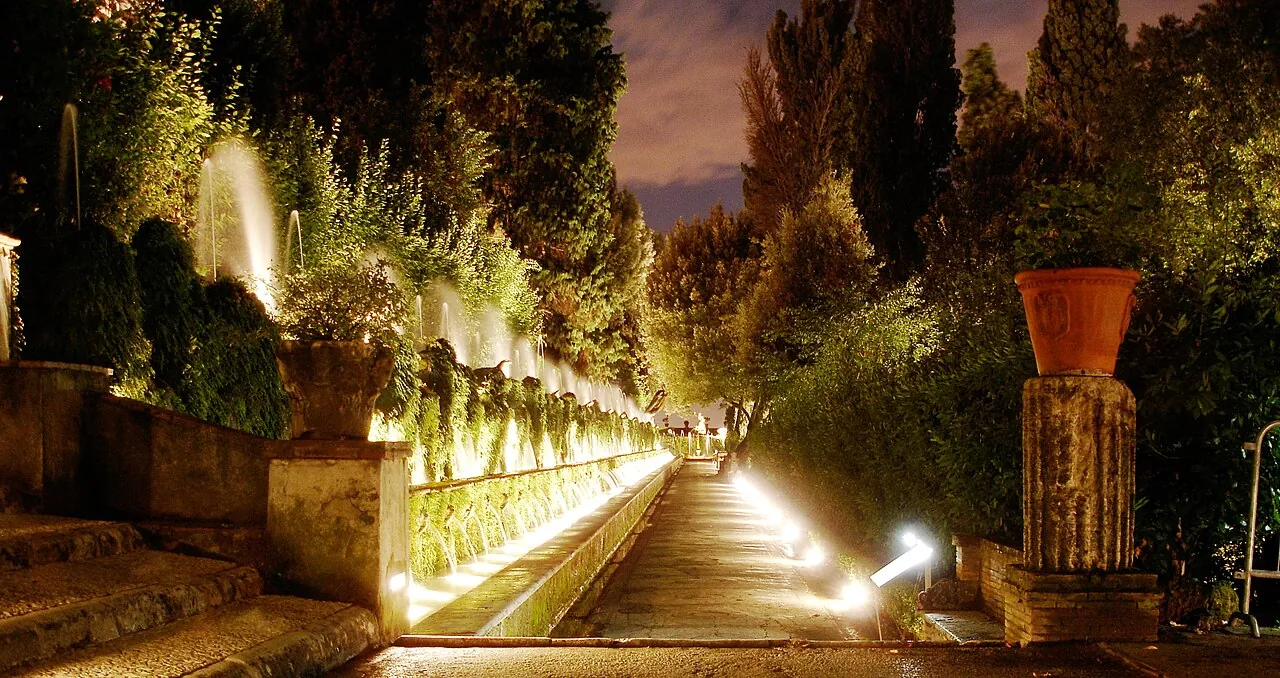
Villa d'Este in Tivoli is not just a beautiful garden. It is an engineering system. The garden sits on a hillside with a drop of about 50 meters. Water from the Aniene River is captured upstream, carried through an underground aqueduct to the highest point of the garden, and from there distributed by gravity to all the lower levels through a network of channels, basins, and fountains. There is no mechanical pumping — the pressure is purely hydrostatic. The hydraulic engineering is the architectural design. Pirro Ligorio, the architect, is also a hydraulic engineer.
The 500 fountains of Villa d'Este are not merely decorative. Some produce sounds — the water organ is a pipe organ powered by water passing through sound tubes, driven by the pressure of the water itself. There was also a system that produced birdsong — small flutes driven by air compressed by water. And there were the so-called "water tricks": fountains hidden along the paths that soaked unsuspecting guests — a tradition also found in Mannerist villas throughout central Italy. Water is not just seen: it is heard, felt, feared.
Topography as design
The garden of Villa d'Este is designed as a path descending from the villa (at the top) downward — and then rising again. The villa looks down on the garden; the visitor looks up toward the villa. The direction of the path produces a progressive reading of space: first the view from above, then immersion in the lateral axes, then the ascent with a new perspective. It is a narrative path, not just a landscape one.
The horizontal axes — the great avenues parallel to the contour lines — alternate dense vegetation zones with panoramic openings. The Avenue of the Hundred Fountains (a straight channel 130 meters long flanked by 100 fountains shaped like eagles, lilies, and boats — the emblems of the Este family) is the most formal. The Fishpond Canal, at the far end of the garden, is the widest — a collecting basin 80 meters long that reflects the sky. The sequence is designed like a musical composition: rhythm, pause, climax.
The iconographic program: the villa as allegory
The garden of Villa d'Este is not just a landscape: it is literary. Pirro Ligorio — who is an antiquarian and scholar of antiquity as well as an architect — designs the garden as an allegory of the virtue of Hercules: the path from bottom to top represents the Choice of Hercules between Vice (easy, pleasurable, downward) and Virtue (difficult, ascending, toward the summit). Water, fountains, games — pleasure — are below. The villa — contemplation, governance — is above. The garden is not just beautiful to look at: it tells something about the value of intellectual effort over sensual pleasure. It is a message intended for the cardinal's visitors — diplomats, intellectuals, princes — who understood the classical reference.
Ligorio was also the most important antiquarian in Rome of his time — responsible for the excavations of Hadrian's Villa, two kilometers from Tivoli. Many of the decorative elements of Villa d'Este (statues, reliefs, inscriptions) were ancient pieces recovered from the excavations at Hadrian's Villa, relocated into a modern context. The villa is also, in this sense, a museum of the ancient world — organized not as storage but as an experience integrated into the landscape.
European influence and the Romantic decline
Villa d'Este becomes the model for the Italian garden throughout Europe. Versailles is its direct heir, immensely amplified: Le Nôtre knows the Italian gardens and brings their principles to France — transforming the topographic descent into a horizontal plane, the geometry into a continental scale, the water into immense scenographic effects. The Italian garden becomes the French garden — the model of European absolutism.
But the story of Villa d'Este after the 16th century is also a story of neglect. After the Este family died out in the 18th century, the property passed to the Habsburg-Este, then to the Italian State. Over centuries of neglect, the garden ran wild — trees grew out of control, fountains clogged, statues were stolen or deteriorated. Ironically, it is in this state of romantic decay that Villa d'Este attracted Grand Tour travelers and inspired artists. Franz Liszt lived there for long periods in the 1860s–1880s, composing pieces of "Years of Pilgrimage" drawing inspiration from the cypresses and fountains. Corot, Turner, and Fragonard painted the abandoned garden — finding beauty in the decay, not in the original geometry. The garden we see today is the result of 20th-century restorations that sought to reconstitute the 16th-century geometry — but the calcified travertine on the fountains, the moss, and the centuries-old cypresses are the involuntary legacy of the centuries of neglect.