Jacopo Tatti, known as Sansovino, is born in Florence in 1486. He is a sculptor before he is an architect — he trains in Florence in the workshop of Andrea Sansovino, whose nickname he takes, then moves to Rome where he works on the great papal building sites under the pontificates of Leo X and Clement VII. In Rome he meets Raphael, Bramante, Giulio Romano. He absorbs the grammar of ancient architecture — orders, proportions, modulation — and becomes one of its most capable interpreters. When the Sack of Rome (1527) suddenly dissolves the city's cultural environment, Sansovino is forty-one, with an entire career still ahead of him. He intends to go to Florence. He stops in Venice for a few months. He never moves again.
Venice needs Sansovino for precise reasons. The city is extremely wealthy and culturally vibrant — Titian, Aretino, Bembo form one of the most fertile intellectual circles in Europe — but its architecture has fallen behind Florence and Rome. Fifteenth-century Venetian architecture is Gothic with Renaissance insertions, ornamental and rich but not systematic in its proportions. The Senate wants someone who can build "all'antica" — with correct classical orders, proportions grounded in theory — and Sansovino can do it better than anyone else available. Within a few months he is named Proto (protomagistro, the chief architect of the Procuratia de Supra) of the Republic. He remains so for almost fifty years, until his death in 1570.
The Marciana Library: Istrian stone and the light of the lagoon
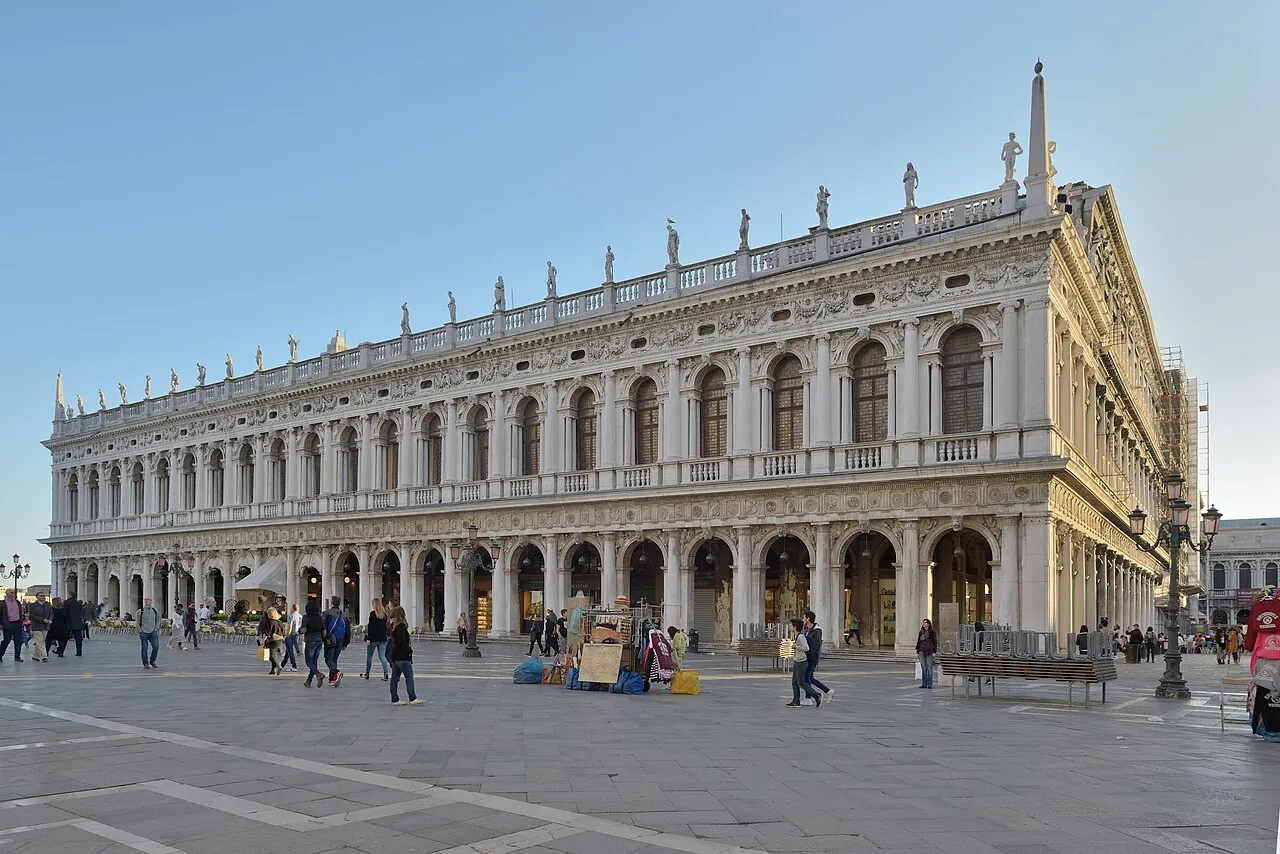
The Biblioteca Nazionale Marciana (1537–1554) is Sansovino's masterpiece — and probably one of the most important buildings of the Italian Renaissance outside Florence and Rome. Eighty meters long on the Piazzetta di San Marco, facing the Doge's Palace, it has two stories of loggias: a Doric order on the ground floor, an Ionic order on the first floor. Each bay is an arch framed by engaged columns, with a heavily decorated frieze — garlands, putti, masks — and a balustrade with statues at the top. The whole is built in white Istrian stone — the limestone quarried in Istria (today Croatia) that Venetians had used for centuries because it withstands salt water better than Italian marble.
The crucial detail of the Library is the depth of its moldings. Sansovino designs cornices and frames with pronounced projection, so as to create strong shadows on the surfaces. In Venice, light is indirect and diffuse — reflected off the lagoon's water, softened by the humidity in the air. Under these conditions, a facade with flat moldings becomes illegible: it looks like a flat surface. The contrast between light and shadow, easily achieved in Rome under direct sun, requires a deliberately exaggerated projection in Venice. Sansovino calibrates the detail to the environment. It is a contextual sensibility that anticipates the concept of "critical regionalism" by four hundred years.
Palladio, who studies the Library closely, calls it "the richest and most ornate building since antiquity" — a judgment that surprises until one understands what he means by "ornate": not surface decoration, but richness of relationships, depth of elements, calibration of proportions. Palladio is seeing something many modern visitors miss: the technical perfection of the composition, not just the beauty of the effect.
The Mint, the Loggetta, and the Palazzo Corner
Next to the Library, Sansovino builds the Zecca — the Republic's mint, where the ducat and the grosso were coined. Where the Library is elegant, the Zecca is robust: rustic rustication (stone blocks with a rough, prominent surface), windows with mascarons, a massive, almost prison-like appearance. This is not inconsistency: the Zecca holds the Republic's money — it must look impenetrable. It is the same principle behind Sangallo's Fortezza da Basso in Florence: the building's formal character communicates its program before one even enters. The deliberate contrast between the Library and the Zecca — built by the same architect at the same time — shows that the Venetian Renaissance is not a uniform style but a repertoire adaptable to the program.
The Loggetta at the foot of the Campanile (1538–1549) is a jewel on a smaller scale: four arches in polychrome marbles, bronzes by Sansovino in the niches (Pallas, Apollo, Mercury, Peace), Latin inscriptions praising Venice. It collapsed along with the Campanile in 1902 and was rebuilt in 1912 with the same stones, reassembled according to detailed photographic documentation. It is technically a copy — but so faithful that it is considered original in every sense that matters.
The Palazzo Corner della Ca' Grande (from 1545) on the Grand Canal is perhaps Sansovino's most influential work on later Venetian architecture. The facade is tripartite: a rusticated ground floor, two stories of loggias with superimposed orders. It is the model from which dozens of Venetian palazzi built over the following two centuries derive. Palladio studies it, adapts it, transforms it — but his basic system comes from Sansovino. The Venetian Renaissance in architecture is, in large part, Sansovino's renaissance.
Influence on Palladio and the Venetian school
Sansovino and Palladio know each other well — both work in the Venetian context from the 1540s onward — and influence each other reciprocally, though asymmetrically: Sansovino is twenty years older than Palladio and holds an official position Palladio will never have in the city. Palladio studies Sansovino, recognizes his mastery, but develops his own grammar, more rigid and theoretically grounded (the treatise of the Four Books, 1570, is the document). Sansovino is more plastic, more open to ornament, more Venetian in the sense of being open to decorative richness. Palladio is more Roman, more austere, more mathematical.
Together — without ever being in direct competition — they define the two poles of sixteenth-century Venetian architecture: the controlled richness of Sansovino, the calibrated severity of Palladio. The Serenissima is large enough to contain them both. And the result — the Piazzetta di San Marco on one side, the churches of the Giudecca and the Lido on the other — is one of the most extraordinary architectural landscapes ever created.