Pius II is one of the most curious minds of the Quattrocento: crowned poet, geographer, author of autobiographical memoirs (the Commentarii), diplomat, cardinal and later pope. He is neither a theologian nor a warrior: he is a humanist who finds himself at the head of the Church at the exact moment when the Renaissance is developing its own theory of the city as a work of art. Pienza is the occasion on which that theory meets the power necessary to realize it — and the result is the only case in which a pope builds a city and names it after himself.
Corsignano is renamed Pienza — City of Pius — in 1462, by papal bull. Bernardo Rossellino, a pupil of Alberti, is entrusted with the project. He has at his disposal not a virgin territory but an existing medieval village, with its winding streets and irregular houses. The task is not to build ex nihilo but to insert into the existing fabric a nucleus of excellence: the central square with the cathedral, the papal palace, the town hall and the bishop's palace. The rest of the village remains medieval. The "ideal city" is in reality a small island of Renaissance order in a sea of the Middle Ages.
The trapezoidal square
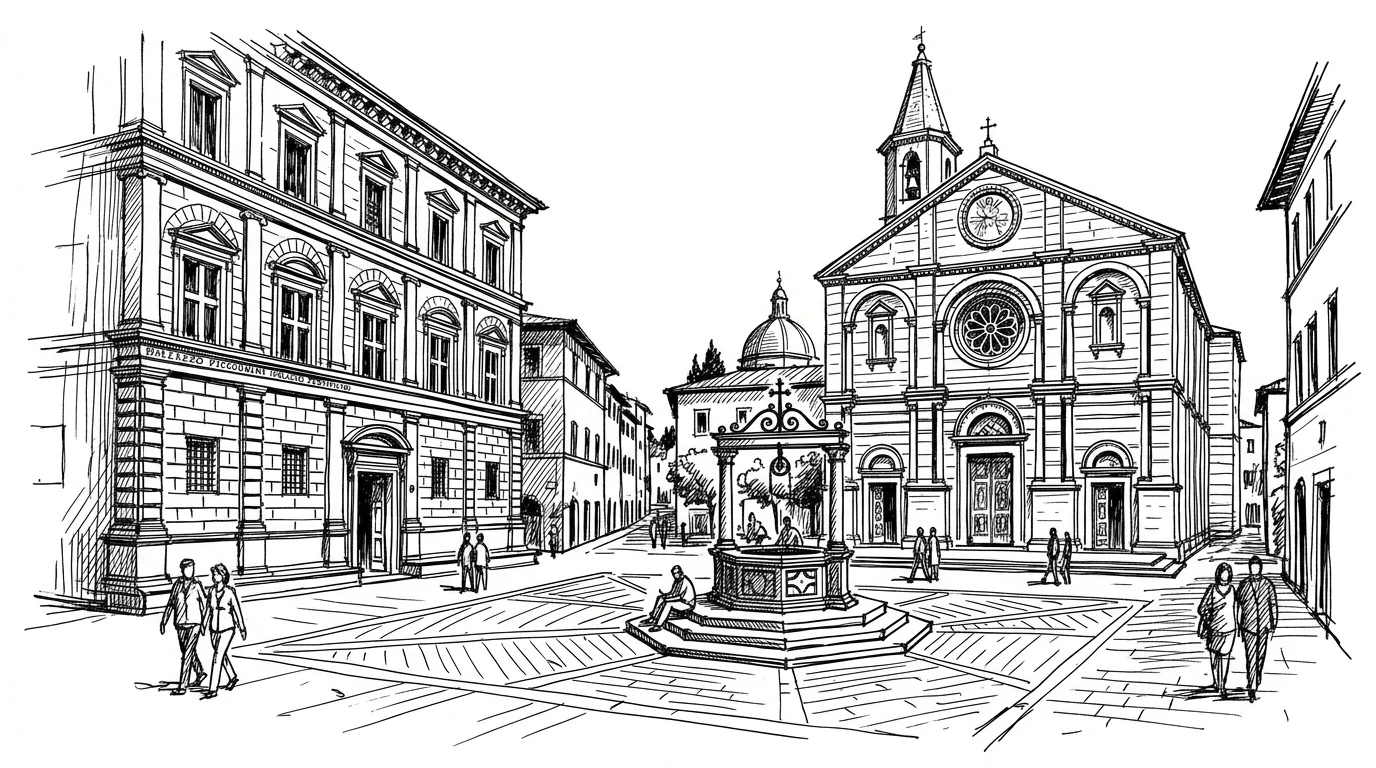
The square of Pienza is one of the first examples of urban space designed as a unified whole in the Italian Renaissance. It is neither square nor rectangular: it is slightly trapezoidal, wider toward the cathedral and narrower toward the town hall. This irregularity is intentional — Rossellino uses it to accentuate the perspective toward the cathedral and to adapt the project to the hill's topography. Renaissance "regularity" is not geometric rigidity: it is the ability to make something appear regular when it is not entirely so.
The four buildings around the square — the cathedral, Palazzo Piccolomini, Palazzo Borgia (the bishop's residence) and Palazzo Comunale — are designed as an ensemble, with coherent scale and proportions. In the Commentarii, Pius II describes his satisfaction with the result: "On every side one saw something beautiful and adorned, worthy of a pontiff." This is not modesty — but it is also a record of the fact that the patron understood exactly what he wanted and controlled the process.
Palazzo Piccolomini
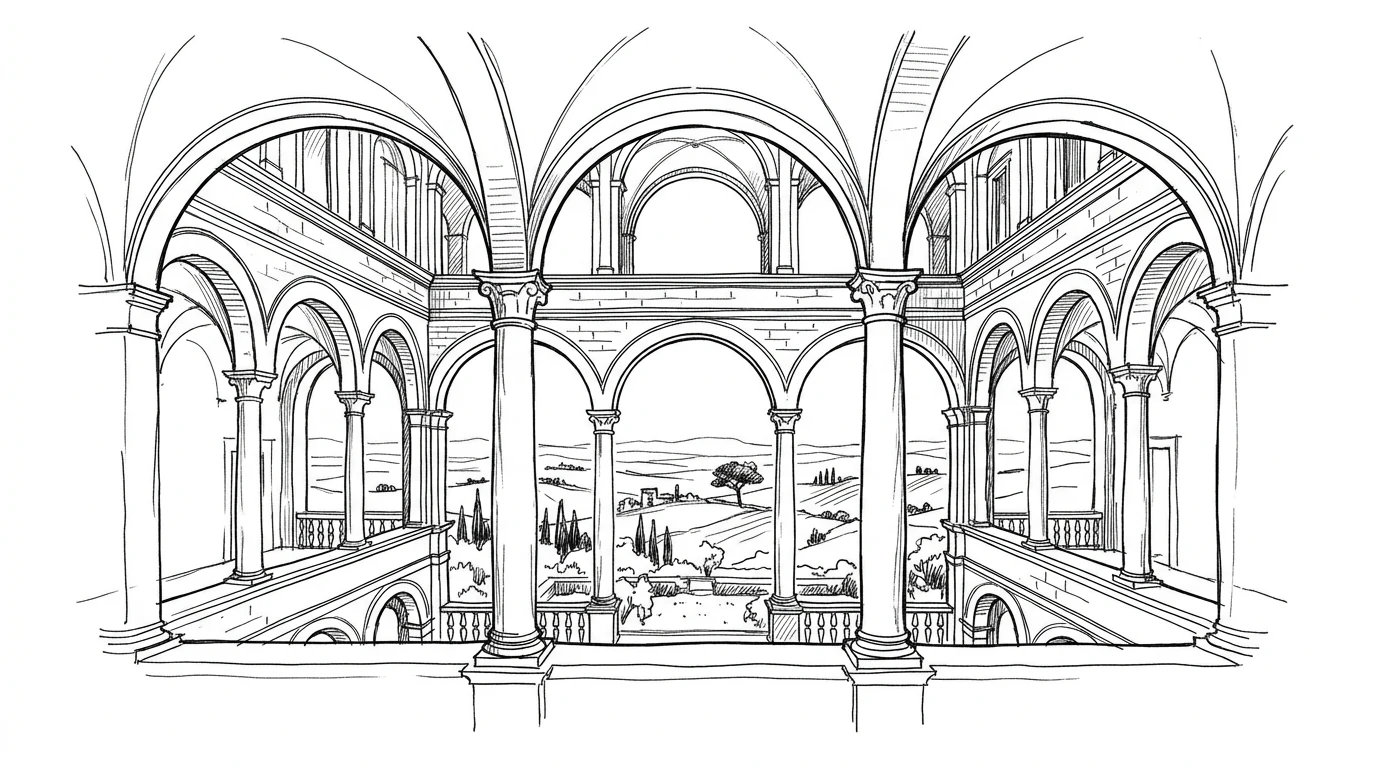
Palazzo Piccolomini, the papal residence, is the most refined part of the project. The main facade facing the square echoes Alberti's Palazzo Rucellai in Florence — pilasters marking the floors, string-course cornices, mullioned windows with arches. But the most original part is the rear: a three-story loggia that opens onto the landscape of the Val d'Orcia. It is one of the very first examples of architecture designed for the contemplation of the natural landscape — the loggia does not look onto the city or an enclosed garden, but directly onto the open countryside, onto Monte Amiata in the distance, onto the Val d'Orcia sloping away to the south.
In the Commentarii, Pius II describes this view with explicit admiration — he is a fifteenth-century pope writing about landscape like a modern humanist, with an aesthetic sensibility for nature that anticipates by two centuries the fashion for "landscape" as an artistic category. The hanging garden behind the palace — which no longer exists in its original form — was conceived as a transition between the architecture and that landscape.
The cathedral that is sinking
The cathedral of Pienza has a structural problem that Rossellino already knew about during construction: the ground it stands on is unstable — alternating clay and rock — and the rapid construction left no time for adequate settling. The cathedral floor visibly tilts toward the valley. There are cracks in the walls of the choir. Continuous restoration work from the 18th century onward has slowed but not stopped the subsidence. The ideal city of the Renaissance has a cathedral that is slowly sliding away.
Pius II died in 1464, two years after the cathedral's consecration. He did not live to see the damage. But the situation illustrates well a truth of commissioned urban planning: the speed of execution and the political will of the patron do not substitute for the time needed for foundations to settle.