Federico da Montefeltro, Duke of Urbino, is one of the most effective condottieri of the Italian Quattrocento — and one of the most self-aware architectural patrons. It is no coincidence: his wealth comes from the mercenary companies he leases to Italian and foreign princes, and that wealth is systematically invested in building the image of an ideal prince — cultured, pious, generous with the arts. The palace begun around 1468 with the architect Luciano Laurana (later continued by Francesco di Giorgio Martini) is the center of this operation.
Urbino is a mountain town in the Marche region, not a natural capital or a commercial port. It has no resources of its own comparable to those of Florence or Venice. Federico transforms it into a European intellectual center through his court: he gathers manuscripts (his library was one of the richest in Europe), commissions portraits (Piero della Francesca, Justus of Ghent), maintains intellectuals and artists, and builds a palace that is at once residence, symbol, and manifesto.
The tower façade
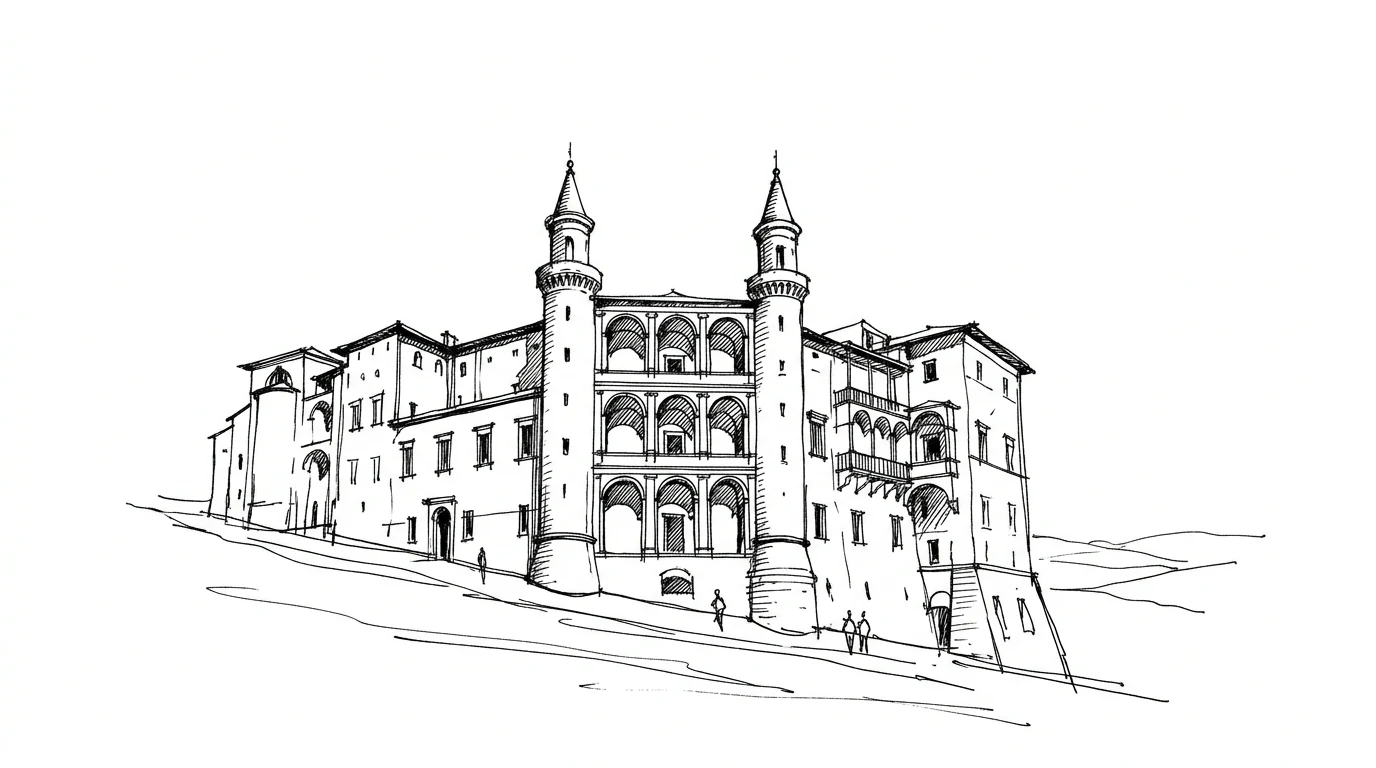
The main façade of the Ducal Palace facing the town is a wall of medieval brick. The façade on the valley side — the one with the two cylindrical towers and the three tiers of loggias between them — is one of the most sophisticated architectural compositions of the Italian Renaissance. The two towers are not defensive: they are plastic elements framing the loggias. The building, seen from the valley side, appears almost light — open, luminous, in dialogue with the landscape. From the town side, it is closed and massive. Two opposite characters for two different relationships: with the territory and with the subjects.
This double nature is a deliberate choice. Federico does not want a defensive palace — the medieval palace that already existed on the site was that. He wants a palace that is also a cultural statement, a building that communicates something precise about its patron. The tower façade communicates openness, proportion, refinement — all the qualities Federico wants to associate with his name.
The studiolo
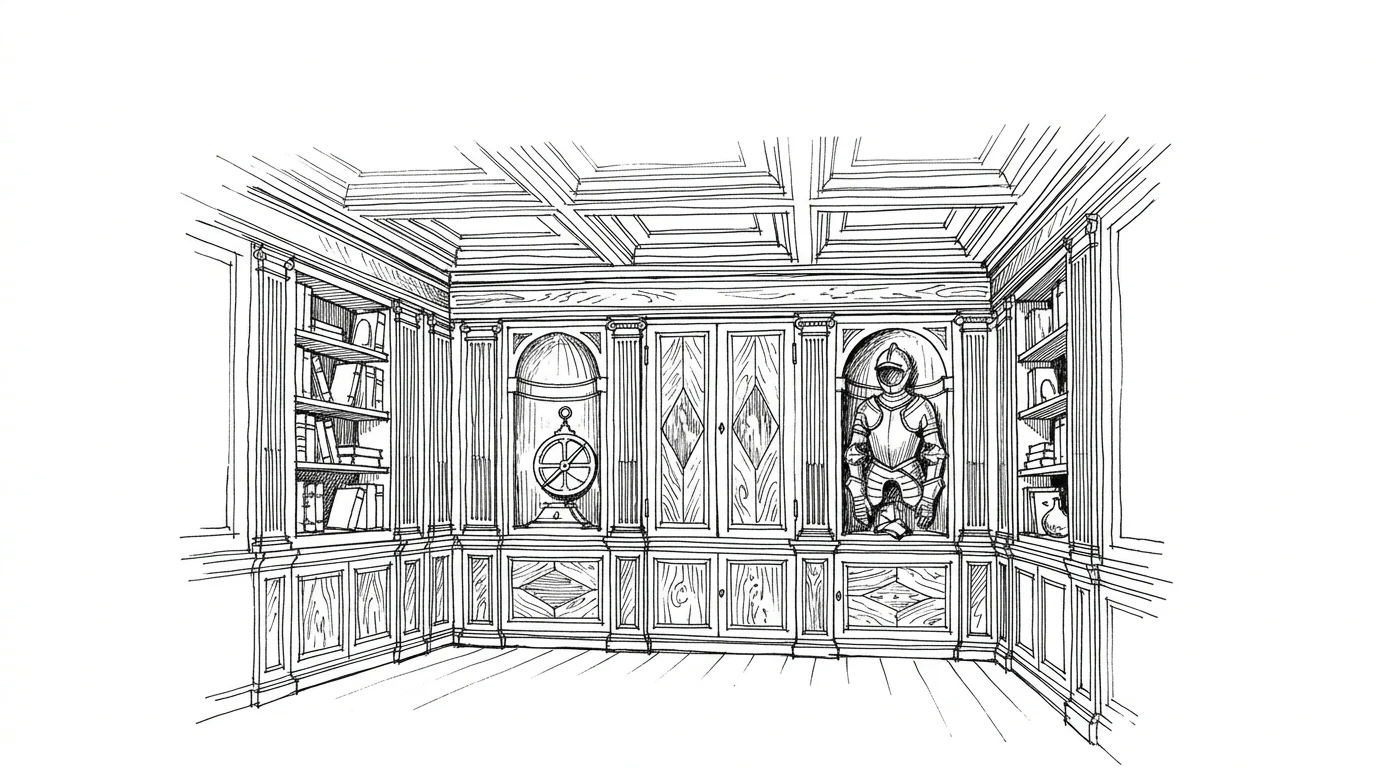
Federico da Montefeltro's studiolo is a room measuring about 3.6 × 3.7 meters in the Ducal Palace. The walls are covered with wooden intarsia — panels of different wood types and colors that simulate open shelves with books, scientific instruments, armor, and study objects. Above the intarsia, a series of painted portraits of illustrious men (now kept at the Louvre and the Uffizi). Above the portraits, the gilded coffered ceiling with Federico's portrait in the form of a coat of arms.
The studiolo is the private space of the humanist prince: the place where he withdraws to read, to reflect, to be himself away from the court. But it is not a private space in the modern sense — it is a public demonstration of his privacy. The intarsia show the instruments of culture and war together: books and armor, mathematical instruments and chivalric insignia. Federico does not choose between the humanist and the condottiero: he is both, and the studiolo states it.
Raphael and Urbino
Raphael Sanzio was born in Urbino in 1483 — thirteen years after the start of work on the Ducal Palace. His father Giovanni Santi was Federico's court painter. Raphael grew up in an environment saturated with Renaissance art at the highest level: the palace, the court, the library, the artists working there. The training he later completed in Florence and Rome did not start from zero: it started from Urbino, from an environment where artistic quality was already a norm and not an exception.
The case of Urbino illustrates how a systematic investment in architecture and culture can transform a marginal place into a landmark center. Federico could not compete with Florence or Venice in economic terms: he competed in terms of quality. He won that challenge.