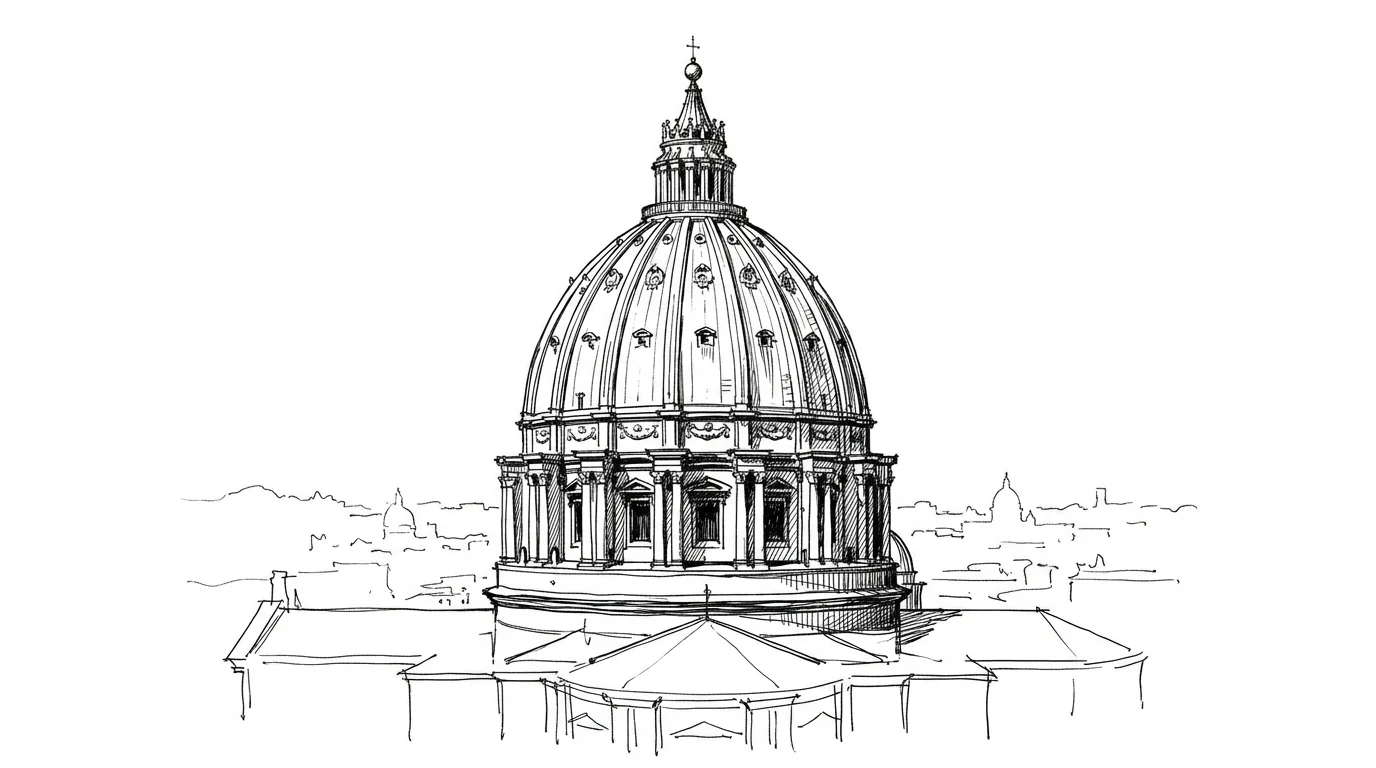
In 1546, Michelangelo is seventy-two years old and wishes to die in peace. Paul III summons him and offers him the direction of the construction site of St. Peter's, left without guidance after the death of Antonio da Sangallo the Younger. Michelangelo refuses. He has already said no to similar projects many times. The pope insists. Michelangelo accepts, on one condition: no payment. An architecture made for the soul — not for money — is the only kind worth doing at seventy-two. He will work on St. Peter's for seventeen years, until his death in 1564. He will not see the dome completed.
The problem with Michelangelo the architect is that he always comes after Michelangelo the sculptor and painter. The Sistine overshadows everything. The David overshadows everything. But Michelangelo as an architect is something specific and distinct — not simply an artist applying his sensibility to another discipline, but a thinker with a precise idea of what architecture is: a body. The walls of a building behave like the musculature of a human body — they tense, they compress, they have visible internal tensions.
The Laurentian Library: architecture that disturbs
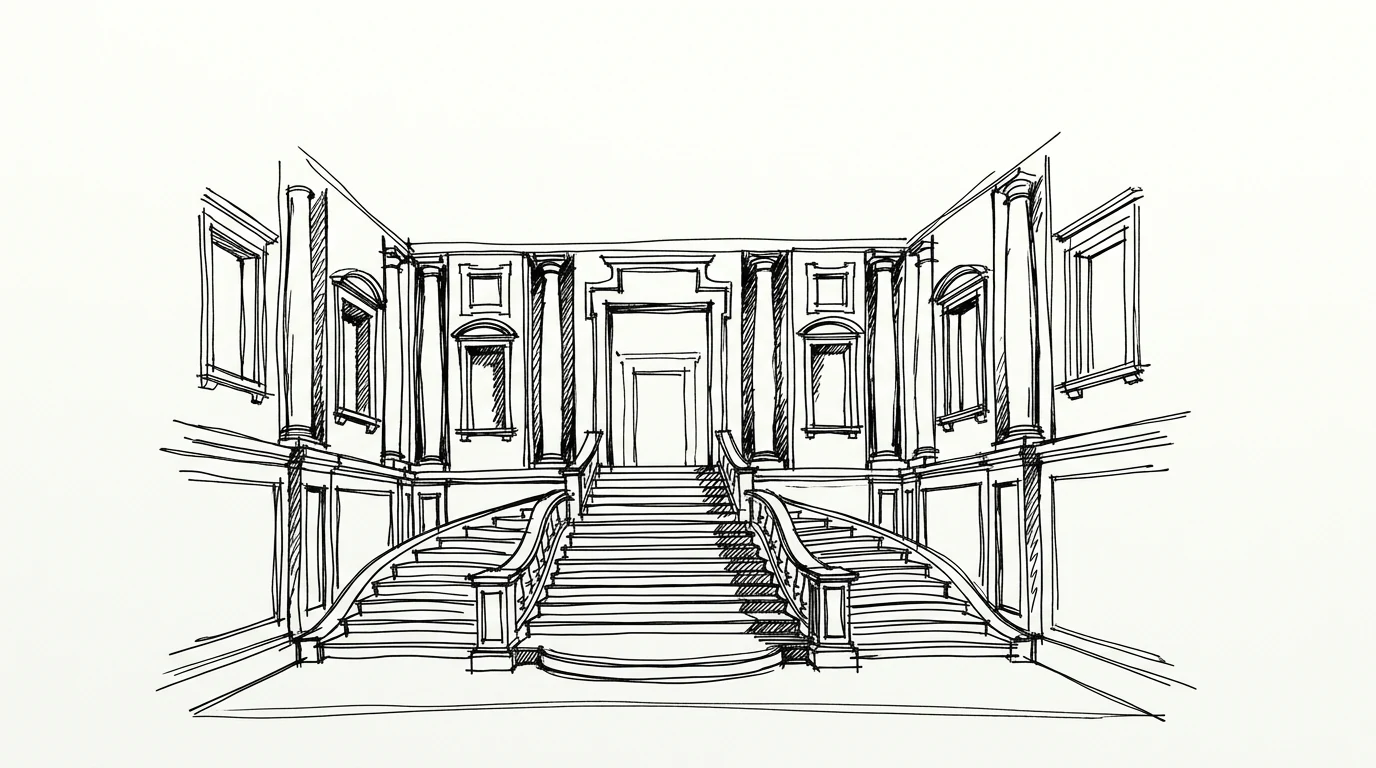
In 1524, Clement VII — a Medici — commissions Michelangelo to build the library of the convent of San Lorenzo in Florence. The result is one of the most disconcerting spaces of the Renaissance, and deliberately so. The vestibule of the Laurentian Library is a tall, narrow room, with columns that support nothing — they are recessed into the wall, decorative — and brackets beneath the columns that hold up nothing. The windows are blind — niches that look like windows but open onto nothing. The staircase descending at the center has three flights merging into one — an object that changes shape as you descend.
All this consciously violates the rules that Alberti and Bramante had codified: columns must bear weight, windows must open, staircases must have a clear direction. Michelangelo knew perfectly well the rules he was violating. He violated them to produce a precise effect: a sense of tension, of space pressing against its own limits. It is the first manifestation of what would come to be called Mannerism — architecture that uses the rules in order to break them, that cites classical language in order to subvert its meanings.
The Campidoglio: the oval space
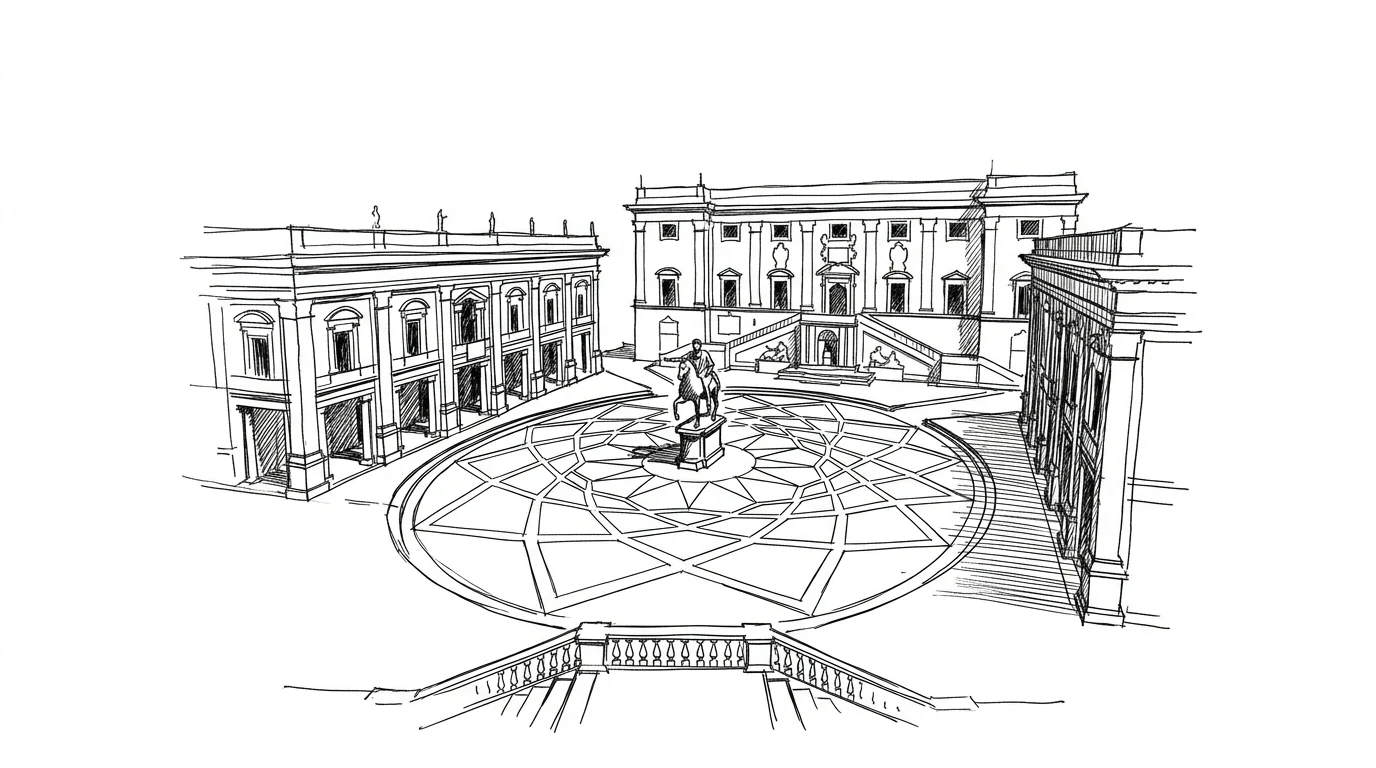
In 1536, Paul III asks Michelangelo to arrange the piazza of the Campidoglio — the symbolic hill of Rome, then in a state of neglect. Michelangelo's design is radical: an oval piazza, with the equestrian statue of Marcus Aurelius at its center, flanked by two palaces set at a slight opening toward the city (not at a right angle, but at roughly 80 degrees), and a third building closing the back — the Palazzo Senatorio. Access is via a ramped staircase — the cordonata — passable even on horseback.
The oval piazza is revolutionary: until then, Renaissance piazzas were rectangular, based on the orthogonal grid. An oval has no privileged axes: it orients the gaze toward the center without imposing a direction. The paving — designed with a geometric pattern converging toward the center, where the statue stands — amplifies this effect. It is designed to be seen from above, like a drawing on the ground, more than as a space to walk through. Michelangelo never saw the result: the piazza was completed only in the 17th century, with modifications.
The dome of St. Peter's
Michelangelo takes the design for St. Peter's and simplifies it: he eliminates the bell towers, reduces the number of bays, and emphasizes the central dome until it becomes the absolute focus of the building. The dome he designs is hemispherical, not a shallow profile like that of the Pantheon — more similar to Brunelleschi's dome, which Michelangelo knew well, but larger: 42 meters internal diameter against the Pantheon's 43.44 and Santa Maria del Fiore's 41.5.
The crucial difference from Brunelleschi is structural: the dome of St. Peter's is supported by a drum with windows — a solution Brunelleschi had avoided for fear of the lateral thrust the openings would weaken it with. Michelangelo solves the problem with much more massive ribs and with internal circular metal chains that hold the dome together like a barrel. When Giacomo della Porta completes it in 1590, he modifies the profile making it more pointed — the dome we see today is slightly different from Michelangelo's, but the basic structure is his.
The architect who would not bend
During the seventeen years of the St. Peter's construction site, Michelangelo systematically refused every compromise proposed to him. He had parts built by his predecessors demolished when they did not match his design. He quarreled with the building administrators, with patrons, with subcontractors. He wrote indignant letters whenever he found that something had been changed without his consent. At eighty years old, in Rome, in winter, he still climbed the scaffolding.
Which is exactly the opposite of what one believes about a great Renaissance master. The image is that of the divine, inspired artist, above material contingencies. The reality is that of a scrupulous old man who checks every detail because he knows that if he doesn't check it himself, someone will get it wrong. It is not myth — it is craft taken to the extreme.