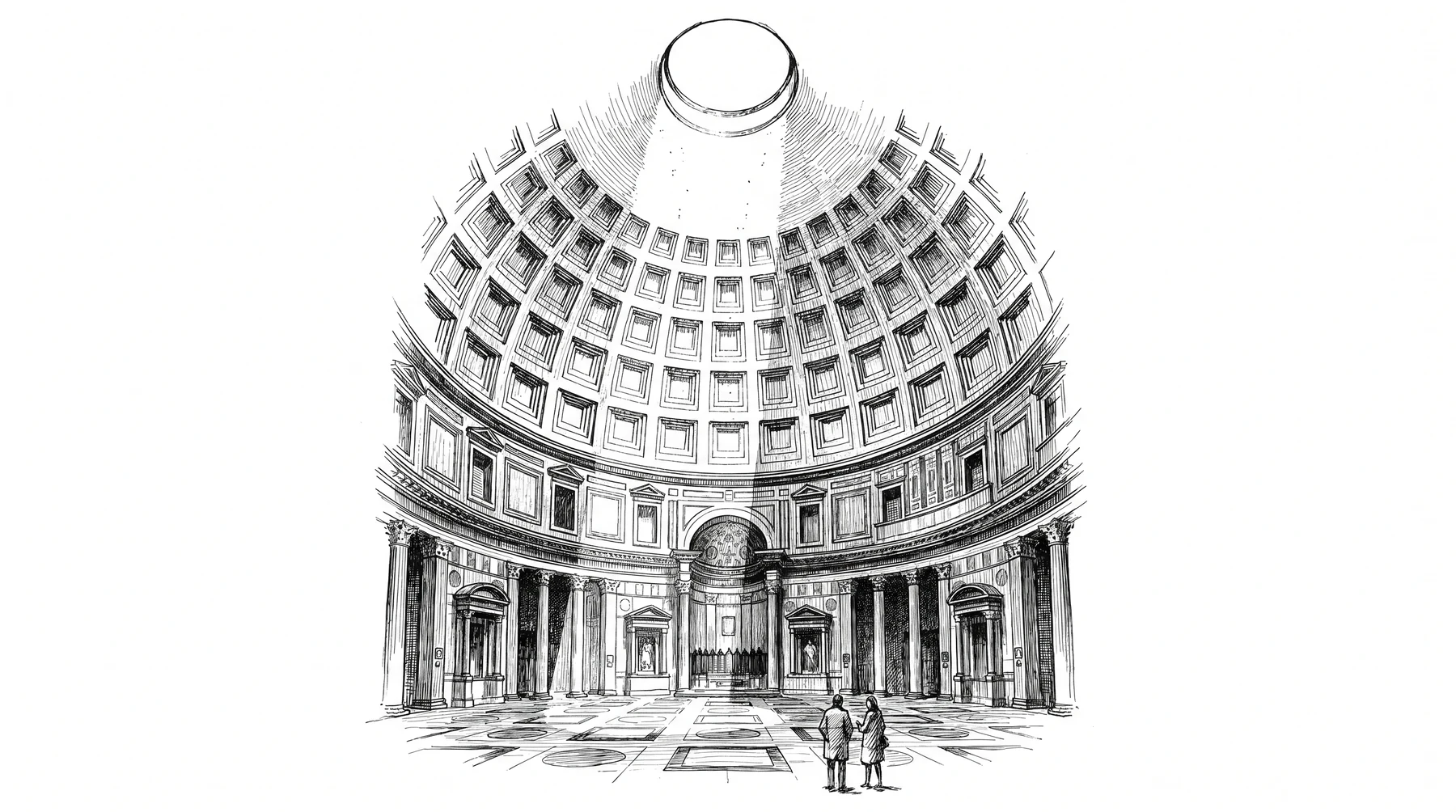
There is a moment, entering the Pantheon, when you stop looking and start feeling. It is not immediate. The outer portico prepares you for something ordinary — columns, pediment, inscription: the usual grammar of the Roman temple. Then you enter, and the space annuls you. Not because it is enormous — the Colosseum is far bigger. It is because it is <em>right</em> in a way almost no other building in history has managed to be.
What you are perceiving, even without knowing it, is a proportion: the dome has exactly the same diameter as the total interior height. Forty-three metres and forty-four centimetres in every direction. You can draw a perfect sphere inside the Pantheon — it would touch the floor, touch the oculus at the top, touch the walls all around without grazing anything. It is a geometry the body perceives before the mind can analyse it. Hadrian knew this. His architects knew it. And this awareness was a precise message: you are inside something absolute.
The first lie: the inscription
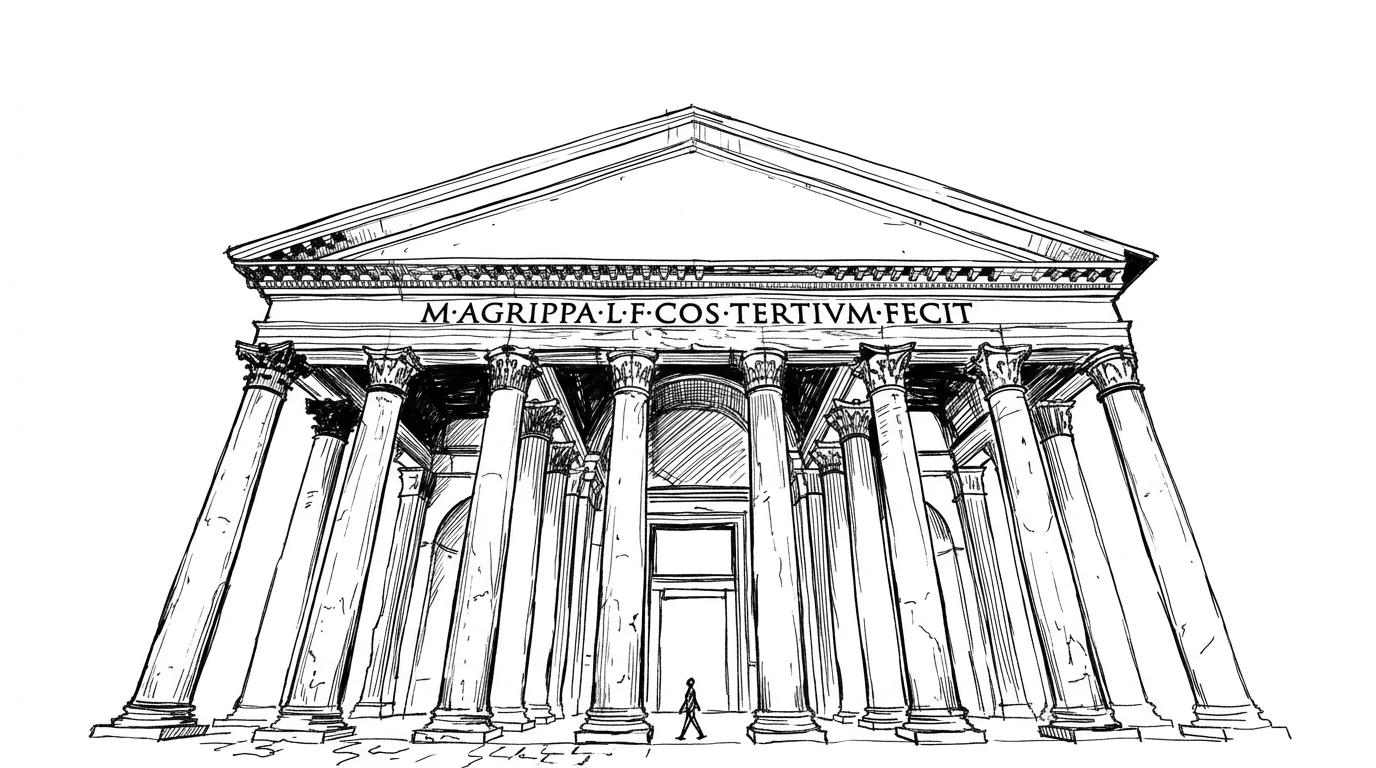
The Pantheon we see today is not Agrippa's Pantheon. The inscription on the pediment reads <em>M. Agrippa L.f. cos. tertium fecit</em> — Marcus Agrippa, son of Lucius, consul for the third time, built this. It is false. Not in an absolute sense: Agrippa did build a Pantheon on that site in 27 BC, but what we are looking at is a building constructed by Hadrian between 118 and 125 AD, almost a hundred and fifty years later. Hadrian kept the inscription out of deference, or as political strategy — attributing the authorship to Agrippa, a friend of Augustus, was a way of placing himself within the Augustan imperial tradition without seeming presumptuous.
Which is already interesting: the most perfect monument of Roman architecture carries the name of the man who did not build it, by the will of the man who did build it. Hadrian was like that — an emperor who built enormous works and did not sign them. His name appears on none of the most important buildings of his reign. He was convinced that greatness was proven through the work, not through the attribution.
The portico that does not add up
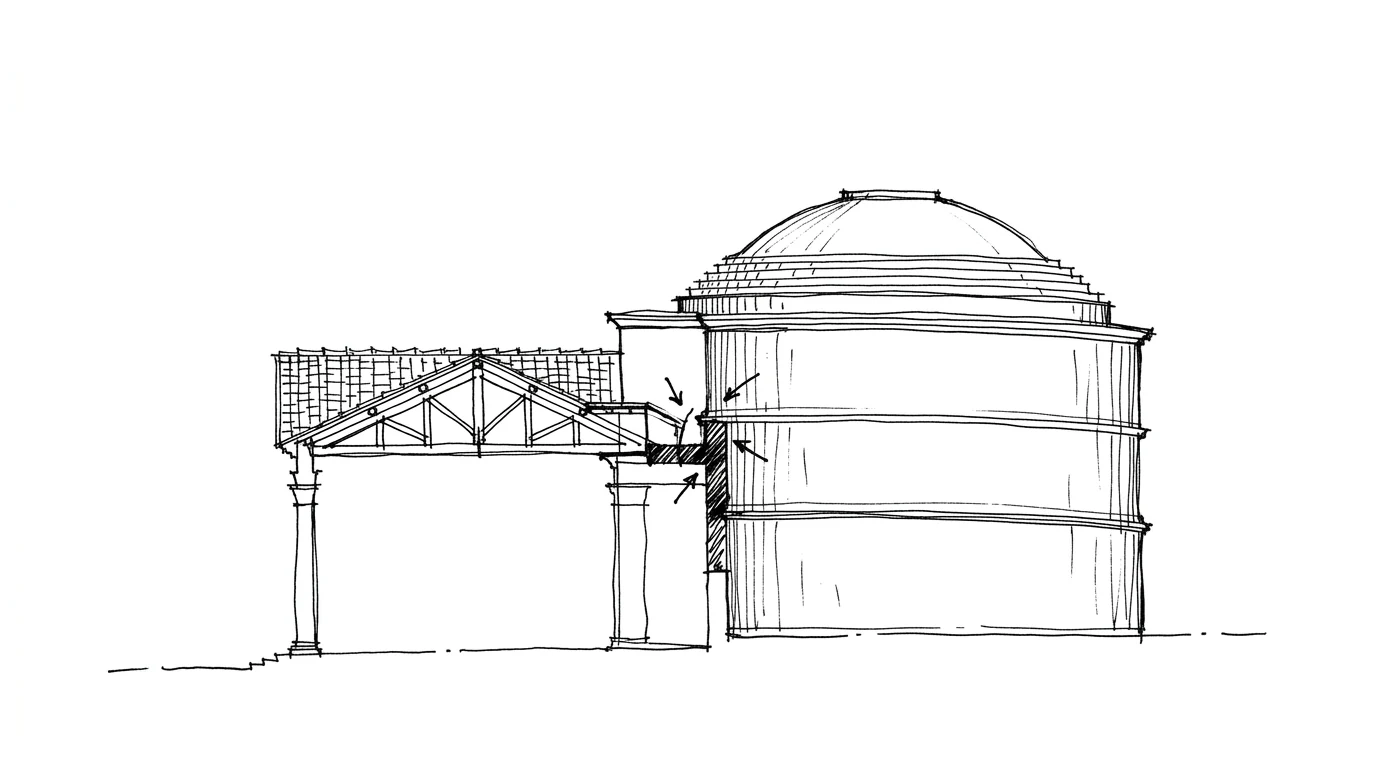
If you enter from the main front and look up, the pediment will seem slightly squashed to you — the columns too tall relative to the entablature. You are right: the proportions are deliberately altered. Agrippa's original portico was connected to a wider building, with taller columns. When Hadrian rebuilt the rotunda, the pediment-rotunda combination created a misalignment. The solution was to lower the pediment slightly. So the portico looks integrated while it is, structurally, an addition that does not quite match.
There is also a scale problem that is often overlooked. The portico's columns are Egyptian granite — forty tonnes each, carried from the Nile to the Tiber by ship. Hadrian had ordered forty-eight, but only forty arrived, and two broke during transport. The original design called for a deeper portico, with two rows of columns instead of one. What we see is a reduced version, adapted to the columns available. The Pantheon's perfection has a history of logistical compromises that is rarely told.
The concrete that knows what to do
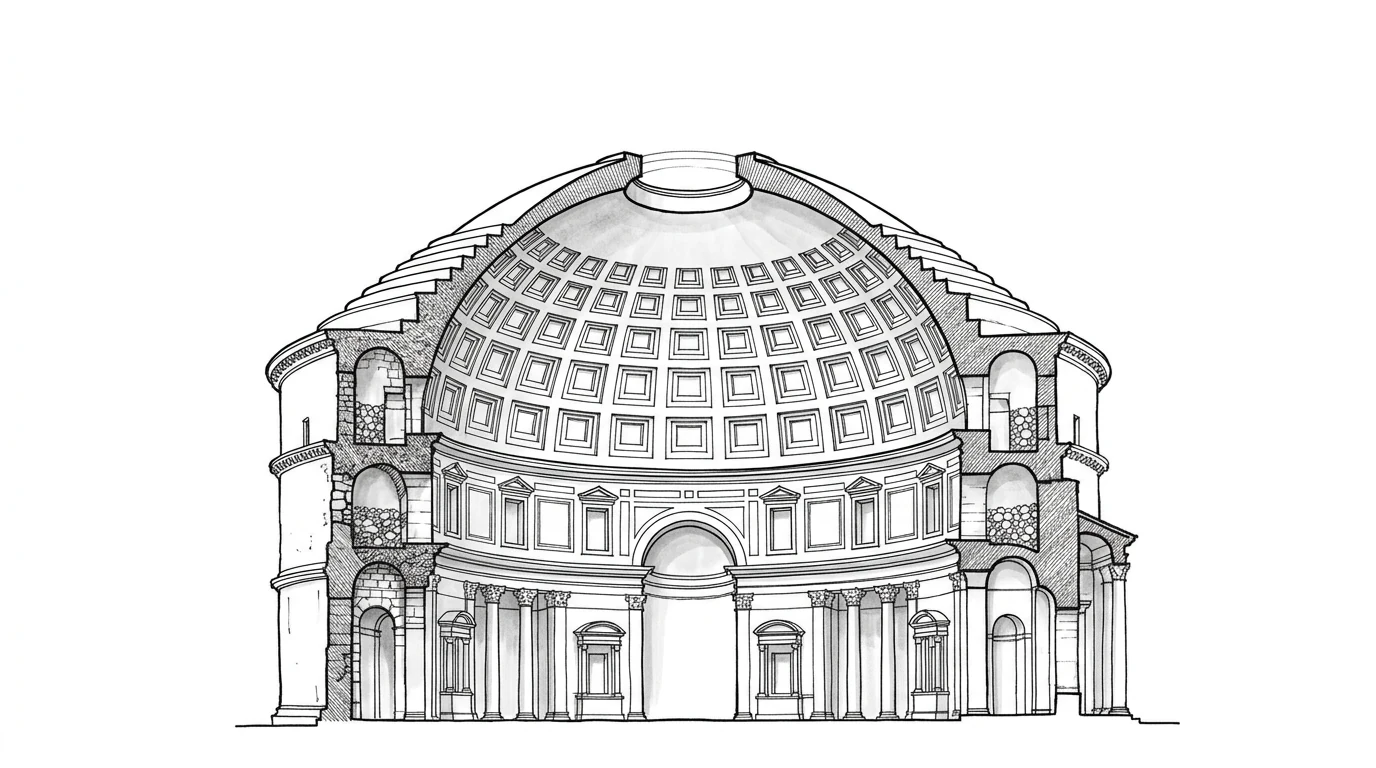
The Pantheon's dome is the largest unreinforced concrete structure of the ancient world — and for many centuries the largest of all. It has a diameter of 43.44 metres. St Peter's dome, built fourteen centuries later, measures 41.47 metres. The Pantheon is wider.
How does it hold up? The answer lies in the concrete, and in how it is used. Hadrian's architects knew something materials science only rediscovered in the twentieth century: concrete can be lightened by varying the aggregates. At the base of the dome, where the weight is greatest, they used travertine and tufa — dense stones. As the dome rises, the aggregates become lighter: volcanic pumice, then pumice alone. At the oculus, the thickness is 1.20 metres and the material is almost compacted air.
There is a second system: the coffers. The twenty-eight rows of recessed panels decorating the interior of the dome are not mere geometric ornaments. Each coffer subtracts mass from the shell without reducing its structural strength. Each coffer reduces the weight by about five tonnes. Added together: roughly 140 tonnes less than a smooth shell. It is not decoration applied to the structure: it is the structure becoming decoration.
The oculus and the light
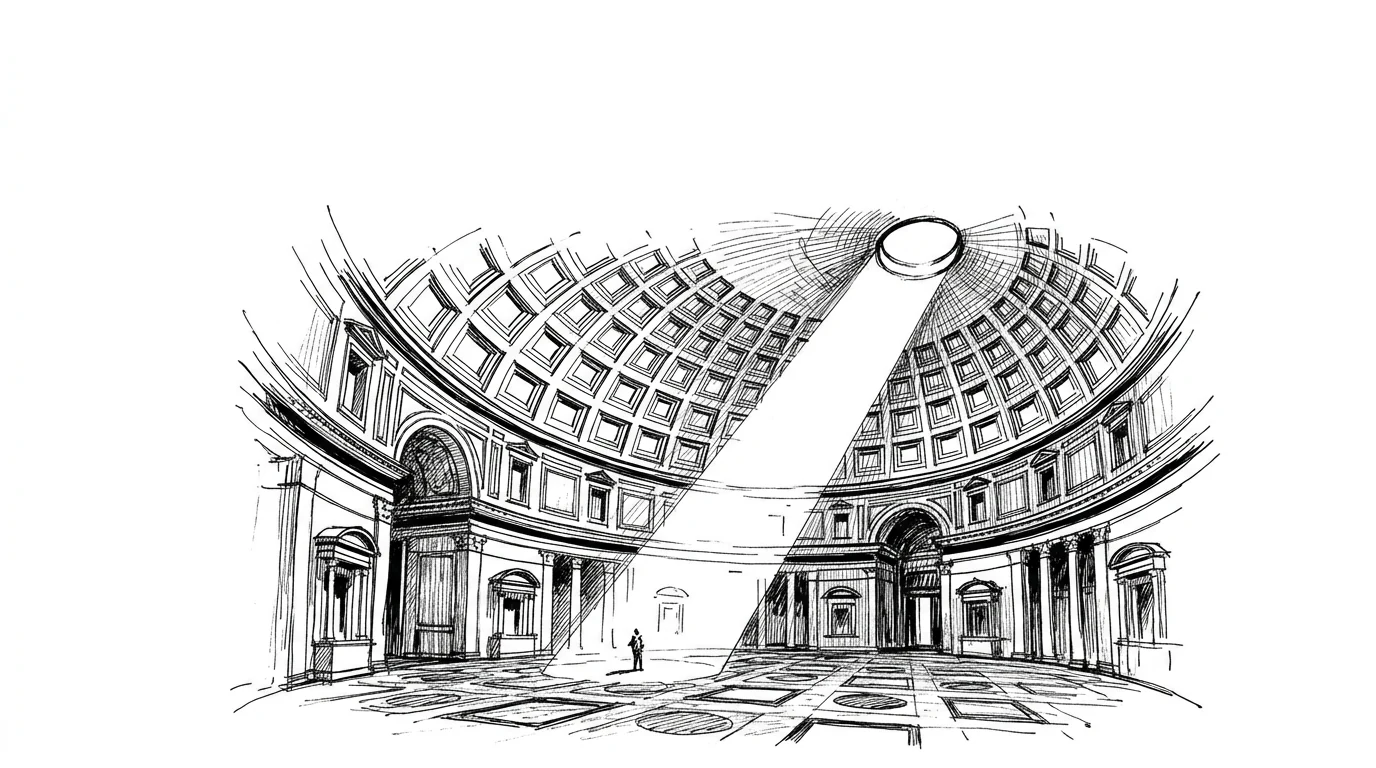
The oculus — the circular opening 8.92 metres in diameter at the apex of the dome — is the building's only source of light. When it rains, water comes in. The floor has a hidden drainage system that collects it. This is not a design flaw: it is a choice. The oculus puts the interior of the temple in direct contact with the sky.
The beam of light the oculus casts onto the interior of the Pantheon moves through the day like a sundial 43 metres in diameter. At the spring equinox, at noon, the beam of light illuminates the entrance of the portico directly. On the founding date of the Roman Empire, 21 April, the same beam illuminates a precise point of the rotunda. These are not chance effects. The Pantheon's orientation was calculated to produce these alignments. The temple also functioned as an astronomical-calendrical instrument, one of the ways Rome made visible its relationship with the cosmos and with time.
Why it survived
The Pantheon is Rome's best-preserved ancient building. The reason is not structural — it is religious. In 609 AD, Pope Boniface IV transformed it into a Christian church, dedicated to Santa Maria dei Martiri. From that moment, destroying the Pantheon meant desecrating a church. The building's Christianisation was its safe passage through the Middle Ages.
Not that the Christian centuries were gentle. Constans II in 663 carried off the gilded bronze roof tiles of the portico's covering. Urban VIII in 1625-1626 had the portico's bronze beams dismantled to make the cannons of Castel Sant'Angelo and the baldachin of St Peter's — hence the quip attributed to Pasquino: <em>Quod non fecerunt barbari, fecerunt Barberini</em>. What the barbarians did not do, the Barberini did (Urban VIII's family).
Yet the fundamental structure is intact. The dome you see today is the same one seen by Michelangelo, Brunelleschi, Bramante — all the Renaissance architects who came to Rome to study it. Brunelleschi, before understanding how to build the dome of Santa Maria del Fiore, came to the Pantheon with Donatello. He had no paper. He measured with his hands and memorised.
What comes after
The Pantheon poses a problem for every architect who comes after: how do you surpass a perfection that is also unrepeatable? The conditions that allowed it to be built — an imperial state machine with unlimited resources, workers specialised in construction techniques now lost, a patron willing to wait years — have never been recreated.
Brunelleschi does not copy the Pantheon: he studies it to understand the principle, then applies it differently. Michelangelo says the dome of St Peter's will be "bigger but not more beautiful". It is a surrender. It is a man who looked at 43.44 metres of geometric perfection and understood that direct comparison is a lost war. The intelligent response is not to imitate — it is to do something different with the same quality of thought.
Which is exactly the opposite of what is commonly believed. It is believed the Renaissance copied antiquity. In reality, the great Renaissance architects studied antiquity to understand <em>how to think</em>, not to copy <em>what to do</em>. And the Pantheon is the place where this kind of study always begins.