If you ask a tourist visiting the Parthenon why those columns look so right — so inevitably right, as if they could not have been otherwise — they will almost certainly answer with the word "proportion." And they will be right, but in the wrong way. They will mean proportion as beauty. The Greeks meant proportion as structure.
The architectural orders were not invented as an aesthetic system. They were developed as a constructive system — a set of proportional rules establishing the relationship between the parts of a building based on how those parts hold each other up. The fluting on a column is not ornament: it reduces the visual weight of the shaft and manages the play of light that helps the eye perceive the cylindrical form. The capital is not a decorative addition on top of the column: it is the structural transition between the vertical element (the column) and the horizontal element (the architrave). Every part has a reason that precedes and justifies the aesthetics.
Understanding this changes the way we look at two thousand years of Western architecture. The orders were not "quoted" by architects of the past because they were beautiful. They were used because they were a shared, precise, and — not a trivial point — proven language.
The Doric: the oldest, the most difficult
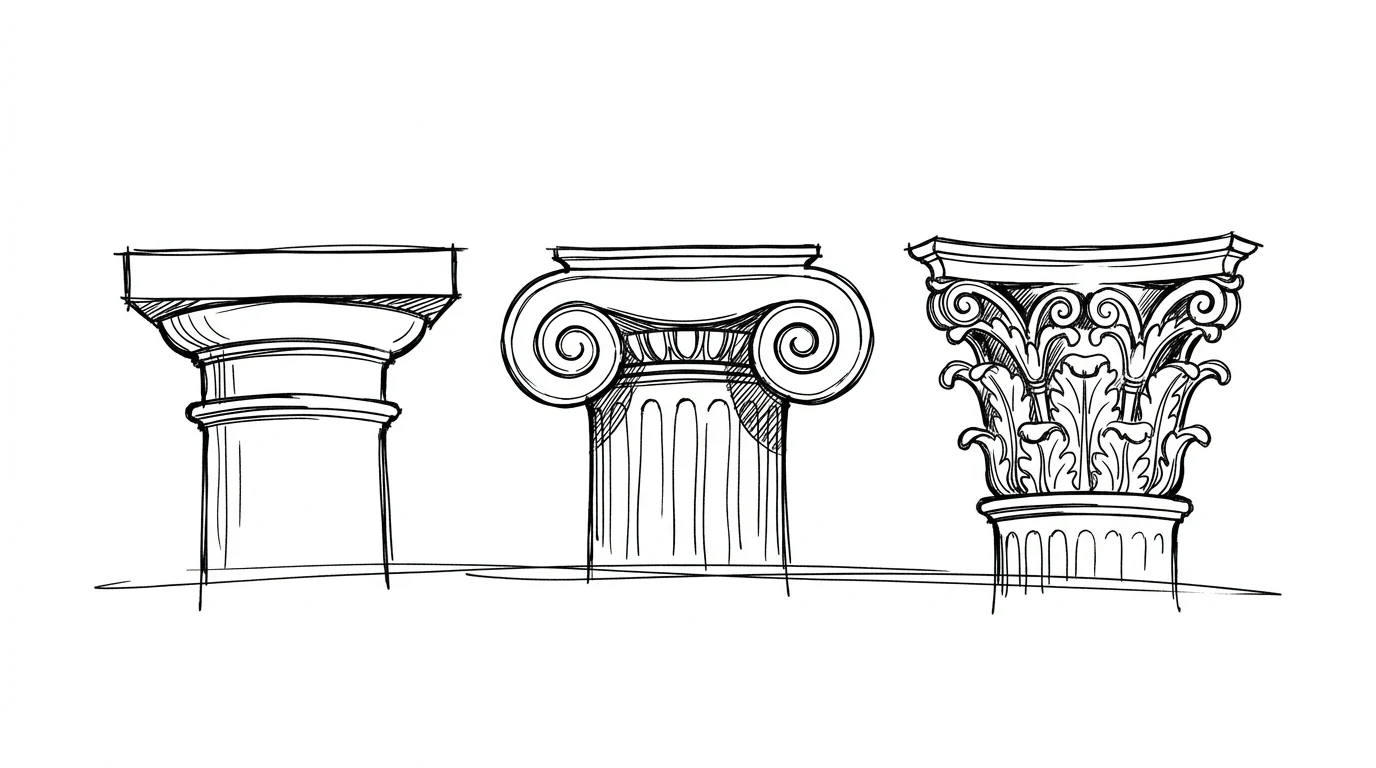
The Doric order is the oldest of the three Greek orders and, in a very precise sense, the most difficult. Not difficult to build — difficult to use well. It has no bases beneath the columns: the shaft rises directly from the stylobate, the upper step of the temple. The capital is essential: an echinus (a kind of curved-profile cushion) and an abacus (a square slab) with no ornament at all. The entablature above the columns is divided into triglyphs — blocks with three vertical grooves — and metopes, smooth or carved panels.
Il problema del dorico si chiama angolo del triglifo. Le regole del sistema stabiliscono che i triglifi debbano essere centrati sulle colonne e sugli intercolunni. Ma all'angolo dell'edificio, queste due regole entrano in conflitto: il triglifo d'angolo deve essere all'estremo del fregio, ma se è centrato sulla colonna d'angolo, lascia una metopa angolare più stretta delle altre. I Greci non trovarono mai una soluzione teorica soddisfacente. La risolsero empiricamente, aggiustando le spaziature. Il Partenone, che è il tempio dorico più studiato, ha intercolunni leggermente più stretti agli angoli esattamente per questa ragione.
This unresolvable imperfection is one of the reasons the Doric is considered the strictest and most "masculine" of the orders — a characterization going back to Vitruvius that would become canon in the Renaissance. But it is also why using it well requires deep knowledge: every Doric building is a slightly different proportional problem.
The Ionic: the column that lies about its age
The Ionic is the order of the Aegean coast — of Asia Minor, of the islands, of Athens when it wants to appear refined rather than serious. It has a base, which the Doric lacks. The shaft is more slender — the height-to-diameter ratio rises from about 1:6 in the Doric to about 1:8 or 1:9 in the Ionic. And it has the capital with volutes: two lateral spirals that in the frontal view look perfectly symmetrical, but that on the corner sides create a problem similar to the Doric triglyph's: how do you turn the corner with a capital that has two identical faces? The solution of the corner Ionic — the capital with four equal volutes — is elegant but not entirely convincing.
The Ionic is often described as "feminine" in opposition to the "masculine" Doric — a classification Vitruvius explains by claiming its proportions resemble those of a woman, the base like a shoe, the volutes like hair. It is the kind of analogy that would make people roll their eyes today, but it structured European architectural thought for two thousand years. What matters, beyond the metaphor, is the proportional relationship: the Ionic is slimmer, visually lighter, building a sense of elegance where the Doric builds a sense of solidity.
The Corinthian: the most successful lie in architectural history
The Corinthian is the order you know best even if you don't realize it, because it is the one Rome exported across the whole Empire, that the Renaissance revived, that the Baroque pushed to extremes, and that Neoclassicism brought back into circulation. Its capital — a basket of acanthus leaves from which volutes emerge — is the most reproduced architectural element in history.
Vitruvius tells its origin as a legend: a Corinthian sculptor named Callimachus supposedly saw on a young girl's tomb a basket holding her toys, covered by a roof tile, with acanthus leaves grown up around it in spring. He is said to have drawn the capital from this image. It is a beautiful story and almost certainly invented. What we do know is that the Corinthian first appears in the 5th century BC, and that for its first two centuries it was used almost exclusively inside buildings — the Tholos at Epidaurus, for instance — not on exteriors. As if the Greeks considered it too ornamental for public use.
It is the Romans who bring it to the exterior and make it the order of imperial grandeur. The Pantheon, the Colosseum (on its third level), the Temple of Mars Ultor in the Forum of Augustus: when Rome wants to declare power, it uses the Corinthian. Not because it is the most structural — it is the least rational of the three, the most "applied." But because its visual richness translates, in common perception, into magnificence. The lie works.
Rome adds two orders. And lies about why.
The Greek system of three orders — Doric, Ionic, Corinthian — becomes a Roman system of five with the addition of the Tuscan and the Composite. The Tuscan is a simplified Doric: slimmer, with a base, without triglyphs in the frieze, without fluting on the shaft. The Composite is the Corinthian with Ionic volutes added to the capital: two orders in one, the maximum possible complexity.
La codifica esplicita dei cinque ordini avverrà solo nel Rinascimento, con Sebastiano Serlio nel 1537. Ma è Vitruvio, nel I secolo a.C., a fissare il sistema greco e a preparare il terreno. Il suo De Architectura — l'unico trattato architettonico antico sopravvissuto — è la fonte da cui tutta la teoria rinascimentale attinge. Il problema è che Vitruvio è spesso oscuro, a tratti contraddittorio, e scrive di edifici che non esistono più. Brunelleschi, Alberti, Palladio lo leggono tutti, ma lo integrano con quello che vedono nelle rovine. La teoria e la pratica non coincidono mai perfettamente. Ed è da quel margine che nasce tutta l'architettura rinascimentale.
Entasis: the column that lies to the eye
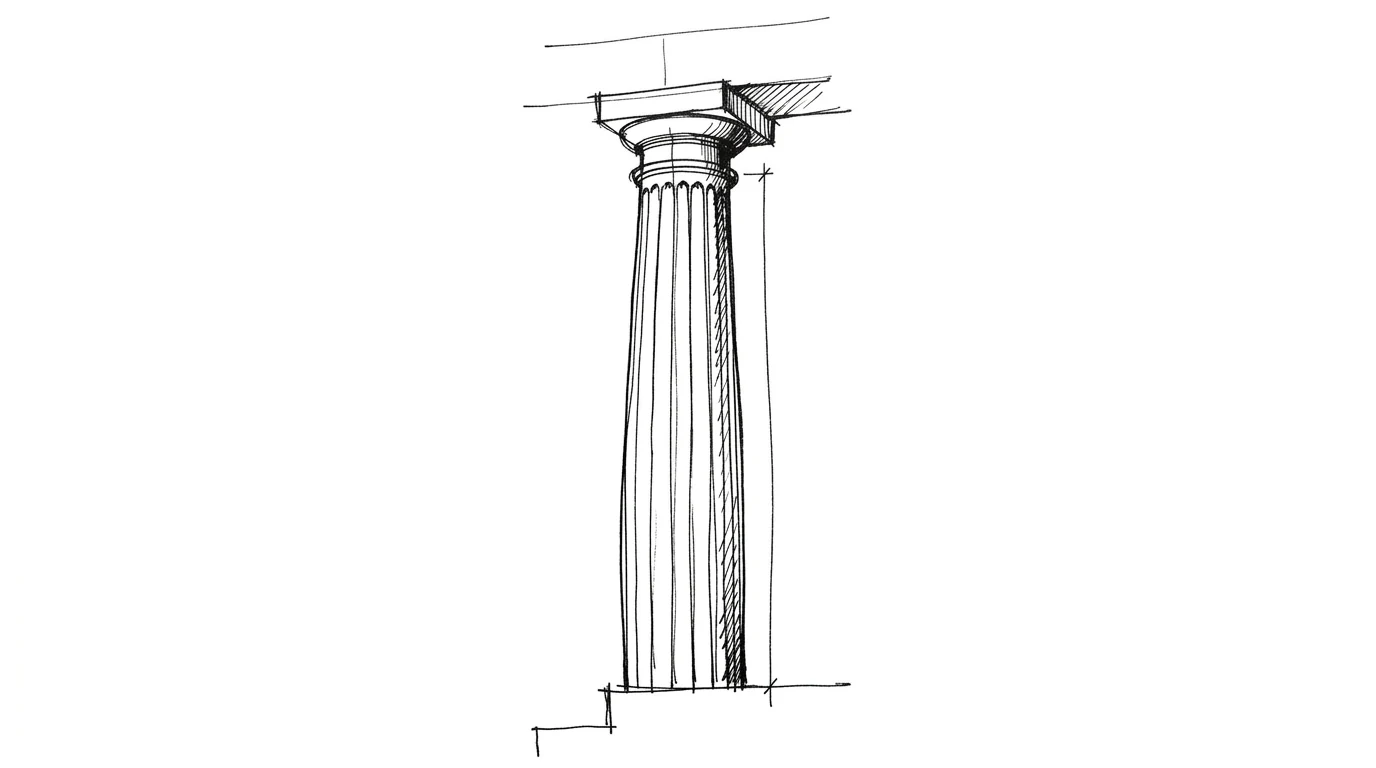
Il fusto della colonna dorica e ionica non è un cilindro perfetto. Ha una leggera convessità nella parte mediana — si chiama entasi, dal greco "tensione". Se si costruisse una colonna perfettamente cilindrica, l'occhio umano la percepirebbe come leggermente concava al centro, più stretta di quanto non sia. L'entasi corregge questa distorsione percettiva producendo artificialmente la percezione di una linea dritta.
It is not the only optical correction in Greek architecture. The stylobate of the Parthenon is not flat: it curves upward by about 6 centimeters at the center on the short facades and about 11 centimeters on the long ones. The columns are not vertical: they lean slightly inward — if extended upward, they would meet at a height of about 2.4 kilometers. The corner columns have a larger diameter than the others because, seen against the light, they appear thinner. The frieze tilts slightly outward at the top so it can be read better from below.
All these corrections produce a building that looks geometrically perfect precisely because it is not. It is a system of coordinated lies, calculated with a precision that has no equivalent in pre-modern architecture. And none of these devices is visible to the naked eye: they can be measured, not seen. The result is that the Parthenon looks "right" to anyone who looks at it, architect or tourist, because the corrective system works exactly beneath the threshold of conscious perception.
Why the orders are still relevant
Nel 1923 Le Corbusier pubblica Vers une Architecture e dichiara, tra le altre cose, che la colonna greca è morta. Che il cemento armato e l'acciaio hanno reso obsoleto qualunque sistema proporzionale basato sulla colonna portante in pietra. Ha ragione tecnicamente. Ha torto storicamente.
The orders are not relevant because we still use them — we don't, except in neoclassical banks and the government buildings of certain regimes that like to appear eternal. They are relevant because the problem they solve — how to build a system of proportions the eye perceives as harmonious — has not been solved better by any other system. Le Corbusier's Modulor (1948) is an attempt to do the same thing with measurements based on the human body. Modernism's modular grids are another attempt. None of these systems has produced the same visual coherence at large scale.
This does not mean we must return to Corinthian columns. It means that every time an architect decides how the parts of a building should relate to one another — how much window, how much wall, how much projection, how much rhythm — they are answering the same problem to which the Greeks of the 5th century BC gave the most enduring answer architectural history remembers.