Rome, 1633. On Via del Quirinale, Gian Lorenzo Bernini is designing the church of Sant'Andrea al Quirinale. A few hundred meters away, on that same Via del Quirinale, Francesco Borromini has just received the commission for San Carlo alle Quattro Fontane. Same street, same cramped lot dimensions, same ecclesiastical patronage, same need to do something great with little space.
What they will produce has nothing in common. It is as if they had lived in different eras.
Who they were, before becoming enemies
Gian Lorenzo Bernini is born in Naples in 1598 to a sculptor father. By age ten he is already in Rome, and at eleven he carves his first work for Cardinal Scipione Borghese. He is a child prodigy in an environment — papal Rome of the early seventeenth century — that loves child prodigies and knows what to do with them. By twenty-six he is already the city's leading sculptor. At thirty-three he receives the commission for the baldachin of St. Peter's, the most important work in the most important basilica of the Christian world. He has not yet built anything significant as an architect. It does not matter: in Rome, visible talent is rewarded even before it has been verified.
Francesco Borromini is born in Bissone, in Canton Ticino, in 1599 — one year after Bernini. He arrives in Rome at fifteen as an apprentice stonecutter, much as Palladio had arrived in Vicenza. He works for Maderno on the fabric of St. Peter's. Then, for eleven years, he works under Bernini as a draftsman and technical collaborator. Eleven years drawing the details of someone else's ideas, seeing his own name appear on no work. It is the kind of training that produces either a docile executor or an unmatched creative fury.
In 1634, when he finally receives the commission for San Carlo alle Quattro Fontane — his first entirely own work — Borromini is thirty-five years old, with fifteen years of accumulated anger.
Two methods, one same city
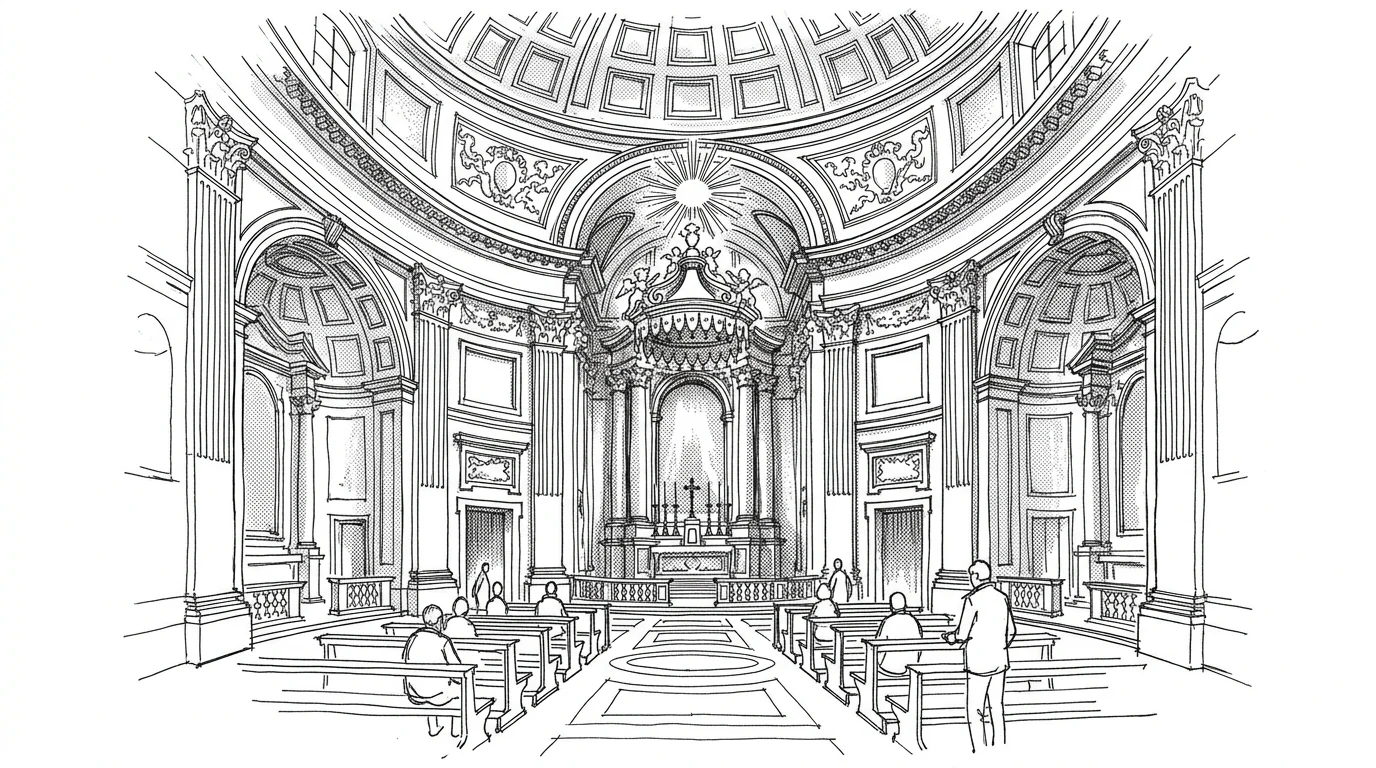
To understand the difference between the two, one must stand in front of two buildings. The first is Bernini's Sant'Andrea al Quirinale (1658–1671). The plan is an ellipse with its major axis running crosswise to the entrance — you don't enter into the church's depth, you enter into its width. The altar is on the short side, facing the entrance. Everything opens toward you. The space is theatrical in the literal sense: there is a stalls area (the nave), a stage (the presbytery), and a backdrop (the apse with the glory of Sant'Andrea). Bernini built a theater whose protagonist is God — or rather, the story of a God who wants the Church.
The second building is Borromini's San Carlo alle Quattro Fontane (1634–1668). The plan is an oval, but not a simple oval — it is an oval built through the interpenetration of two equilateral triangles inscribable in a circle, a figure Borromini derived from his research on Platonic polyhedra. No visitor to the church can read its plan intuitively. The space does not offer itself: it envelops you, orients you upward, makes you feel inside something you cannot measure at a glance.
Bernini builds narrative space. Borromini builds mathematical space. Bernini wants you to understand. Borromini wants you to feel something you cannot explain.
The rivalry: what they said about each other
Contemporary accounts of this relationship are partial and often secondhand, but consistent enough to give a picture. Bernini considered Borromini a dangerous innovator who "corrupted" architecture with eccentric geometries. He said, according to Baldinucci, that Borromini had come into the world "to ruin architecture." This is not an aesthetic criticism: it is a moral condemnation. For Bernini, who moved in the papal orbit with the ease of someone who had always enjoyed the highest protection, Borromini represented instability, caprice, the rejection of shared rules.
Borromini, for his part, accused Bernini of being an amateur — a good sculptor who became an architect thanks to powerful patrons, not technical competence. The most documented criticism concerns the bell tower of St. Peter's: Bernini had designed two bell towers for the basilica, one of which showed structural problems already during construction. Borromini was among the first to publicly point out the flaws in the project. The tower was demolished. It was an enormous public humiliation for Bernini — and Borromini, as far as can be told, did nothing to soften it.
Sant'Ivo alla Sapienza: the impossible masterpiece
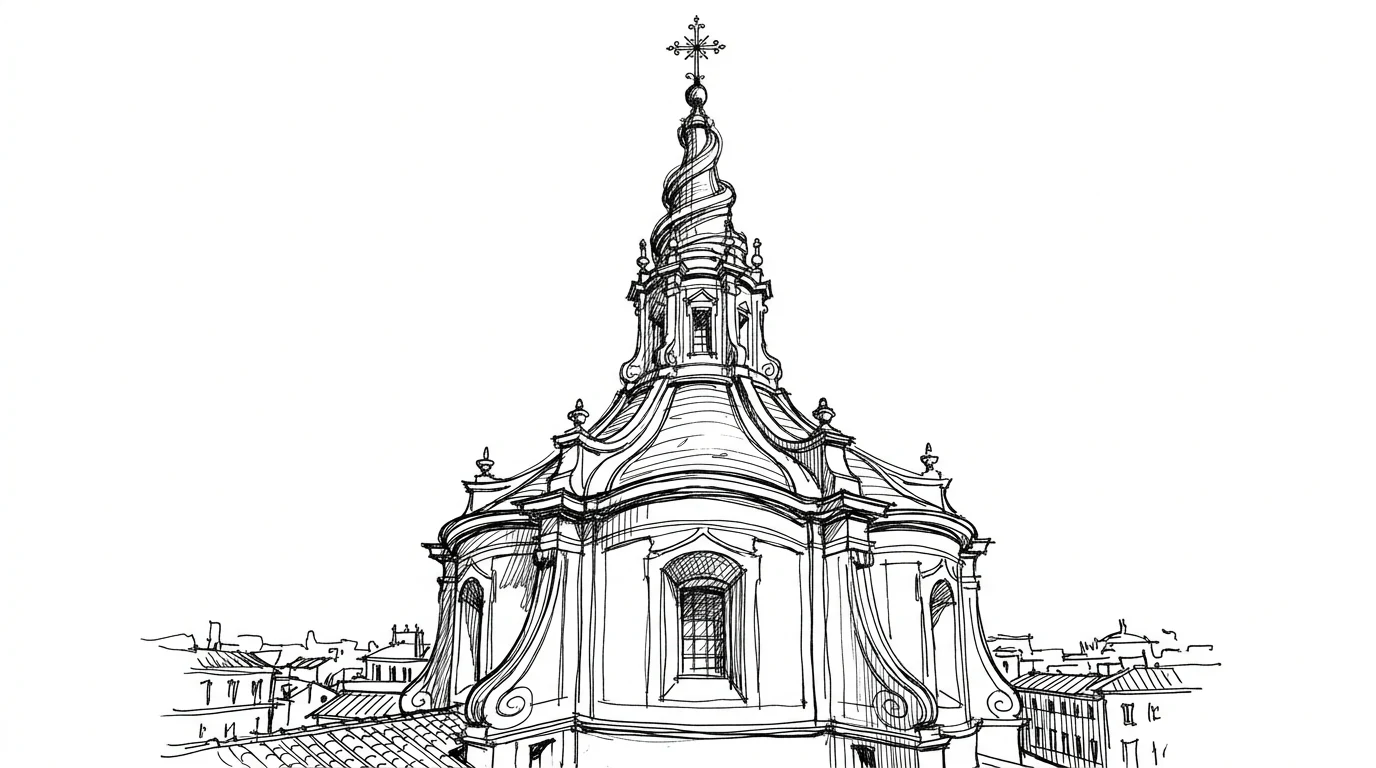
If there is a Borromini building that shows his method in its purest form, it is Sant'Ivo alla Sapienza (1642–1660), the church of the University of Rome. The plan is a star-shaped hexagon — an equilateral triangle with its corners recessed into semicircles, alternating with projecting corners, generating an undulating perimeter impossible to describe verbally without drawing it. The dome rises from this plan with a logic that seems impossible: every segment of the curved wall transforms, as it rises, into a rib of the vault. Then, above the lantern, a helical stone spiral winds upward toward the sky.
This spiral has no precedent in European architecture. It has no precedent in the architecture of any culture, in fact. Borromini derived it from the Tower of Babel — a biblical image, not an architectural model. He took a myth and built it in stone. The result is an element that, even today, three and a half centuries later, is not easy to classify: is it a spire? A roof? A symbol? Yes, all three.
Bernini and the square: space as an embrace
It would be wrong to dismiss Bernini as the mediocre winner. St. Peter's Square (1656–1667) is one of the most successful works of urban design in history. The elliptical colonnade embracing the square is not a boundary — it is an opening. Bernini explained it with one of his most celebrated metaphors: the arms of the Church opening to welcome the faithful. It is rhetoric, certainly, but rhetoric that works because it is built in space. The curve of the colonnade does not enclose the square: it directs it, scales it, prepares it for the building behind. It is a space that is never fully understood until you stand at its center, and then it is perfect.
This is Bernini's strength that Borromini could never have matched: the ability to work at large scale, in urban space, so that the result is immediately legible to anyone. Borromini worked well in small spaces — the more difficult and cramped the site, the more his method produced brilliant solutions. Bernini worked well at large scales — the more visible and public the context, the more effective his rhetoric. They were not rivals on the same ground. They were extraordinary on different grounds that happened, by geographic and biographical chance, to coincide in the same time and the same city.
Death and what remains
Borromini dies on August 2, 1667. He wakes at night, takes his sword, and throws himself upon it. He survives long enough to receive the sacraments and dictate his final testamentary wishes to notaries. He dies a few hours later. He is sixty-seven. Bernini dies in 1680, at eighty-one, in his home in Rome, surrounded by his grandchildren and the recognition of half a century of triumphant career.
The subsequent history is well known. The eighteenth century uses Borromini as a negative example — Baroque architecture at its worst, caprice without discipline. The eighteenth century uses Bernini as a positive example — controlled grandeur, heroic classicism. The nineteenth century rediscovers both as excesses to avoid. And then the twentieth century arrives.
Aalto read Borromini. Scharoun read Borromini. Carlo Scarpa read Borromini. Renzo Piano has said he often returns to Sant'Ivo alla Sapienza. Deformed geometry, space that isn't understood at first glance, the curve as structure before ornament — all of this is Borromini, filtered through three centuries of oblivion and rediscovery. Bernini is in museums. Borromini is in schools of architecture.
Neither of them would have appreciated the other's judgment. Which is probably the best way to know that the judgment is right.