The ideal city is a recurring obsession in the history of architecture and urban planning — from Plato (the imagined Republic) to Thomas More (Utopia, 1516) to Le Corbusier (the Ville Radieuse, 1930) to Buckminster Fuller (the dome over Manhattan). The common denominator: the real city is chaotic, inefficient, unjust — the city designed from scratch could be rational, fair, beautiful. The history of these ideal cities is almost invariably the story of a dream that collides with reality — political, economic, social — and is never realized. Or is realized only in partial and distorted form.
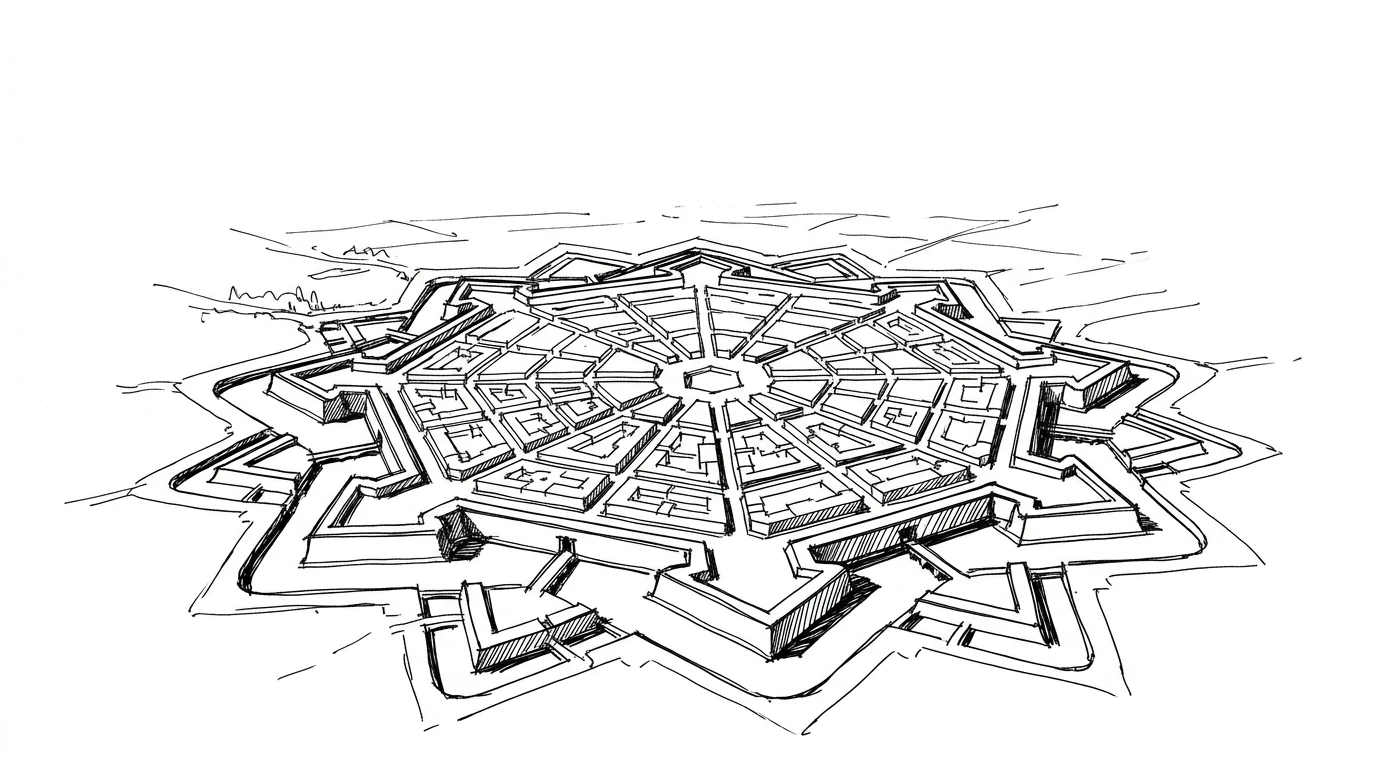
The Renaissance is when this obsession becomes systematic. Filarete, Alberti, Francesco di Giorgio Martini, Leonardo da Vinci — all design ideal cities. Filarete's Sforzinda (1461) is the best known: an eight-pointed star with 16 towers at the corners and midpoints, radial streets converging at the center, a central square with the main institutions (ducal palace, cathedral, market). The star shape is not decorative — it is defensive: the points and towers eliminate the blind spots that rifles and cannons could exploit. The Renaissance ideal city is also a fortress-city.
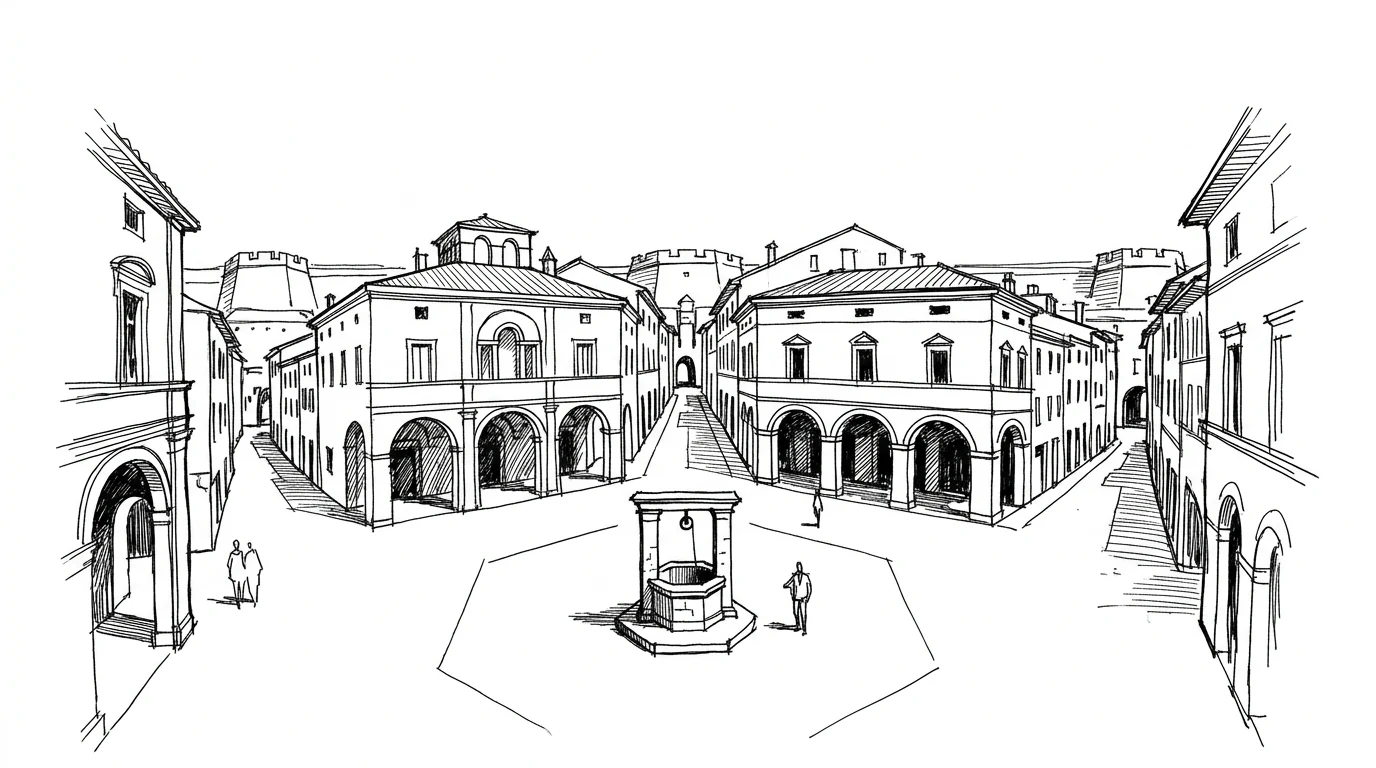
Palmanova: the ideal city that was built
The best example of a Renaissance ideal city actually built — and still standing — is Palmanova, in Friuli. Founded in 1593 by the Republic of Venice as a border fortress against the Ottomans, it has a nine-pointed star plan that is almost exactly what Filarete had described 130 years earlier. The moat, the bastioned walls, the radial streets, the hexagonal central square with its well — all just as in the theoretical design. Palmanova was built in just a few years, populated by force (the Venetians had to compensate residents to move to this city out of nowhere), and remained largely empty for the first decades of its existence.
The problem with the ideal city is always the same: it is designed by those in power, not by those who live there. Palmanova had no market, no craftsmen, none of the informal structures that make a city livable. The Venetians had to pay residents to stay. The ideal city is a top-down project in a bottom-up phenomenon: cities emerge from the sum of thousands of individual decisions over time, not from a master plan.
Brasilia and the utopias of the 20th century
The 20th century produces its own ideal cities — and the results are just as ambiguous. Brasilia (1960 — designed by Lúcio Costa and Oscar Niemeyer) is the most famous example: a capital built from nothing in the center of Brazil to symbolize progress and modernization. The plan resembles an airplane (or a bow and arrow — interpretations vary): an east-west monumental axis with the Government Palace and Parliament at one end, a north-south residential axis with the "superquadras" — housing blocks set in greenery. Beautiful in aerial photographs. Less beautiful at ground level, where the distances between points of interest are enormous and the car is the only way to get around.
The sharpest critique of Brasilia comes from Jane Jacobs in 1961 — "The Death and Life of Great American Cities" — which doesn't discuss Brasilia specifically but addresses all rationally planned cities: they lack a mix of uses, the complexity of the urban fabric, the narrow streets that allow for chance encounters, the old buildings that house low-cost activities. The ideal city is, by its nature, free of imperfections — and imperfections are exactly what make cities livable. A paradox that is hard for planners to accept.