Marcus Vitruvius Pollio is not a great architect. He did not build the Pantheon, nor the Colosseum, nor the Baths of Caracalla. He is a military engineer — he designed catapults and siege engines for Julius Caesar, then aqueducts and basilicas for Augustus. His contribution to architecture is not a building: it is a book. The "De Architectura" — ten books written between 30 and 20 BC — is the only manual of architecture from classical antiquity to survive the destruction of the centuries. Every other treatise on Greek and Roman architecture is lost. Vitruvius survived by chance — and for two thousand years he has defined the canon of Western architecture.
The three Vitruvian principles — "firmitas, utilitas, venustas" (soundness, utility, beauty) — are the most quoted formula in the history of architecture. They appear in Book I, chapter 3. Soundness concerns structure: the building must hold up over time. Utility concerns function: the building must serve the purpose for which it was built. Beauty concerns aesthetics: the building must be pleasing to the eye and harmonious. Three requirements. Not one, not two: three. And the order is not accidental — soundness comes before beauty. A beautiful building that collapses has failed.
The Renaissance rediscovery
Vitruvius's "De Architectura" survived in dozens of medieval manuscripts, the oldest copied in Carolingian monasteries. It circulates in the Middle Ages, but few truly understand it — it is written in technical Latin full of Greek terms, and describes buildings that no longer exist. The turning point comes in 1414, when the librarian and manuscript hunter Poggio Bracciolini finds a particularly good copy in the abbey of St. Gallen in Switzerland. He brings the manuscript to Florence. From that moment the "De Architectura" becomes the reference text of Renaissance architecture.
Alberti — Leon Battista Alberti, author of "De re aedificatoria" (1452) — draws on Vitruvius but criticizes him: the Latin is obscure, many passages are incomprehensible, the measurements do not add up. Alberti rewrites Vitruvius in elegant Latin and adapts him to the needs of Renaissance architecture. In practice, "De re aedificatoria" is the Renaissance version of the "De Architectura". From Alberti onward, every architect who wants to be taken seriously must know Vitruvius — or at least pretend to.
The architectural orders: the vocabulary of the West
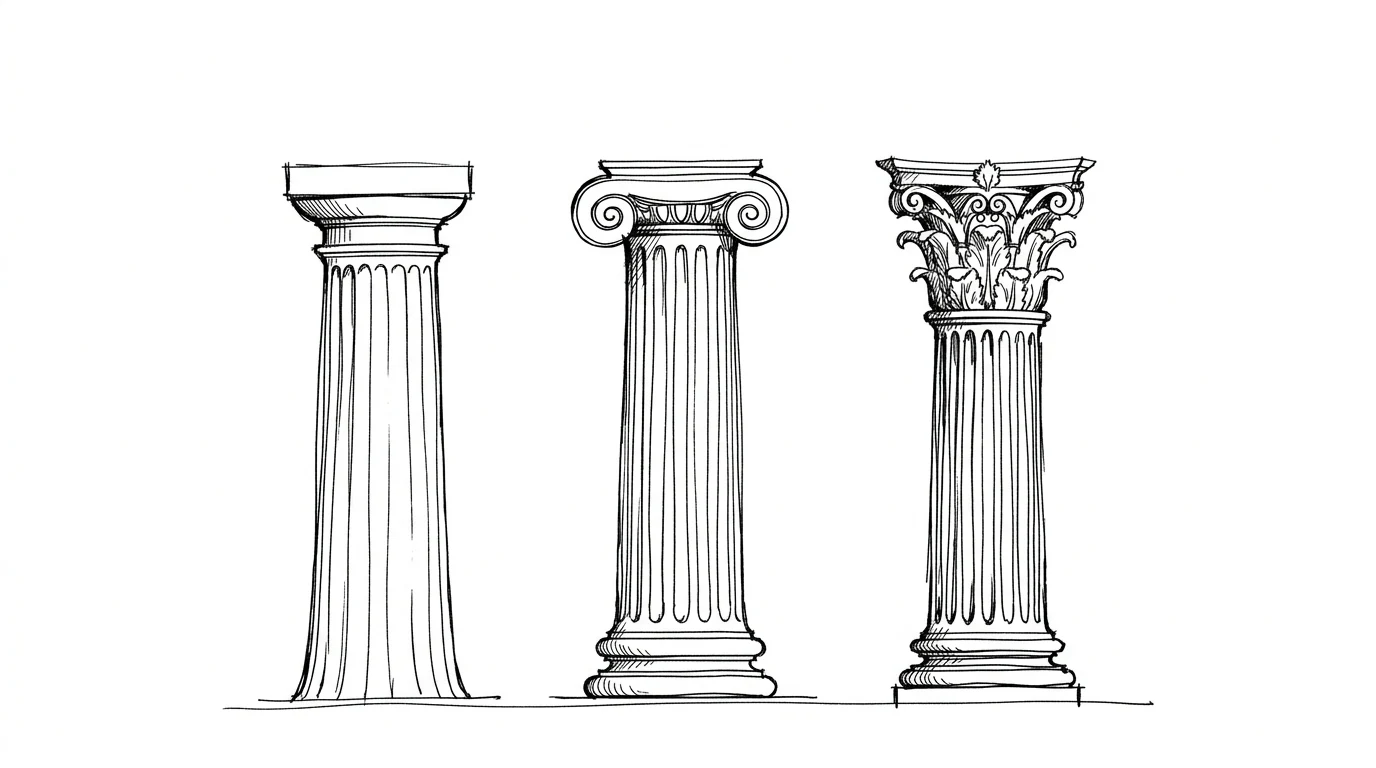
Vitruvius's most lasting contribution to architecture is not the "firmitas, utilitas, venustas" triad — it is the codification of the architectural orders. In Books III and IV of the "De Architectura" Vitruvius describes three Greek orders with precise proportional rules: the Doric (column 6–7 diameters high, no base, plain capital — which Vitruvius likens to the male body), the Ionic (8–9 diameters, with base, volute capital — female body), the Corinthian (9–10 diameters, with base, acanthus-leaf capital — the body of a young girl). To these three Greek orders the Romans add the Tuscan (a simplified Doric, without fluting, with a base) and the Composite (a capital that combines Ionic volutes with Corinthian leaves). Five orders. Two thousand years of architecture built on this grammar.
Every major building from Alberti to the nineteenth century uses one or more of these orders — not as nostalgic quotation, but as a shared language guaranteeing recognizable proportions. The U.S. Capitol has Corinthian columns. Sansovino's Biblioteca Marciana in Venice uses Doric on the ground floor and Ionic on the piano nobile — the "correct" sequence according to Vitruvius. When twentieth-century Modernism breaks with the orders — when Mies van der Rohe declares that the Doric column has nothing left to say — it is a deliberate break with two thousand years of Vitruvian canon. To understand why Modernism is a revolution, one must understand exactly what it overturned.
The first illustrated edition: Fra Giocondo and Cesariano
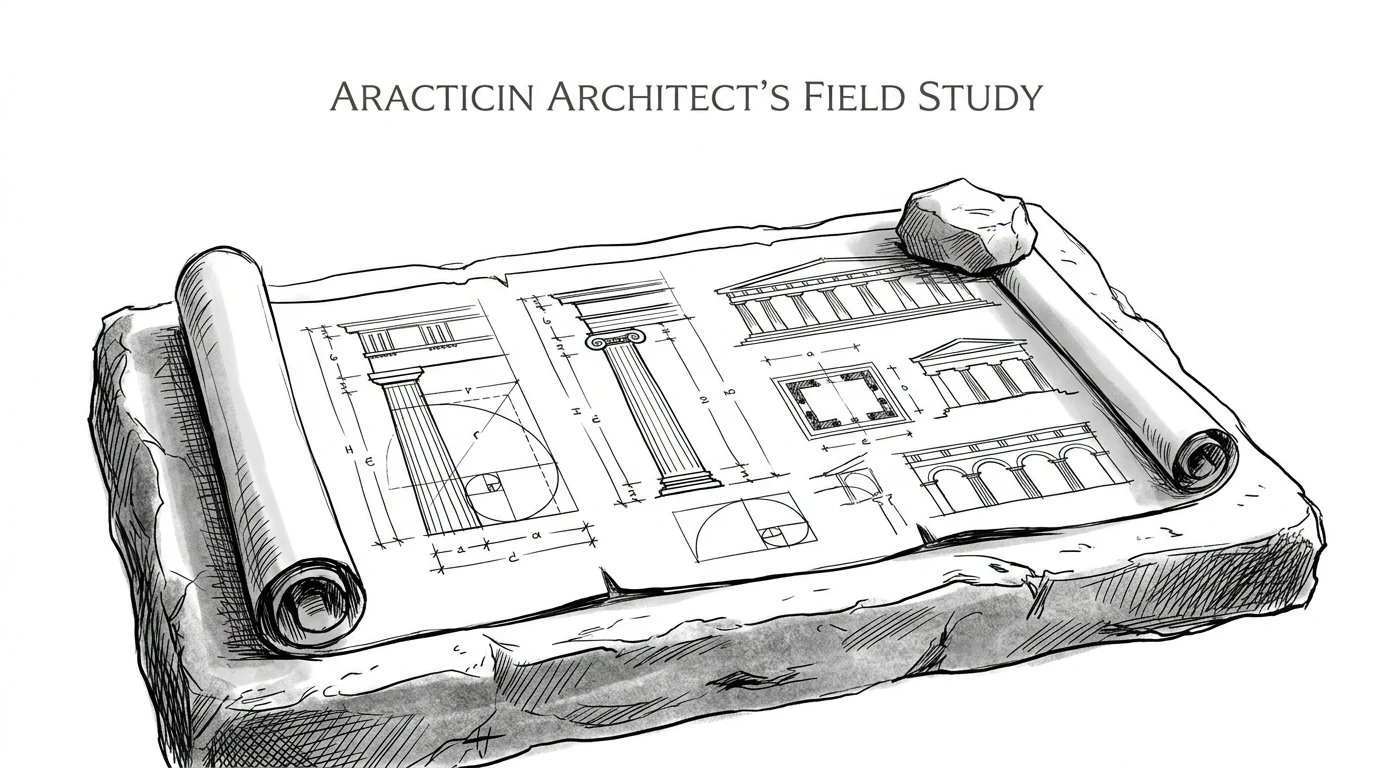
The "De Architectura" circulates in Carolingian monasteries as a text without images — and Vitruvius writes of proportions, columns, temples that no one who has never seen them can grasp without a drawing. The first printed edition — Rome 1486, unillustrated — is already a step forward. But the real turning point comes in 1511, when Fra Giocondo (Verona, 1433–1515), architect and hydraulic engineer, publishes in Venice the first illustrated edition with 136 woodcuts showing the orders, the temples, the war machines. For the first time, readers of Vitruvius can see what he describes.
In 1521 Cesare Cesariano publishes in Como the first annotated Italian translation, with elaborate illustrations that include — in a way philologically dubious but culturally effective — the plan of Milan Cathedral interpreted according to Vitruvian canons. The illustrated editions of the sixteenth century are the manuals on which the architects of the mature Renaissance and the Baroque are trained. Palladio studies these editions before writing the "Four Books of Architecture" (1570). Giacomo Vignola writes the "Rule of the Five Orders of Architecture" (1562) as an illustrated summary of the Vitruvian orders reduced to their essentials — the most widely used manual in the history of Western architecture before the twentieth century. Vitruvius is not a text: he is a tradition.
Vitruvius and beauty
Vitruvius's "venustas" is not subjective beauty — mere personal taste. It is objective beauty — the proportion, harmony, and order that result from applying geometric rules and the canons of the architectural orders. For Vitruvius beauty is rational: it derives from the correct application of mathematical proportions. The human body is the model — its beauty comes from the fact that its proportions follow the 1:8 ratio (the head is one eighth of the height), and its parts are proportionally related to one another. Leonardo's "Vitruvian Man" — the famous 1490 drawing — is not a quotation of Vitruvius: it is an illustration of Vitruvius, who in Book III describes the proportions of the perfect human body.
Which is exactly the opposite of what is commonly believed: Vitruvius is not an old-fashioned formalist. His three principles — soundness, utility, beauty — are still the best definition of architecture there is. Every time someone debates whether a building is "good" or "bad", they are essentially applying the Vitruvian triad: does it hold up? does it work? is it beautiful? The answers change across the centuries — what is "beautiful" in the 1st century BC is not the same as what is "beautiful" in the 21st — but the questions remain the same.