| Average density (marble/granite) | 2,600–2,800 kg/m³ |
|---|---|
| Compressive strength (marble) | 80–200 N/mm² |
| Compressive strength (granite) | 150–300 N/mm² |
| Flexural strength (marble) | 8–25 N/mm² |
| Elastic modulus (Carrara marble) | ~60,000 N/mm² |
| Thermal expansion coefficient | 4–12 × 10⁻⁶ /°C (varies by type) |
| Average embodied carbon (marble/granite) | 0.058–0.10 kg CO₂/kg |
| Reference EU standard | EN 1467 (raw marble) · EN 12670 · UNI 8458 |
In 447 BC, Pericles put Phidias in charge of overseeing the Parthenon construction site. The architects Ictinus and Callicrates designed a Doric temple built entirely in Pentelic marble — the variety quarried from Mount Pentelikon, 19 km from Athens. Each block weighs 10 tonnes on average. The work was done without machines: chisel, mallet, tracing bow. The colonnade leans slightly inward; the shafts show entasis (a central swelling) to correct the optical illusion of narrowing. The precision of the dry joints between blocks is millimetric — measured in tenths of a millimetre on the contact surfaces, worked with abrasive.
What still strikes visitors today is the durability: 2,500 years of Mediterranean exposure, earthquakes, gunpowder (1687, the explosion of the Ottoman munitions depot), 20th-century pollution. The marble has lost an average of 2–4 mm of thickness to dissolution in acidic conditions in just the last 50 years — more than in the preceding 2,450 years, according to YSMA monitoring (the Acropolis Restoration Service). That's a statistic about pollution, not about the stone.
Petrographic classification and origin
The rocks used in architecture belong to three petrological categories with very different technical behaviours. Metamorphic rocks (marble, slate, quartzite) come from the high-temperature, high-pressure transformation of pre-existing rocks: marble is recrystallised limestone or dolostone, with visible calcite or dolomite grains. Intrusive igneous rocks (granite) form through slow solidification at depth: the granular structure is coarse, hardness is high, porosity is almost nil. Sedimentary rocks (travertine, sandstone, limestone, tuff) form through the deposition and cementation of sediments: variable porosity, layered structure, highly variable behaviour.
The stone varieties
Marble (calcite/dolomite): Carrara, Paros, Penteli
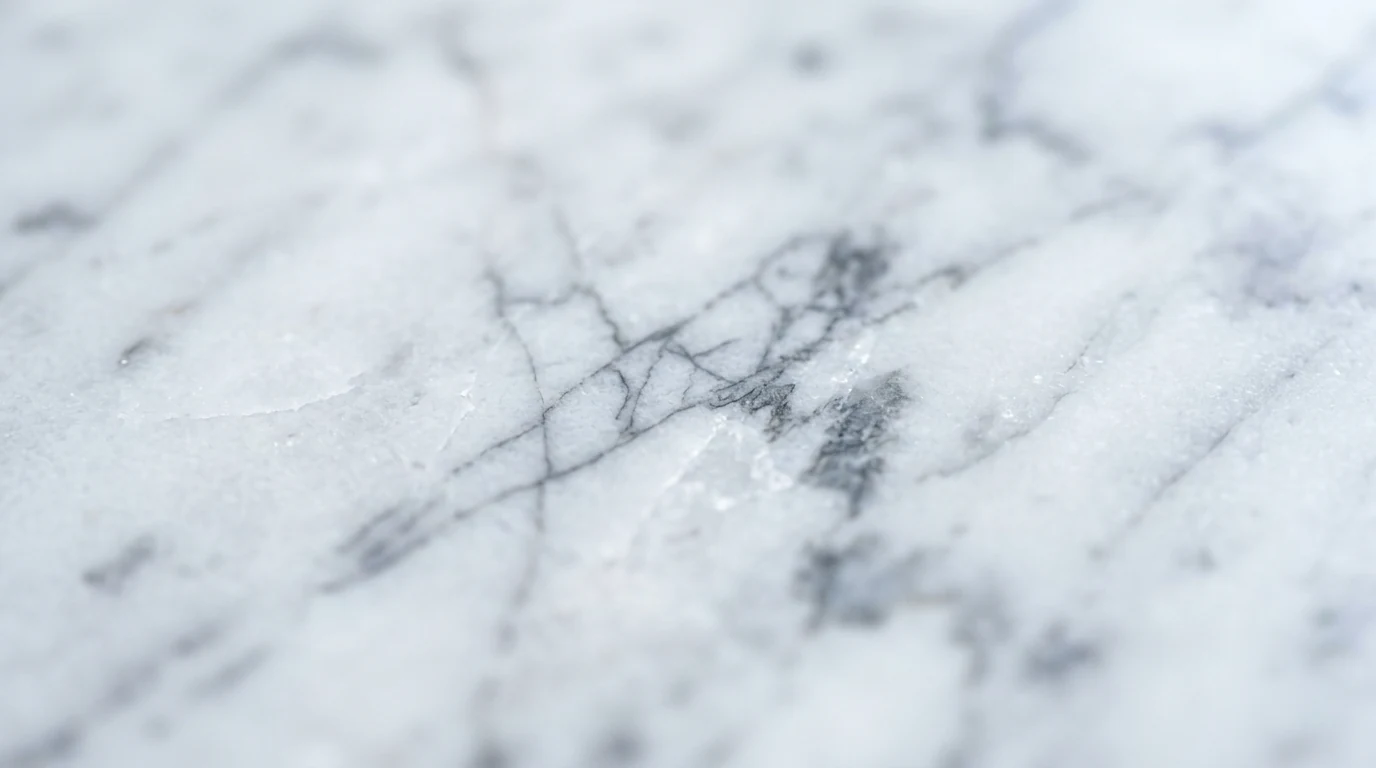
Marble is metamorphosed, crystalline-grained limestone, with a calcite content > 95% (calcitic marble) or dolomite > 50% (dolomitic marble). The Bianco Carrara variety — quarried from four main basins in the Apuan Alps — has a compressive strength of 120–180 N/mm², a thermal expansion coefficient of 4.5 × 10⁻⁶ /°C, and open porosity < 0.5%. Optical transparency (translucency) depends on the size of the crystalline grains: Carrara marble has average grains of 0.3 mm, Greek Paros marble up to 3 mm (a translucency that justified its preferred use for Greek sculpture). Marble's structural problem in cladding: hysteretic behaviour (residual deformation after each thermal cycle) leads to "bowing" of slabs under 30 mm thick exposed to direct solar radiation — documented on numerous 1980s facades with 20 mm slabs.
Travertine (porous, Tivoli)
Roman travertine is a chemically-precipitated limestone from carbonate-rich thermal waters, quarried mainly at Bagni di Tivoli, near Rome. Its structure is marked by elongated cavities and voids (traces of organic material or escaping CO₂ bubbles) that give it an open porosity of 4–12% — far higher than marble. Density: 2,200–2,500 kg/m³. Compressive strength: 40–100 N/mm². Freeze-thaw behaviour depends critically on saturation: closed cavities tend to become saturated, and the freezing cycle can crack the stone (EN 12371). The Colosseum, St Peter's Basilica, Richard Meier's Getty Center (Los Angeles, 1997) — all travertine. On facades, the cavities are normally filled for outdoor use; left open for aesthetic effect indoors.
Granite (intrusive, high hardness)
Granite is an intrusive igneous rock made of quartz (20–30%), alkali feldspars and plagioclase (40–60%), and micas (biotite, muscovite). Its Mohs hardness is 6–7 (against 3 for marble and travertine). Compressive strength: 150–300 N/mm². Porosity: 0.1–2%. Elastic modulus: 50,000–80,000 N/mm². The best-known Italian varieties are Rosa Baveno (VB) and Serizzo (CO/SO). Granite is practically unaffected by atmospheric acids — unlike marble (calcite + acid = soluble gypsum). That's why Egyptian columns and Aswan granite obelisks kept outdoors (including those in Rome) show an almost intact surface after 3,500 years. On site, granite is far harder to work than marble — it requires diamond-tipped tools and longer cutting times, at a processing cost 30–50% higher.
Basalt (extrusive, extremely hard)
Basalt is an extrusive (volcanic) igneous rock, very fine-grained, dark, dense (2,900–3,100 kg/m³), with a Mohs hardness of 6–7. Compressive strength: 200–400 N/mm² — among the highest of any building stone. Very low porosity (0.1–2%). Thermal expansion coefficient: 5–7 × 10⁻⁶ /°C. In Italy: basalt from Mount Etna and the Euganean Hills. Used for high wear-resistance road paving (Roman-style setts), bridge cladding, heavy-duty industrial flooring. Difficult to work: cutting produces a high concentration of silica dust — significant occupational silicosis risk, requiring local extraction ventilation.
Sandstone (sedimentary)
Sandstone is a clastic sedimentary rock made of quartz grains (60–95%) cemented by silica, calcium carbonate or iron oxides. Variability is enormous: Florentine Pietra Serena (a grey calcareous sandstone used by Brunelleschi and Michelozzo) has a compressive strength of 35–65 N/mm² and excellent workability, which allowed the finest details of the Florentine Renaissance. The German and English siliceous sandstones (Sandstein) used in northern European Gothic cathedrals have similar strengths but highly variable frost behaviour. On site, Milan Cathedral uses Candoglia marly limestone for its spires — technically a limestone, not a sandstone, but with similar workability characteristics.
Tuff (volcanic, lightweight)
Volcanic tuff is a pyroclastic rock consolidated from deposits of cemented volcanic ash. Neapolitan yellow tuff (quarried in the Phlegraean Fields) has a density of 1,100–1,500 kg/m³, compressive strength of 2–8 N/mm², thermal conductivity of 0.30–0.60 W/(m·K). Its lightness and ease of cutting (with a circular saw or by hand) make it the historic building material par excellence in the Campania area. All of historic Naples is built in tuff: the Spanish Quarters, the Decumano Maggiore, the Vesuvian villas. Limitation: low mechanical strength and high hygroscopicity require surface protection outdoors. Tuff masonry plastered with lime is, paradoxically, far more durable than the same masonry left unplastered.
Vicenza stone (soft limestone)
Vicenza stone (or Chiampo stone) is a soft Eocene limestone, pale cream in colour, with a compressive strength of 15–40 N/mm² and porosity of 20–30%. Very easy to cut and carve: Palladio used it systematically in the Venetian villas, in the loggias and columns of Vicenza. Its low strength imposes structural limits — it isn't suited as a primary load-bearing material for buildings taller than 3–4 storeys. Outdoors, it tends to lose its worked surfaces to acid dissolution within a few decades: Palladian villas are periodically re-worked or protected with ethyl-silicate consolidants.
Slate
Slate is a clayey metamorphic rock (phyllite) with a laminar structure (schistosity) that allows it to be split into very thin sheets (3–8 mm). Density: 2,700–2,900 kg/m³. Flexural tensile strength along the cleavage direction: 30–60 N/mm². Excellent impermeability. Roofing lifespan: 100–150 years, with replacement of rusted hooks. Ligurian Lavagna is Italy's main production hub; Spain (Galicia) is Europe's largest producer. Use in roofing requires checking the load-bearing structure: the weight of slate sheets (45–60 kg/m²) exceeds clay roof tiles (35–45 kg/m²) and is far greater than modern lightweight systems.
Flint
Flint is a cryptocrystalline siliceous rock (microcrystalline quartz), extremely hard (Mohs 7), with sharp edges when fractured. It isn't a modern building material in the traditional sense, but its presence in historic medieval masonry — alternating with brick in regular courses — is characteristic of large areas of central and southern Italy. Compressive strength: 200–300 N/mm². Working is limited to percussion (flaking): cutting with ordinary tools is impossible without diamond-tipped equipment. In restoration, reintegrating flint masonry requires sourcing from historic quarries or compatible demolitions.
Behaviour over time
The durability of stone outdoors depends on the chemistry of the exposed surfaces. Limestones and marbles (calcite, CaCO₃) react with atmospheric carbonic and sulphuric acid to form soluble gypsum (CaSO₄·2H₂O): rain washes the surface away at a rate of 0.02–0.04 mm/year in urban settings (ENEA data on samples from the Acropolis and the Colosseum). Siliceous rocks (granite, basalt, quartzite, siliceous sandstone) are essentially inert to atmospheric acids: degradation happens through abrasion, thermal cycling and biological colonisation (lichens, moss). The freeze-thaw cycle is the deciding parameter for use in Alpine climates: water absorption (EN 13755) and frost resistance (EN 12371) must be verified and declared on the technical data sheet before installation.
| Dimension | Score | Assessment |
|---|---|---|
| 🌿 Environmental | 6/10 | Intrinsically low embodied carbon: 0.058–0.10 kg CO₂/kg for Italian marble and granite (ICE Database v3.0, University of Bath, 2019). No high-temperature chemical transformation. Critical issue: quarrying causes permanent landscape alteration, erosion, habitat loss. Transport from distant quarries (India, China, Turkey) significantly raises the final carbon footprint — a slab of Chinese granite can have a total LCA 3–5 times higher than the Italian equivalent from sea and road transport alone. |
| ⚖️ Ethics | 5/10 | The Turkish and Chinese marble supply chain is largely opaque: working conditions in quarries, waste management, and the health of workers exposed to silica dust are hard for a European client to verify. ISO 45001 certifications exist but aren't the norm. Italian quarrying (Carrara, the Candoglia quarries, Tivoli travertine) is subject to environmental impact assessment, integrated environmental authorisation, and regional environmental agency controls: incomparably higher standards. Choosing local stone is also a documentable ethical choice. |
| 🏘️ Social | 8/10 | Very strong identity value: travertine is Rome, slate is Liguria, Pietra Serena is Florence. Local stone is sedimented material culture. No health risk for end users in ordinary installation and use. Occupational risk for stone cutters: free crystalline silica in sawing dust — mandatory EN 149 PPE and local extraction ventilation. Italy's stone industry (the Carrara, Verona and Orosei districts) employs around 30,000 people directly. |
| 💶 Economic | 5/10 | Flooring installation cost: €80–200/m² for standard Italian travertine/marble; €150–350/m² for prized varieties (Calacatta, Statuario, exotic granites). Decade-scale maintenance is required: waterproofing, polishing, joint sealing. Very long service life if properly maintained (100+ years). The quality-to-durability ratio is favourable long-term, unfavourable short-term given the high initial costs compared with ceramic tiles. |
| Average score | 6.0/10 |
Uses through history
Classical Antiquity (7th c. BC – 4th c. AD): Stone is the primary material of the classical Mediterranean civilisations. The Pantheon uses Egyptian granite for the pronaos columns (eight monolithic 14-metre columns, quarried at Aswan), travertine for the exterior, tuff and pumice for the foundation walls. The Parthenon is entirely in Pentelic marble — column shafts, architraves, friezes, metopes, acroteria. The Egyptians used local limestone for the body of the Giza pyramids and red Aswan granite for the burial chambers — the hardest and most noble material, reserved for sacred spaces.
Gothic and Romanesque (11th – 15th c.): Northern European Gothic cathedrals explore the structural limits of limestone: piers, flying buttresses, and pinnacles carry loads in ways that minimise tension (which stone doesn't handle well). Chartres uses limestone from Berchères-sur-Vesgre; Notre-Dame de Paris uses Lutetian limestone from the Paris region. Beauvais Cathedral (1284) partially collapsed from excessive height relative to the section of its piers — a case study in the mechanical limits of stone under eccentric compression.
Modernism and stone as envelope (20th – 21st c.): Mies van der Rohe, in the Barcelona Pavilion (1929), uses stone no longer as structure but as skin: Roman travertine for the floors, golden onyx for one wall, Alpine green marble for another. Stone loses its load-bearing function and becomes surface, texture, colour. Adolf Loos had already established the principle in the Goldman & Salatsch store in Vienna (1912): cipollino marble cladding as a statement of value with no structural role. Today, stone in architecture is almost exclusively cladding: 30 mm ventilated slabs anchored to steel systems, with hook verification under EN 1991.
Reference figures for the project
| Bianco Carrara marble — Rc / flexural Rt | 120–180 N/mm² / 8–18 N/mm² |
|---|---|
| Roman Travertine — Rc / porosity | 40–100 N/mm² / 4–12% |
| Rosa Baveno granite — Rc | 180–260 N/mm² |
| Etna basalt — Rc | 200–400 N/mm² |
| Pietra Serena — Rc | 35–65 N/mm² |
| Neapolitan yellow tuff — Rc | 2–8 N/mm² |
| Ligurian slate — flexural Rt | 30–60 N/mm² |
| Embodied carbon, Italian marble | 0.058–0.080 kg CO₂/kg |
| Standard ventilated slab thickness | 30–40 mm (marble/travertine) |
Research and the contemporary frontier
Research into natural stone in architecture is moving in two opposite directions. The first is ultra-thin stone: stone-fibreglass or stone-aluminium composite laminates allow facade slabs of 3–6 mm, unthinkable with stone alone given the risk of flexural failure. Companies such as Levantina (Thin Stone) and StonePly sell composite panels with 3 mm stone layers bonded to an aluminium or carbon-fibre backing — the system's flexural strength is 5–10 times higher than stone alone. Weight drops from 70–80 kg/m² (a 30 mm slab) to 8–12 kg/m² (a 5 mm composite), revolutionising anchoring systems.
The second direction is reuse: demolition stone — structural tuff elements, travertine blocks, granite columns — is a material heritage to be fed back into the construction cycle without further extraction. The StoneCycling research project (TU Delft) is developing protocols for cataloguing, structural verification and reuse of stone elements in new buildings. In Italy, the “End of Waste” regulation on construction and demolition inert waste (Ministerial Decree 127/2024, which replaced Decree 152/2022) opens a crack of daylight, but the regulatory framework for reclaimed structural stone is still insufficient for seismic applications.