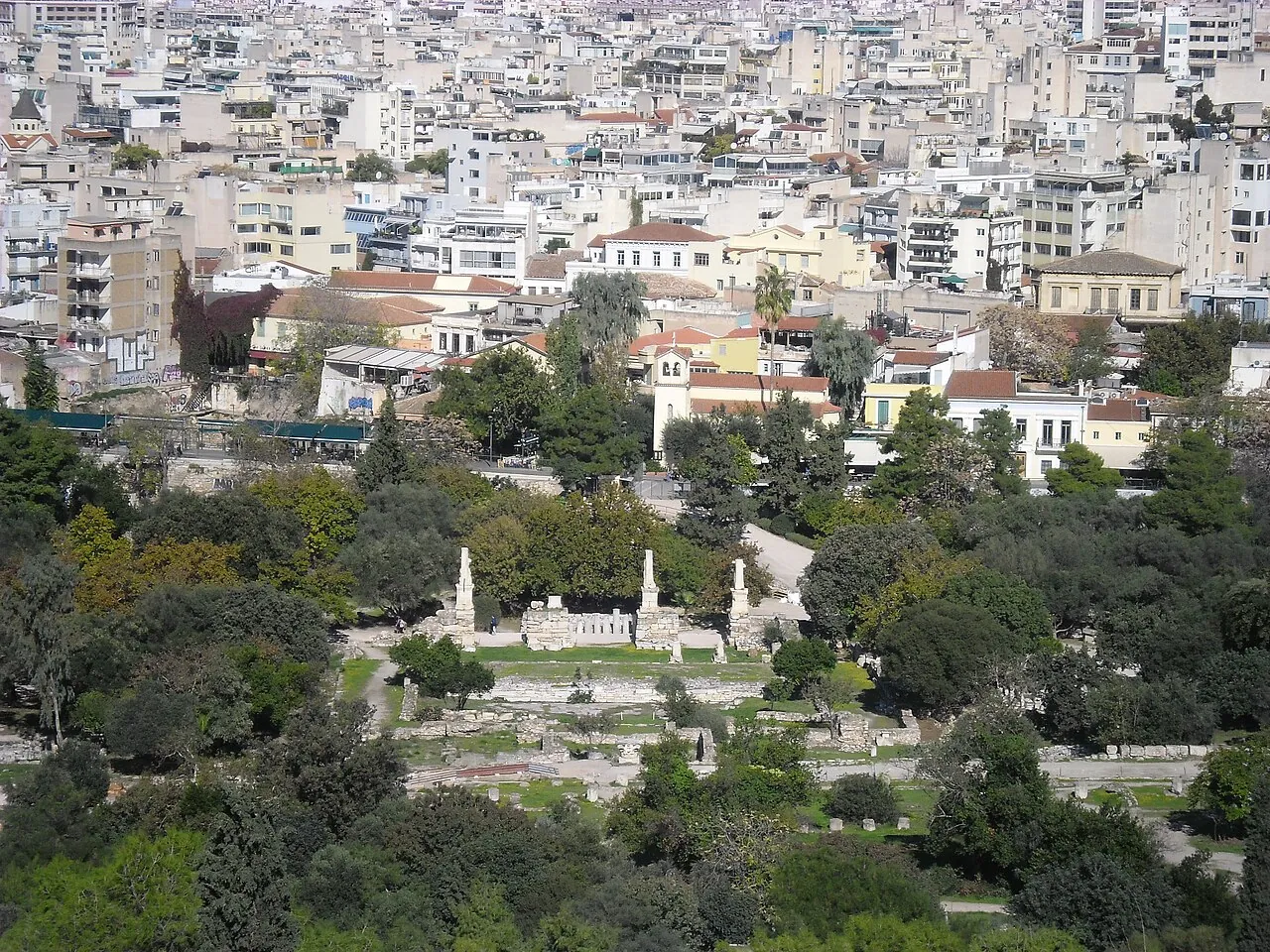
The Athenian agora is one of the most studied and least understood public spaces in the history of architecture. It tends to be imagined as an orderly square, surrounded by symmetrical buildings, with a clear composition. Which is exactly the opposite of what is actually found. The Athenian agora is a space that grew organically over centuries, with buildings added in positions dictated by necessity rather than by a plan, with functions overlapping and shifting over time. It is not a designed square: it is a space defined by use.
The word <em>agora</em> in archaic Greek means "assembly" — before it was a physical space, it meant the gathering of citizens. It later came to denote the place where the assembly meets. The Athenian agora at its most developed stage (5th–4th century BC) includes the <em>bouleuterion</em> (seat of the Council of Five Hundred), the <em>prytaneion</em> (seat of the presiding officers), the <em>court of the Heliaia</em>, several temples, the Stoa Basileios, the Stoa Poikile — and a central open space where the market is held, public executions, religious ceremonies, athletic contests. All together, all mixed in.
The stoa as an architectural element
The most characteristic architectural element of the Greek agora is the stoa — a colonnaded portico that defines the edge of the open space. The stoa offers shade, shelter from the rain, a transitional space between outside and inside. It is not a freestanding building: it is a built boundary of the public space. It gives shape to the agora without enclosing it.
The Stoa of Attalos in Athens — rebuilt in the 1950s by the American School of Classical Studies — is 116 meters long, has two levels of columns (Doric on the ground floor, Ionic on the upper floor) and today houses the Agora Museum. It is the most faithful reconstruction of an existing Greek stoa. But one must be precise: the modern reconstruction uses modern materials and has comfort features the original did not have. It is a 20th-century historic building that has the shape of a 2nd-century BC building.
The agora as democratic practice
Athenian democracy was practiced physically in the agora. The court of the Heliaia had juries drawn by lot from adult male citizens — up to 6,000 jurors for the most important trials. The physical space required was enormous: proceedings were held in the open areas of the agora, with jurors seated on temporary stands. Each juror received a bronze voting token — thousands of them have been found in excavations.
But let's return to architecture. The <em>kleroterion</em> — the machine for drawing jurors by lot — was an architectural object: a marble slab with slots into which citizens' identification tokens were inserted, then drawn at random. Athenian democracy had physical hardware, built of stone and bronze, that served to guarantee the randomness of the electoral process. The architecture of democracy is not just the space — it is also the tools through which the democratic process takes place.
From the agora to the forum
The Roman forum is the direct descendant of the Greek agora, with two significant differences. The Roman forum tends toward closure and symmetry — progressively, over the course of the imperial age, it becomes a space surrounded by monumental buildings on all sides, with clear axes and symmetrical compositions. The Greek agora remains more open, less formal, more plural in terms of the buildings that surround it. The second difference concerns commerce: the imperial Roman forum excludes the market (relegated to covered markets like Trajan's Markets). The Greek agora welcomes it.
It is a political difference as much as an architectural one. The agora reflects democracy — chaotic, negotiated, plural. The imperial forum reflects centralized power — ordered, hierarchical, monofunctional. The architecture of public space is always a mirror of the political system that produces it.