The problem with the Roman Forum, for anyone visiting it today, is that it looks like a meaningless field of ruins — scattered columns, truncated arches, disorganized slabs of marble. What is hard to grasp is that the Forum was never a unified design: it is an overlay of nine hundred years of construction, demolition, reconstruction, expansion, fires and restoration. Every emperor added something. Every war destroyed something. Every restoration covered something earlier. The final result — what we see today — is a sediment, not a plan.
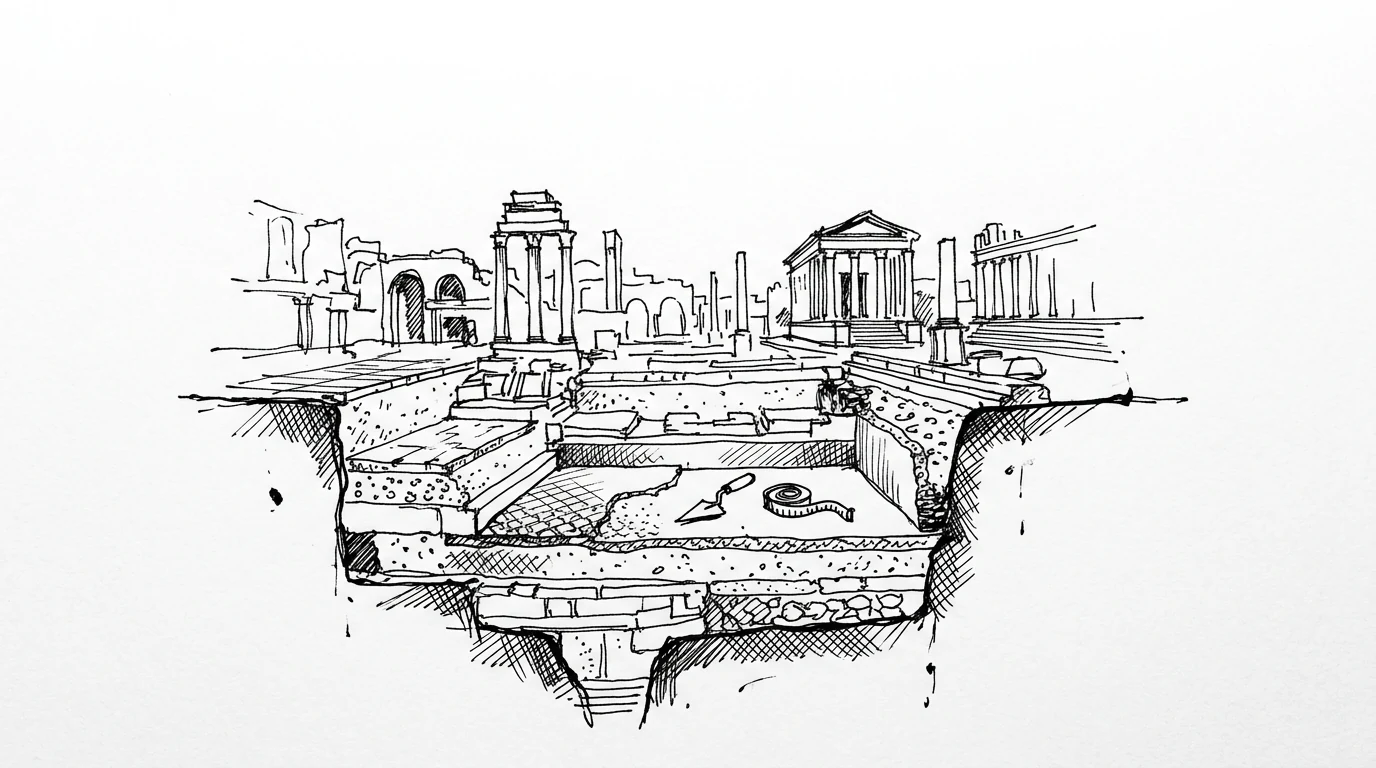
The Forum begins, according to tradition, as a marshy area between the Palatine and the Capitoline, drained in the 7th century BC by a great work of engineering — the Cloaca Maxima, Rome's sewer system, which still carries its waters into the Tiber today. The reclamation turns a marsh into a square. On the square the market is built, then the place of political assemblies, then the temples, then the law courts, then the celebratory monuments. Each layer adds functions, complexity, density.
The Basilica as a Building Type
The Roman Forum introduced one of the most influential building types ever invented in the history of architecture: the basilica. Not in the Christian sense — basilica-churches came three centuries later. The Roman basilica is a large covered hall, rectangular in plan, with side aisles and an apse at the far end, used as a courthouse, exchange, and assembly hall. The Basilica Aemilia (179 BC) and the Basilica Julia (54 BC) flank the Forum on opposite sides.
When Constantine legalizes Christianity in 313 AD, the church needs a building type for the assemblies of the faithful. It chooses the basilica — not the pagan temple, which was small and intimate and served the clergy, not the faithful. The Christian basilica takes up the plan of the forum basilica: a central nave, side aisles, an apse at the far end with the altar in place of the tribunal. Every Christian church in the world derives from a building type born to hold trials.
The Temple of Caesar and Sacred Politics
On the exact spot where the body of Julius Caesar was cremated in 44 BC, Augustus had the Temple of the Deified Julius built, dedicated in 29 BC. The location is no accident: the temple transforms a political event — Caesar's assassination — into an act of religious foundation. Caesar becomes a god, and the site of his death becomes a sanctuary. Every rite celebrated in the temple reminds Rome who killed Caesar and who avenged him — that is, Augustus.
This is the mechanism that the Roman Forum uses systematically for centuries: turning politics into architecture, architecture into memory, memory into legitimation of present power. Every emperor who builds a temple, an arch, a basilica in the Forum is writing his own version of Rome's history in stone. The Forum is a text — not a written text, but a built one.
The Curia and the End of the Republic
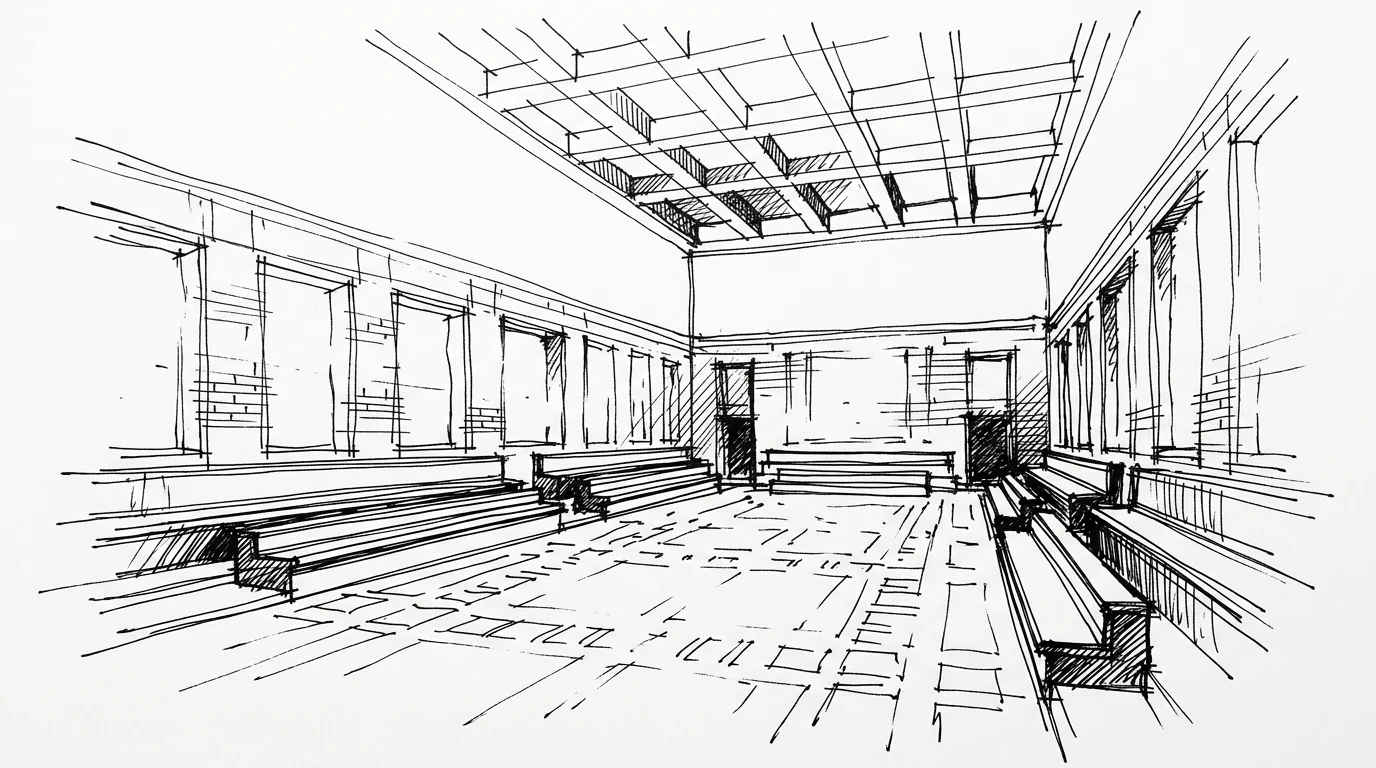
The Curia Julia — the building where the Roman Senate met — faces onto the Forum. The current Curia, well preserved, is the one rebuilt by Diocletian in 283 AD after a fire. Inside, still visible, are the steps on which the senators sat and the original inlaid marble floor — one of the few high-quality Roman floors surviving in situ. The internal proportions are those calculated by Vitruvius to ensure good acoustics: width equal to half the height and length.
The fact that the Curia survived is partly thanks to its transformation into a church in 630 AD — like the Pantheon, it was preserved by religious reuse. The original bronze doors were moved in the 12th century to the basilica of San Giovanni in Laterano, where they still are. The door seen today is a modern copy.
What Remains and Why
The Roman Forum in its current state is the result of four major excavation phases: the 18th century (disorganized antiquarian digs), the 19th century (Napoleonic and later Savoy excavations), the 20th century (Fascist-era excavations — Mussolini had entire medieval quarters demolished to open up the Via dei Fori Imperiali), and the 20th-21st century (systematic excavations with modern methods). Each phase discovered something and destroyed something else. The medieval level of the Forum — which covered the Roman remains — was almost entirely removed during the Fascist period. Excavations continued and flourished, but the loss of the medieval contexts is irreversible.
What one sees today, in short, is not the Roman Forum as it was at any single historical moment: it is a selective reconstruction based on choices made in different eras by people with different aims. History, even when unearthed, is always a story told by whoever does the digging.