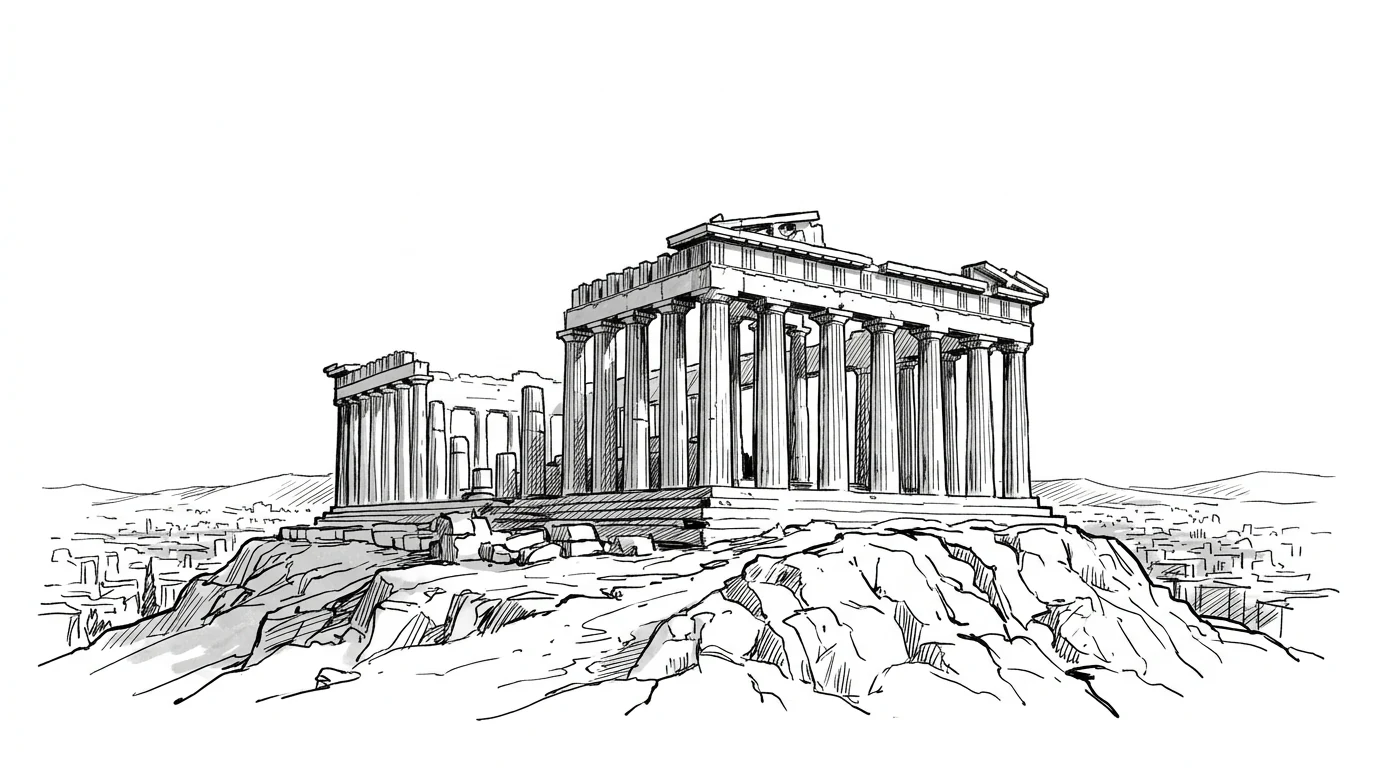
The Parthenon was built between 447 and 432 BC, commissioned by Pericles, designed by Ictinus and Callicrates, with Phidias supervising the sculptural work. It is not the first building on the Acropolis — that hill has been inhabited by the Mycenaeans since around 1400 BC — but it is the one that permanently defines the visual identity of Athens and, by legacy, of all Western culture. When Pericles commissions it, Athens has just led Greece against the Persians. The Parthenon is not just a temple: it is an act of political propaganda in Pentelic marble.
But let's return to a concrete physical fact: the Parthenon is not straight. The columns lean slightly inward. The entasis — the swelling at a third of the height — makes them look straight even though they are not. The platform curves slightly upward at the center (by about 6 centimeters over a length of 70 meters) — an upward curve that keeps the eye from perceiving the horizontal plane as concave. The corner columns are slightly thicker than the others to compensate for the fact that, lit from the front, they appear thinner. Every "error" is calculated to correct an optical illusion.
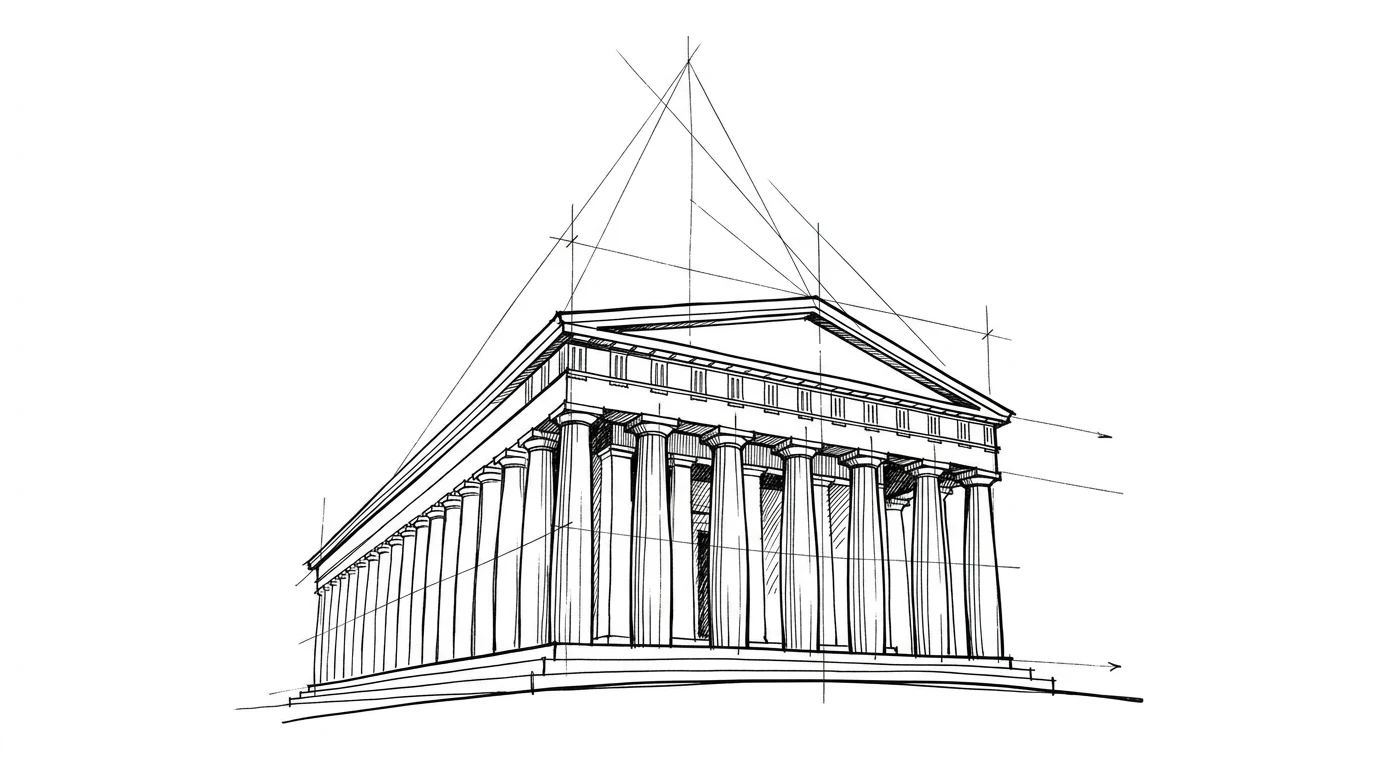
The optical corrections
The Parthenon's system of optical corrections is the most precise record we have of the mathematical and perceptual abilities of fifth-century BC Greek builders. Measurements taken in the 19th and 20th centuries confirmed that the deviations from "perfect" geometry are intentional and consistent — not execution errors, but calculated adjustments. The question that remains open is whether the builders calculated them mathematically or verified them empirically through models.
The columns lean by about 6 centimeters for every 10 meters of height. If the lines of the Parthenon's columns are extended upward, they meet at a height of about 2.4 kilometers. This is not imagination: it is a very elongated pyramid. The Parthenon is structurally designed like a pyramid in marble.
Phidias and the statue that no longer exists
Inside the Parthenon stood the statue of Athena Parthenos — the virgin Athena — sculpted by Phidias in gold and ivory over a wooden core. It stood twelve meters tall. No ancient copy of it has survived, and the statue itself disappeared in late antiquity — probably taken to Constantinople and destroyed in the fire of the imperial palace in 475 AD. We know what it looked like only from ancient descriptions and lesser-quality copies. The temple is famous above all for something that no longer exists.
It is a paradoxical and instructive situation: the Parthenon is famous for being a perfect Greek temple, but what we see today is the empty structure of a container whose contents have vanished. Like looking at a frame without the picture. The Greeks did not build temples for worshippers to gather inside — worshippers stood outside. The temple was the house of the god, and the god was the statue. Without the statue, the temple is architecture without a program.
The 1687 explosion
On September 26, 1687, during the Venetian siege of Athens, an artillery shell struck the Parthenon — which the Ottomans were using as a gunpowder magazine — and caused an explosion that destroyed the central chamber, brought down most of the interior columns, and hurled marble blocks for dozens of meters. The Venetian commander Francesco Morosini had already learned that the Parthenon was being used to store gunpowder, and had ordered his gunners not to hit it. The order did not arrive in time, or was ignored.
The 1687 explosion did more damage in one second than thirteen centuries of reuse, modification, and looting had done before it. The Parthenon survives relatively intact for two thousand years and is half-destroyed in a single episode of war. What we see today is a partial reconstruction of the 1687 damage — the restoration begun in 1975, still ongoing, has reassembled many blocks that fell in the explosion.
The Elgin Marbles and the unresolved question
Between 1801 and 1812, Thomas Bruce, Earl of Elgin, British ambassador to Constantinople, removed about half of the original sculptures of the frieze, pediments, and metopes from the Parthenon and other Acropolis buildings, transported them to England, and sold them to the British Museum in 1816 for 35,000 pounds. The "Elgin Marbles" are today at the British Museum. Greece has been demanding their return since 1832. The British Museum systematically refuses, citing a 1963 British law that forbids it from giving up parts of its collection.
The problem is not only legal. It is that the Acropolis marbles and the London ones are part of the same whole — fragments of the same frieze, parts of the same pediments. Separated, neither set is complete. The Acropolis Museum in Athens, completed in 2009 and designed specifically to house the returned marbles, has deliberately left empty the spaces where the London pieces would go. The empty space as an architectural argument.