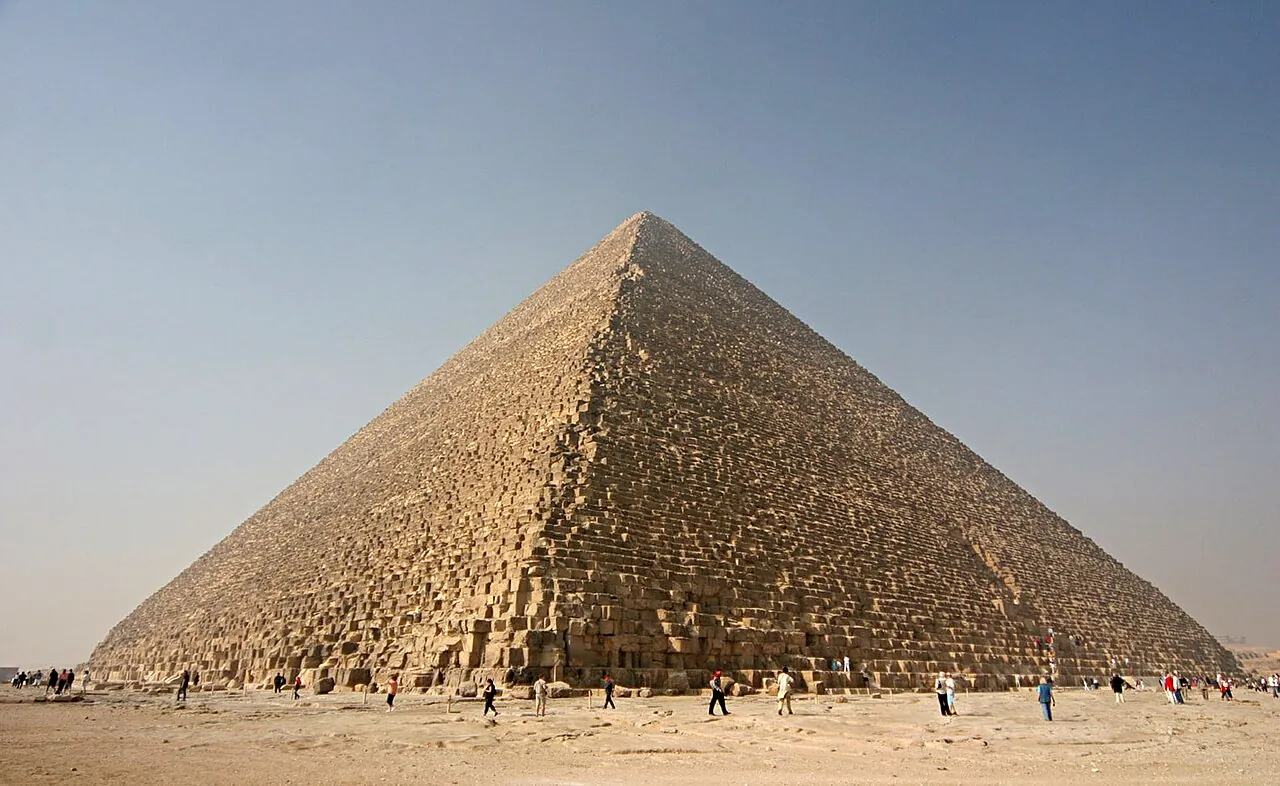
Let's start with what we don't know. We don't know for certain how the blocks of the Great Pyramid were lifted. We don't know how many workers labored on it (estimates range between 20,000 and 100,000). We don't know precisely how many years it took to build — estimates say between 10 and 30 years. We don't know how the Egyptians achieved the structure's extraordinary geometric precision — the orientation to the cardinal points has an error of less than 0.05 degrees. The problem is simple: ancient Egypt left us no construction manual. It left us the pyramids, but not the instructions for building them.
What we do know: the Great Pyramid was built during the reign of Khufu (4th Dynasty, circa 2589–2566 BC). The Giza site had already been chosen for its geological characteristics — the limestone bedrock beneath is stable and allowed many construction blocks to be quarried directly on site. The pink granite used in the king's chamber was brought from Aswan, 800 km to the south, via the Nile.
From the mastaba to the pyramid: 200 years of evolution
The pyramidal form does not emerge all at once. It develops over the course of 200 years starting from the mastaba — a flat, rectangular bench-shaped tomb, with the burial chamber underground. The decisive leap is made by Imhotep, architect and vizier to Pharaoh Djoser, around 2650 BC. Imhotep stacks six mastabas of decreasing size, one on top of the other, creating the Step Pyramid of Saqqara, 62 meters tall. It is the first great stone structure in Egyptian history.
After Djoser, evolution is rapid. The Bent Pyramid of Pharaoh Sneferu (Khufu's father) shows the attempt to build a smooth-faced pyramid, abandoned partway when the walls proved too steep — the angle is corrected at 2/3 of the height, giving the pyramid its characteristic "bent" profile. Sneferu tries again with the Red Pyramid, this time succeeding in building the first true smooth-faced pyramid. He is Khufu's father — who inherits the technique and takes it to its peak.
The king's chamber and the passages
The interior of the Great Pyramid is almost entirely solid — the solid mass of stone occupies 99% of the volume. The voids are few and precise: two access corridors (one descending, toward a chamber never completed below ground level; one ascending, toward the inner chambers), the Grand Gallery (a corridor 8 meters high, inclined), the Queen's Chamber and the King's Chamber. The King's Chamber is lined with pink granite from Aswan — enormous, polished blocks, assembled without mortar with such precision that a blade cannot be inserted between the joints.
Above the King's Chamber there are five empty spaces — the "relieving chambers" — that redirect the weight of the millions of tons above onto the side walls. It is a sophisticated engineering system: without these spaces, the weight of the pyramid above would have crushed the chamber. This is exactly the opposite of the popular reading, which sees the inner chambers as mysterious spaces with no logical function. The function is structural before it is funerary.
The lost casing
Today the Great Pyramid looks like a stepped structure, with exposed, visible stones. It wasn't always so: it was covered by a casing of polished white limestone that made it smooth and brilliant in the sun. The Pyramid of Khafre still retains part of this casing at the top. That of the Great Pyramid disappeared in the Middle Ages — dismantled and used as a quarry to build Cairo. The building we see today is not the one the ancient Egyptians saw.
But let's return to the form. Why the pyramid? Why not an obelisk, a tower, a cube? The most accepted answer is cosmological: the pyramid represents the sun's rays falling obliquely to earth, visible through the clouds. It is the shape of the descending god Ra. The dead pharaoh ascends along the sun's rays toward the sky. The shape of the tomb is the shape of the path the pharaoh takes in the afterlife. The architecture describes a theology.