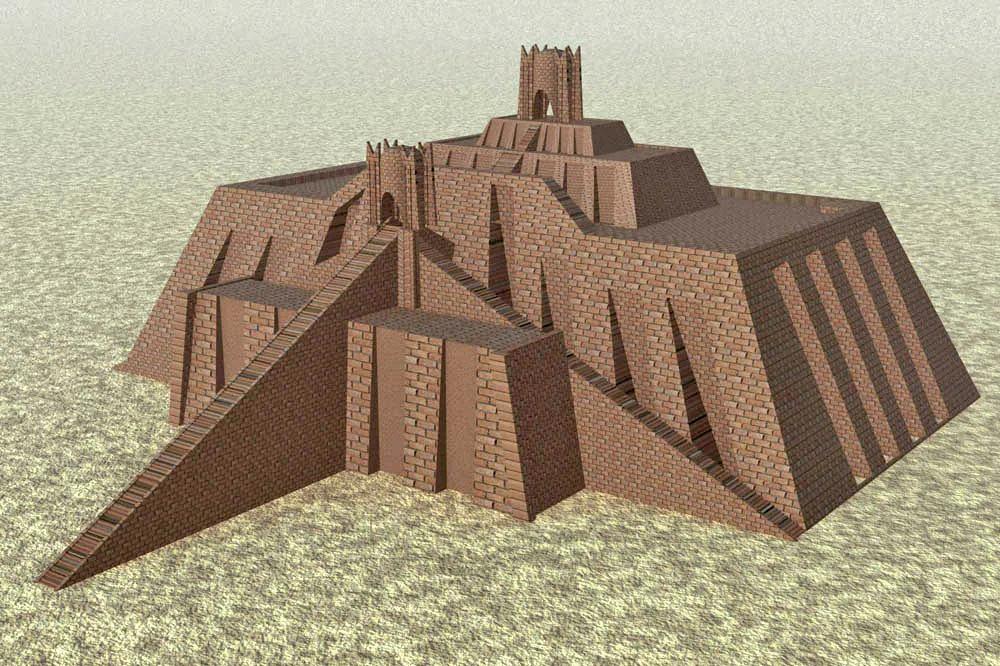
In Mesopotamia there are no mountains. The plain between the Tigris and Euphrates is flat, alluvial, without elevations. Yet Mesopotamian religions place the residence of the gods on mountaintops — like almost all religions of plain-dwelling civilizations. The problem is simple: if your god lives atop a mountain, and you have no mountains, you must build one. The ziggurat is exactly this: a man-made mountain, built where nature put none.
La parola "ziqqurat" deriva dall'accadico zaqāru, "alzarsi in alto, sporgere". Non è un tempio nel senso greco del termine — non è una casa del dio a livello del suolo, accessibile ai fedeli. È una piattaforma sopraelevata, con un piccolo santuario in cima, raggiungibile solo dal sacerdote. Il fedele sta in basso, nel cortile. L'edificio serve a portare il sacerdote — mediatore tra uomini e dèi — vicino al cielo.
The terraced structure
The ziggurat of Ur is the best preserved. It has a rectangular plan of about 64 × 46 meters at the base and originally rose over three terraces — today only two are partially visible. Each terrace is set back from the one below, creating the characteristic stepped profile. The access ramps are monumental: three converging staircases on the main facade lead to the first terrace, from which ramps continue to the upper ones.
The construction technique is adapted to the absence of stone. The core is mud brick — clay shaped into blocks and dried in the sun, cheap and abundant. The outer facing is fired brick, more resistant to erosion. The layers are bonded with natural bitumen, which surfaces naturally in the region. The outer walls lean inward — "batter", in technical jargon — to increase the structure's stability and reduce pressure on the foundations.
The Tower of Babel
The ziggurat of Babylon was called Etemenanki — in Sumerian "house of the foundation of heaven and earth". According to ancient sources it stood about 90 meters tall on a square base of 90 meters. Almost nothing survives — demolished, plundered, eroded. Herodotus describes it as a structure of eight terraces with a sanctuary on top reached by an external spiral ramp. Modern historians debate whether his account is accurate.
That this ziggurat is the origin of the biblical story of the Tower of Babel is likely but not certain. What is certain is that the Jews deported to Babylon in the 6th century BCE saw the Etemenanki — probably under construction, or in ruins, or both at different times. The story of the tower that reaches the sky and is stopped by God corresponds exactly to the structure and function of the ziggurat: a man-made mountain built by humans to draw closer to the gods.
Comparison with the Egyptian pyramid
The ziggurat is often compared to the Egyptian pyramid — the same stepped profile (in the Step Pyramid of Saqqara), the same imposing presence on the plain. But the differences are fundamental. The pyramid is a tomb: it contains the pharaoh's body, it serves death. The ziggurat is an altar: it is empty inside, it serves living worship. The pyramid is closed — you cannot enter it, you cannot climb it. The ziggurat has ramps, staircases, walkable terraces: it is a building in use.
And here one must be precise: the ziggurat was not monumental to impress. It was monumental out of technical necessity. To be visible from a great distance — as a landmark on the flat plain — it had to be tall. To be tall with the materials available (mud brick) it had to be massive at the base. To be massive at the base without collapsing under its own weight it had to take the truncated-pyramid shape. The form follows structural and theological logic, not aesthetics.
The ziggurat as an urban model
Every important Mesopotamian city had its own ziggurat. It was not an isolated building: it was the heart of a temple complex that included storehouses, priests' dwellings, workshops. The temple complex was the city's central economic institution — it controlled food reserves, organized distribution, kept accounting records on clay tablets. The ziggurat, visible from every point in the city, was the physical symbol of this power.
But let's return to architecture. The ziggurat of Ur was restored — controversially — in the 1980s under the regime of Saddam Hussein, who saw in it a link to ancient Mesopotamian greatness to be claimed for political ends. The restoration used modern bricks and altered the original appearance. Today it is a conservation problem as much as a historical one: how do you restore a 4,000-year-old building made of clay in a conflict zone?