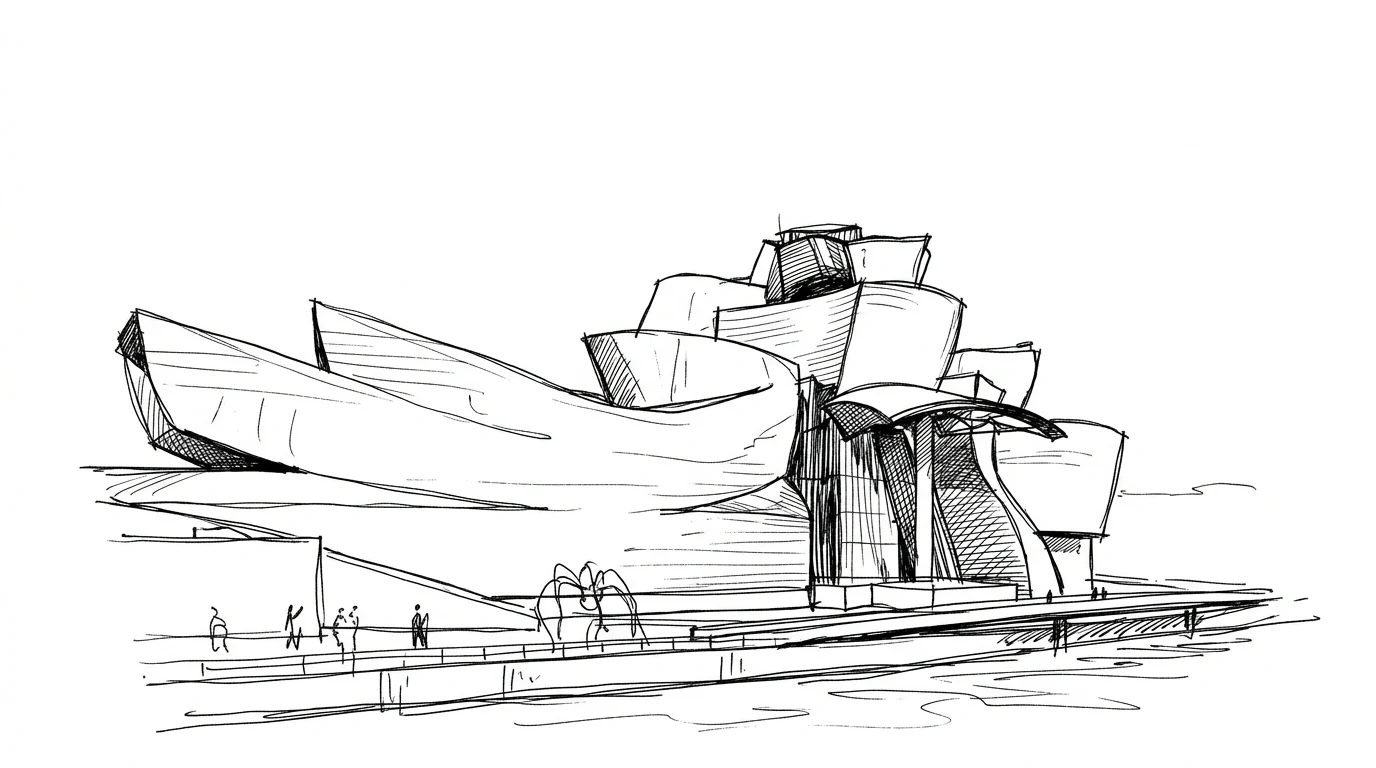
Frank Gehry was born in Toronto in 1929 and emigrated to Los Angeles in the 1940s. He studied architecture at USC, worked for various firms, and opened his own in 1962. For twenty years he was a local architect — good, appreciated, not famous. In 1978 he transformed his own house in Santa Monica, in an ordinary residential neighbourhood, adding a shell of industrial wire mesh, plywood and corrugated sheet metal. The result is the first deconstructivist house in history — not a theoretical manifesto but an experiment on a real building with cheap industrial materials. The neighbours protested. The critic Charles Jencks celebrated it. Gehry became interesting.
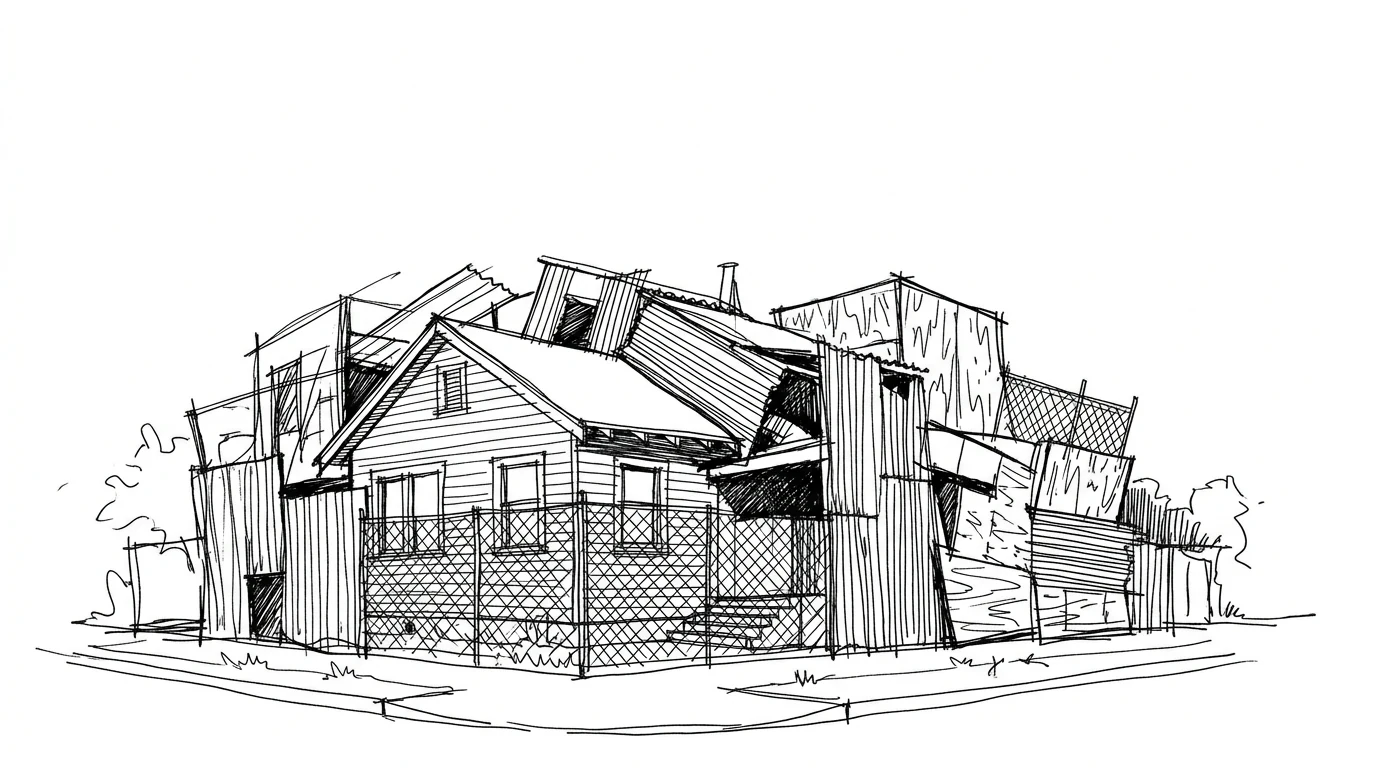
The Guggenheim Bilbao (1997) is the result of a transition Gehry made in the twenty years between the Santa Monica house and Bilbao: from material experimentation with poor materials to formal experimentation with rich materials. The titanium that clads the curved surfaces of the Guggenheim is not the obvious choice — Gehry made it possible by taking advantage of a drop in the price of titanium in the early 1990s. But titanium has a quality no other material has: it changes colour with the angle of the light. The Bilbao museum, depending on the time of day, the season, the sky, is golden, silver-grey, almost pink.
How curved surfaces are designed
The surfaces of the Guggenheim Bilbao could not have been built without the CATIA software, originally developed by the aircraft industry to design non-developable fuselage surfaces. Gehry adopted CATIA in 1989 — software born at Dassault to design fighter aircraft — and uses it to translate his physical models into construction drawings. The process is: a physical model of paper and wire, 3D scanning of the model, processing in CATIA, generation of the cutting plans for each titanium panel.
Every panel of the Guggenheim Bilbao has a different shape. There are panels produced in three copies each, panels produced in two, unique panels. The precision required is that of the aircraft industry — millimetre tolerances on surfaces of several square metres. Without CATIA it would be impossible. With CATIA it is expensive but feasible. Gehry's architecture is the first in history that would not be possible without a specific piece of software.
The Walt Disney Concert Hall and music as form
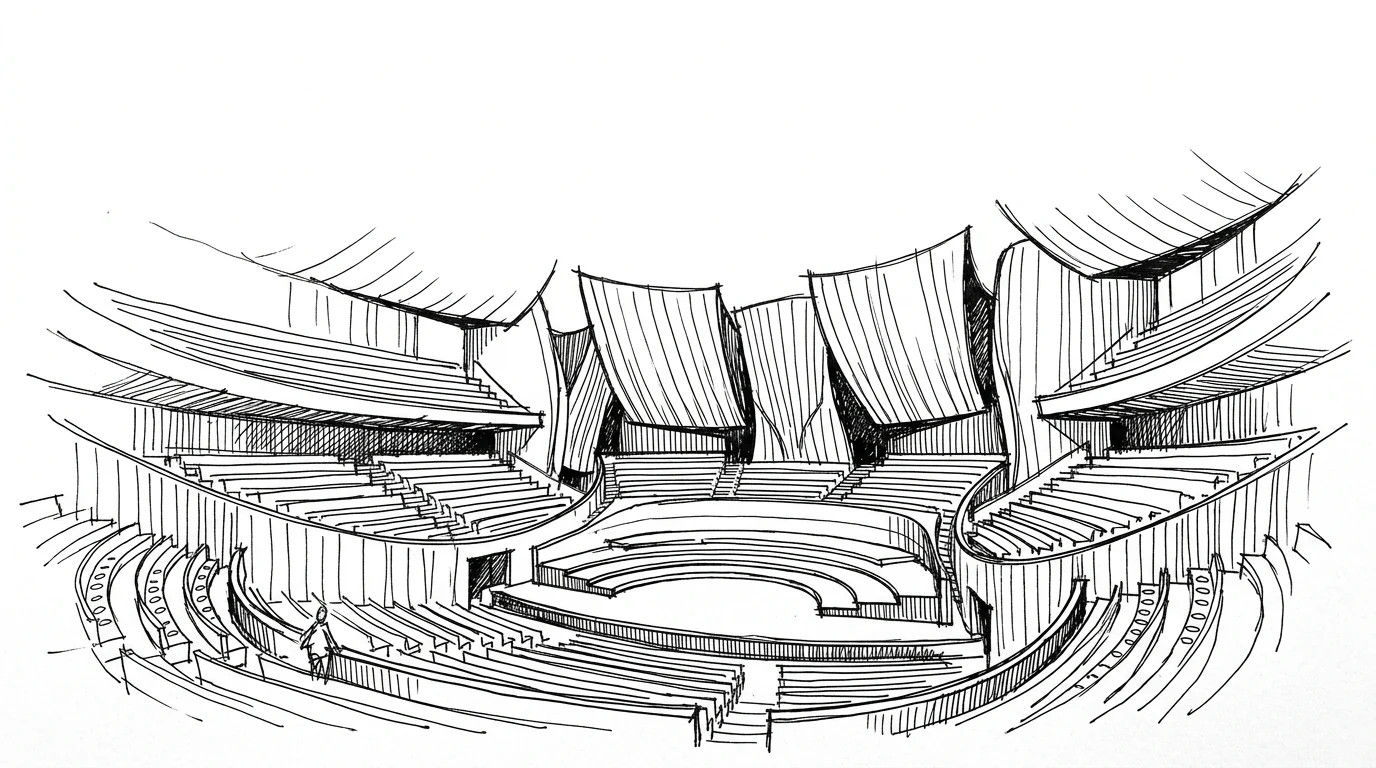
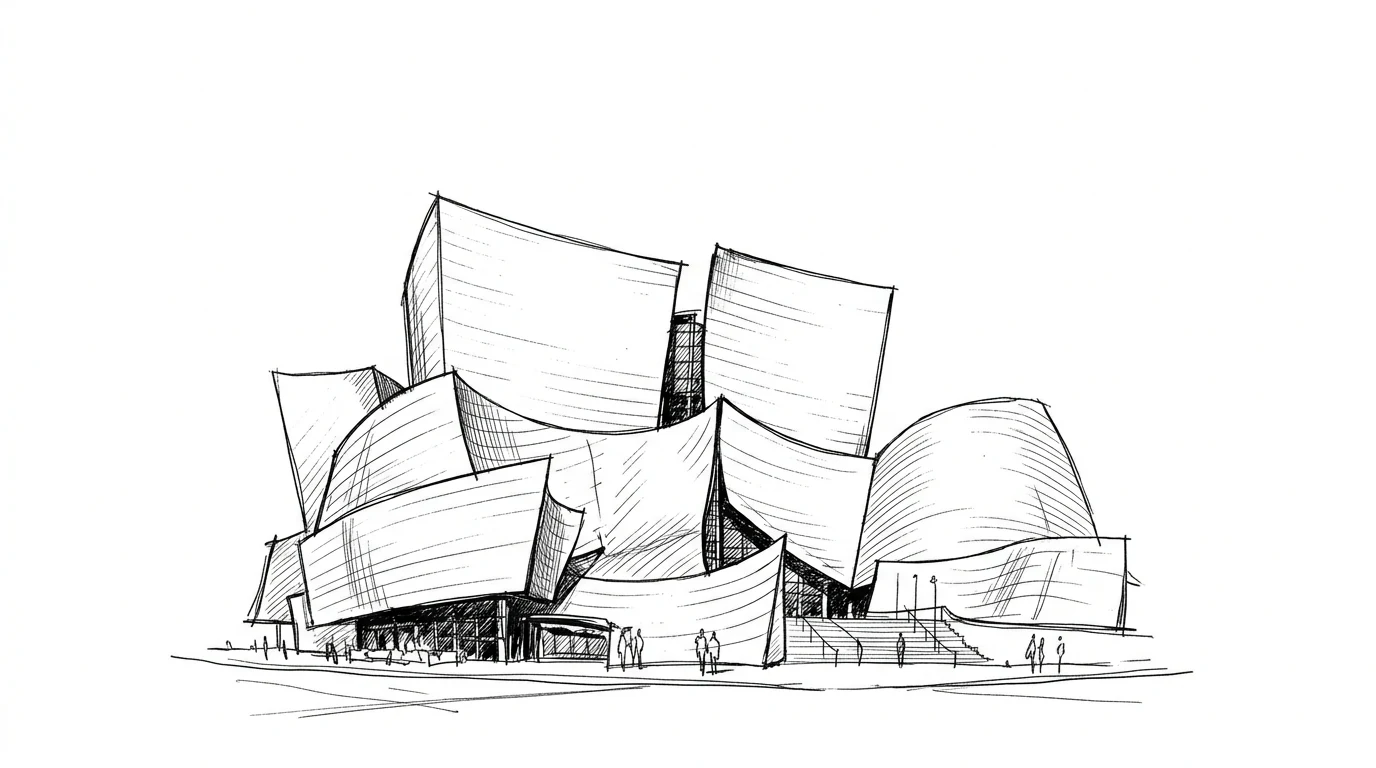
The Walt Disney Concert Hall in Los Angeles (2003) is the building in which Gehry solves the problem Bilbao had raised: how to make a high-quality interior inside a spectacular exterior form. The main problem of an auditorium is acoustics — and acoustics is the opposite of aesthetics: it requires specific surfaces, precise geometries, determined materials. The acoustic consultant Yasuhisa Toyota — who has worked on the best auditoriums in the world — designed the WDCH interior starting from the acoustic requirements and then adapting the form to them. The result is a concert hall in Douglas fir in a “vineyard” shape — with the stage in the middle and the audience on all four sides — which the Los Angeles Philharmonic declared from the outset superior in sound quality to the Dorothy Chandler Pavilion it had replaced.
The stainless-steel exterior — chosen instead of titanium for reasons of cost — reflects light differently from Bilbao's titanium: it is glossier, whiter, and on Los Angeles's sunny days it produced glare for pedestrians and for the residents of the neighbouring condominium, who complained. Gehry and the city solved the problem by sanding some panels to reduce the reflection. Architecture and a daily practical problem: the most beautiful building in the city was blinding the neighbours.
The “Bilbao effect” and its limits
The Bilbao effect — the phenomenon whereby a spectacular building transforms a city's tourism and image — is real, documented, and quantifiable in the case of Bilbao. But it is also specific: a Basque industrial city in decline after the end of the steel industry, investing in culture as a regeneration strategy, and choosing the right architect and the right museum at the right moment. It is not a formula that can be applied arbitrarily.
Cities that have tried to replicate the “Bilbao effect” by commissioning spectacular buildings in metallic ceramic or curved steel have almost always failed — not because the architecture was bad, but because the context was different. Bilbao worked for reasons that had nothing to do with Gehry's titanium: it had an accessible location in the European industrial area, a reachable visitor base, an old city worth visiting, a growing tourist hospitality sector. The titanium is necessary to Bilbao's image — but it is not the cause of its success. It is the symbol of an urban strategy that was already right before the architecture.