Zaha Hadid was born in Baghdad in 1950 into a secular, cultured family: her father was a liberal politician, her mother an artist. She studied mathematics at the American University of Beirut, then architecture at the Architectural Association in London — the most experimental and radical school in Europe at the time. There she met Rem Koolhaas and Elia Zenghelis, the founders of OMA, who took her on as an associate teacher just after she graduated. It was an unusual choice: Hadid had not yet built anything. Koolhaas recognised in her something different from the other students — not only talent, but a way of thinking about space that had no precedent.
What distinguishes Hadid's drawings of the 1980s is their source of inspiration: Russian Suprematism. Malevich, Lissitzky, Rodchenko — the Russian avant-garde of the 1910s and 1920s that broke the world down into pure geometric forms, in movement in space. Hadid took these paintings and treated them as sections of buildings: if Malevich could make a square float in pictorial space, she would make a plane float in architectural space. Her renderings of the 1980s — oblique watercolours and acrylics, like snapshots of buildings in free fall — were published in international magazines as works of art. They were beautiful and constructively impossible. Or so it was thought.
Twenty years without building: the lost competitions
Between 1983 and 1993, Hadid won two major international competitions. The Peak Club in Hong Kong (1983) — a private club on the top of Victoria Peak, with granite blocks that seem to float on the hill — won first prize but was never built for economic and political reasons. The Cardiff Bay Opera House in Wales (1994) won first prize but the jury changed its mind and commissioned the project from another practice. Hadid believed there was prejudice — as a woman, as an Arab woman, as the designer of something the client could not concretely visualise. She was probably right on all three counts.
This twenty-year period in which Hadid won but did not build is fundamental to understanding her trajectory. Instead of softening the projects to make them more buildable — as anyone would have done under that pressure — she radicalised the research. She opened her own studio in 1980 and worked with an increasingly sophisticated group of collaborators on computational simulations of her geometries. When advanced digital design software became available in the late 1990s, Hadid was ready: she had already conceptually solved the problems of form that others were only then beginning to consider.
The first building: Vitra Fire Station
The Vitra Fire Station in Weil am Rhein (1993) is her first building of any size — and she built it at forty-two. It is small: a depot for the firefighters of the Vitra complex, the same complex where Frank Gehry, Tadao Ando and Álvaro Siza work. But it shows something decisive: oblique surfaces, planes that tilt and collide, walls that seem to be falling, can be built. The concrete beams tilt downward without an obvious structural explanation — they are held by hidden reinforcement, calculated with millimetre precision. The building is uncomfortable to use — the firefighters moved elsewhere a few years after the inauguration — but as a statement of principle it is unequivocal.
The MAXXI in Rome
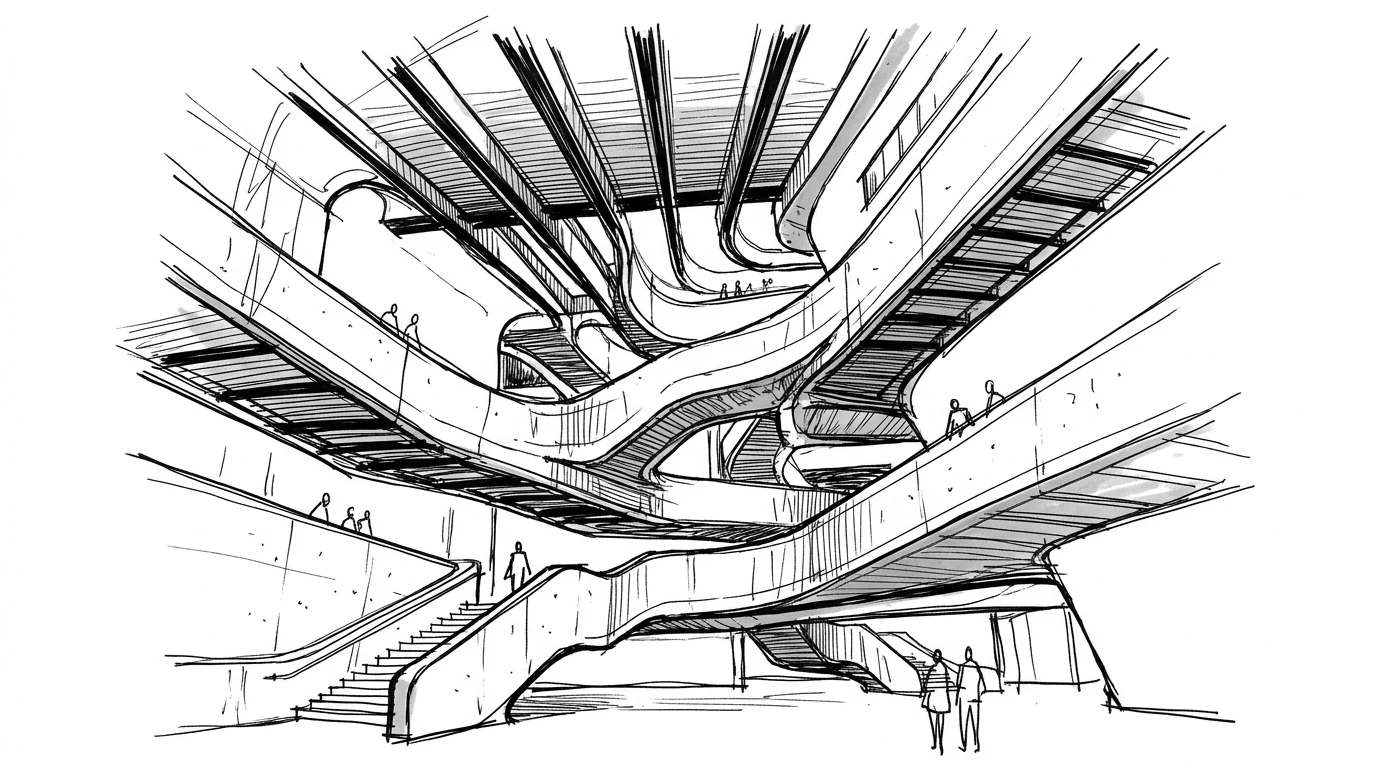
The MAXXI — the National Museum of 21st Century Arts in Rome (2010) — is the project that transformed Hadid from a promise into a recognised protagonist on the world stage. The competition dates from 1998, construction from 2003: twelve years of design and building work on a narrow plot in the Flaminio district, a former Italian Army barracks. The site constraint — a long, narrow urban strip — becomes the generator of the project: instead of a building that occupies the plot, Hadid designed a system of overlapping routes that unroll along the site, with galleries that look onto one another through bridges and voids.
The result has no main façade — you can enter from several sides — and the interior space is pure movement: ramps, stairs and galleries cross like a vertical motorway system. The problem recognised by everyone is that the space is magnificent to walk through but difficult for displaying art. The inclined walls do not allow conventional horizontal hanging. The variable-height ceilings complicate the lighting. The most successful galleries at the MAXXI are those that have found a way of working with irregularity — the curve as an exhibition opportunity, not an obstacle. It is a building that requires curators to be choreographers of space, not only of the work.
Parametricism and the Heydar Aliyev Center
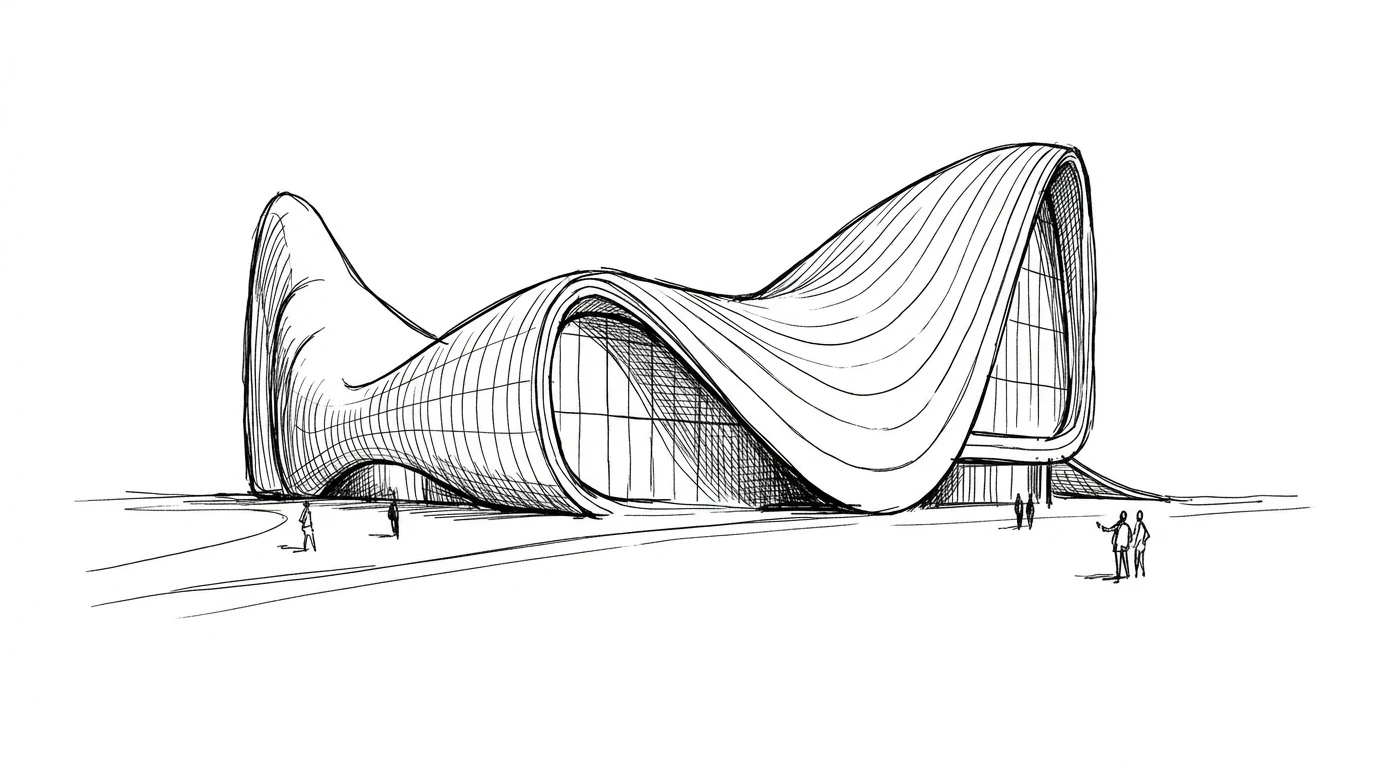
From the 2000s, Hadid and her partner Patrik Schumacher developed “parametricism” — a theory and practice in which forms are generated by computational algorithms that control families of curves, surfaces and volumes coherently. It is not “drawing with the computer”: it is defining mathematical relationships between elements and having them generate the form. The Heydar Aliyev Center in Baku (2013) is the building in which this system reaches its most complete expression: a continuous surface of fibreglass and concrete that rises from the ground, deforms, folds, forms the walls, the roof, the floors — without ever a corner, without ever a discontinuity. Looking at it is like looking at a liquid solidified in the instant before it disperses.
Parametricism has had an enormous influence on architecture schools in the 2000s and 2010s. The risk — pointed out by the sharpest critics — is that it easily produces spectacular forms but not necessarily good spaces. A beautiful curve is not automatically a space that works. Hadid knew this: her best buildings — the MAXXI, the Heydar Aliyev, the London Aquatics Centre for the 2012 Olympics — work the curve as a spatial device as well as a formal one. The less successful ones use it as scenography.
The end and the legacy
Zaha Hadid died in March 2016, at sixty-five, of a heart attack while hospitalised for bronchitis in a Miami hospital. She was working on more than forty projects in twenty countries. The studio — Zaha Hadid Architects, now led by Patrik Schumacher — continues to operate with the same formal agenda. The continuity is operational but not identical: Hadid was the intellectual engine and the media presence of the studio. Her authority derived from an unrepeatable path — twenty years of rejections, then global recognition — that no other collaborator can inherit.
Hadid's influence on contemporary architecture is ambivalent. She showed that apparently impossible geometries can be built. She changed the way digital technology is used in architectural design. She opened professional paths to generations of women architects who before her had fewer role models. She also produced a series of imitators who use the curve as a stylistic signature without the same conceptual solidity. It is the fate of every significant innovation: it is adopted before it is understood.