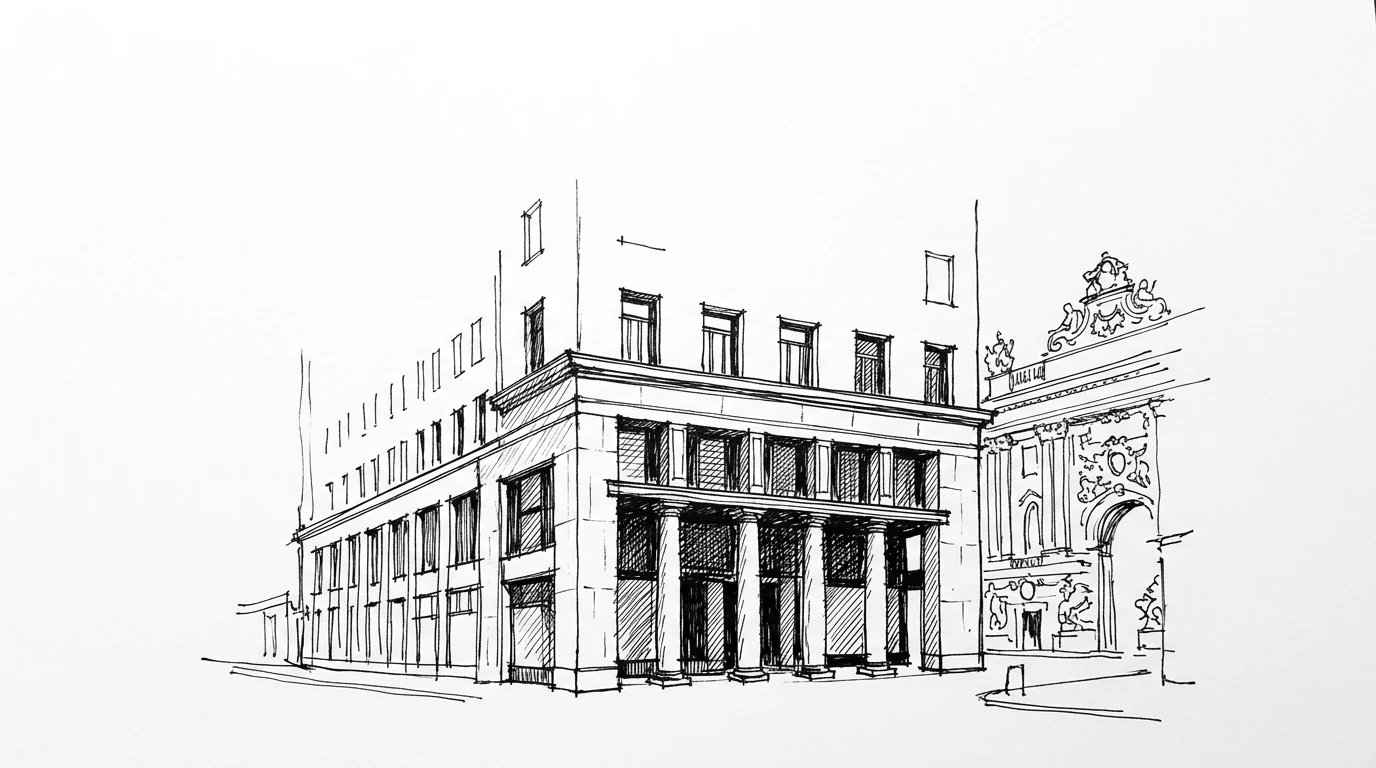
The Looshaus — the Goldman & Salatsch building — was completed in 1911 at Michaelerplatz 3 in Vienna, directly opposite the wing of the Hofburg, the imperial palace of the Habsburgs. Franz Joseph, who still lived in the palace, was furious. According to a much-quoted but undocumented anecdote, he ordered the windows on the square side kept shut so that he would not have to look at that façade. The Wiener Illustrirte Zeitung called it “the house without eyebrows” — because above the windows there are none of the decorative cornices that characterise every other Viennese building. Loos worked the façade in green cipollino and Skyros marble, luxurious and costly materials, but without a single decorative element that does not have a structural function.
Adolf Loos was born in 1870 in Brno, which was then in the Austro-Hungarian Empire. He studied architecture in Dresden, then spent three years in the United States — crucial years, because in Chicago he encountered the work of Louis Sullivan, the inventor of the skyscraper, and the American culture of functional pragmatism. When he returned to Vienna in 1896, he found a city in full artistic ferment — the Secession, Klimt, Jugendstil — and took a stand against all of it with a critical violence that would earn him many enemies and few friends.
Ornament as crime
“Ornament und Verbrechen” — Ornament and Crime — was read as a lecture in 1910 and published in 1913. The text is a provocation built on a historicist argument: the degree of civilisation of a culture is measured by its ability to reduce ornament. A child who scribbles on everything is less civilised than an adult who does not. A primitive who tattoos his body is at an earlier cultural stage than one who does not. Art Nouveau — Jugendstil — is a regression: a return to the atavistic need to cover every surface with decoration.
The argument is debatable — and Loos knows it perfectly well. It is not a rigorous philosophical essay: it is a polemical manifesto. He wants to create scandal and debate, and he succeeds. The effect is to crystallise in a sharp, memorable image an intuition others had already had in a more nuanced way: modern architecture does not need ornament because it has found its beauty in proportion, in material, in light.
The Raumplan
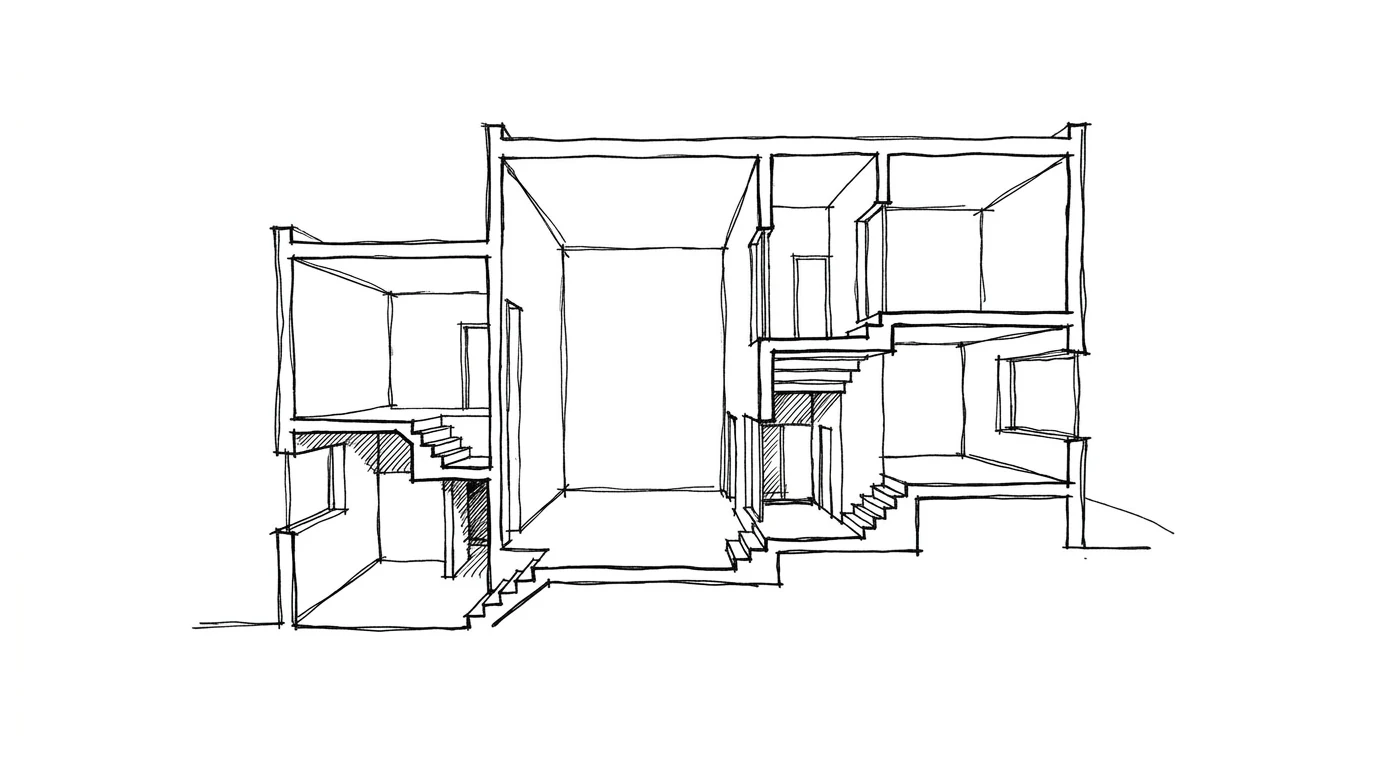
Loos's real invention is not theoretical but design-related. It is called the Raumplan — the plan of space — and it is a system of distributing internal rooms that abandons the principle of the continuous horizontal floor. Instead of having all floors at the same level per storey, Loos links rooms at different heights with short flights of steps, creating an internal section that varies continuously. Each room has the height suited to its function: the living room is high and spacious, the cloakroom is low and compact, the kitchen is at a half-level between the living room and the dining room.
The result is a domestic space in which you enter, go up, go down, and each room has a different quality — not because it is decorated differently, but because it has different dimensions and proportions. It is the opposite both of the traditional bourgeois house (rooms all at the same level with uniform heights) and of Le Corbusier's free plan (a single floor without divisions). It is a third way, typically Viennese — psychological before geometric.
Interior versus exterior
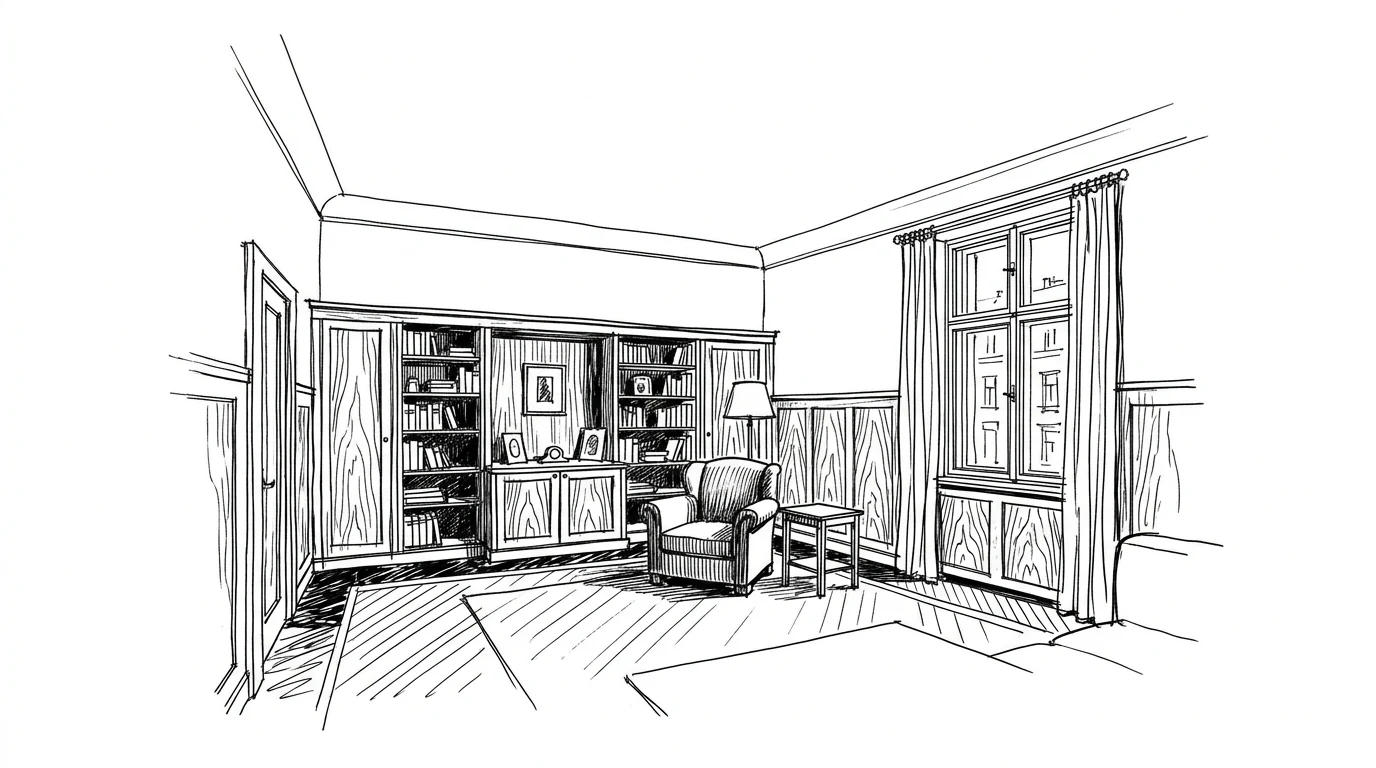
One of Loos's most original ideas — rarely discussed as much as ornament — is the radical distinction between interior and exterior. The exterior of a building, for Loos, belongs to the city and must respect the urban context — it must be sober, and must not impose its own personality on public space. The interior belongs to the inhabitant, is private, and can be the place of maximum sensuality and care in materials: warm wood, polished marble, red velvet, brass. The Looshaus is sober on the outside; the interiors were rich in fine materials, with mahogany shelving and black marble floors.
This distinction — austere public, rich private — is the opposite of Baroque architecture and Art Nouveau, which show all their richness on the outside. It is a bourgeois ethic of discretion translated into an architectural principle. And it has become one of the undeclared foundations of much twentieth-century rationalist architecture: buildings anonymous on the outside, interiors cared for.
Influence and limit
Loos died in August 1933, a few months after Hitler became chancellor and before seeing the National Socialism that would destroy the Viennese culture in which he had grown up. His built work is small — a dozen buildings, mostly private residences. But his essay has had a disproportionate influence: it is cited in every textbook of modern architectural history, and the equation ornament = crime has entered the common lexicon even of those who never read the original text.
The limit of that equation is that for half a century it made it difficult to discuss the subject of ornament without feeling culturally backward. When in the 1970s Robert Venturi and Denise Scott Brown rehabilitated ornament and postmodern decoration, they did so partly in response to the mortgage Loos had placed on the whole discourse. The pendulum had swung too far to one side — and like all pendulums, it swung back.