The cannon changes everything. The 10–15 meter tall vertical wall of the medieval castle — designed to withstand catapults and battering rams, to make climbing difficult, to let archers strike from above — is defenseless against the cannonball. The ball doesn't need to go over the wall: it demolishes it directly. And a vertical stone wall, struck repeatedly in one spot, collapses in a linear fashion — it creates a breach through which the attacking army passes. The Sack of Rome in 1527 is not an exception: it is the norm of a war in which whoever has more cannons wins.
The answer is geometric and counter-intuitive: instead of raising the walls, they are lowered. Instead of making them vertical, they are sloped. Instead of building them in fine stone, earth is added. A low, thick earthen wall absorbs cannonballs (which sink into it without causing collapses) and produces no debris to ease the assault. Projecting bastions — pentagonal or "arrowhead"-shaped — eliminate the "blind spots" at the foot of the walls where attackers used to hide: crossfire from the two flanks of the bastion covers the entire front area with no dead zones. The dry moat — harder to cross than a water-filled one, which cannons drain quickly — completes the system.
The trace italienne and its inventors
The protagonists of this evolution are Italian engineer-architects who build both palaces and fortresses — for them there is no contradiction. Francesco di Giorgio Martini writes the first systematic treatise (Trattato di architettura, ingegneria e arte militare, 1480s), in which the fortress is studied with the same rigor as the villa. Giuliano da Sangallo and his brother Antonio the Elder develop the first practical solutions; Antonio da Sangallo the Younger brings the system to its most elaborate form with the Fortezza da Basso in Florence (1534) and the design for the walls of Rome. Michele Sanmicheli brings the "trace italienne" to Verona — his Gates (Porta Nuova, Porta Palio, 1530s–1540s) are examples where military architecture attains an almost civic formal dignity: they are fortresses, yet they have pilasters, cornices and classical proportions.
The "trace italienne" — the bastioned fortress doctrine — develops in Italy between 1490 and 1530 and is exported across Europe within a few decades. From Brazil (Forte de São João in Salvador de Bahia) to Portugal, from Sicily to Finland, defensive systems from the 16th to the 19th century use the same geometric solutions invented in the workshops of Renaissance Italian engineers. It is probably the most pervasive Italian cultural export of the 16th century — more pervasive than painting, civil architecture, or music — because it answers a vital, immediate need: surviving artillery.
Palmanova: the fortress as ideal city
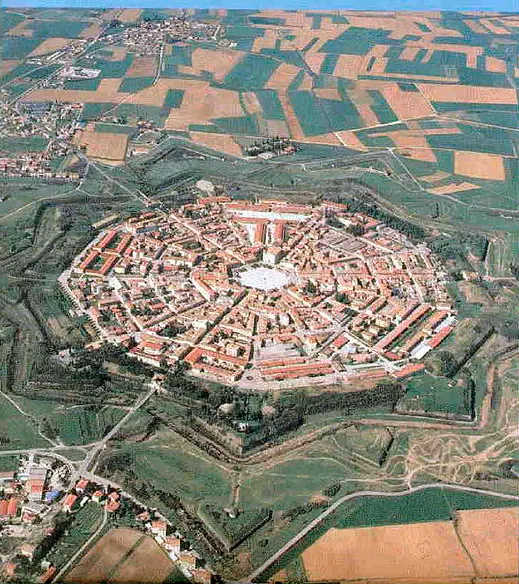
In 1593, the Republic of Venice founds Palmanova in Friuli — a new city built from nothing as an advanced fortress against the Turks and against Austria. The design is attributed to Vincenzo Scamozzi, but was developed by a commission of military and civil experts. The plan is a regular nonagon (nine sides) with star-pointed bastions at the corners, radial streets converging on the central hexagonal square, and rectangular blocks designed with precise proportions. The three successive city walls (Venetian, French, Napoleonic) were layered over the centuries, stratifying defensive systems from different eras.
Palmanova is the theoretically perfect fusion of the Renaissance ideal city (the rational geometry of urban space, theorized by Filarete and Francesco di Giorgio) and the bastioned fortress (defensive geometry). It is also, in fact, an almost failed experiment as a city: planned to house a significant population, it remained for centuries a small garrison. Perfect geometry did not produce urban vitality. The rationality of the plan did not by itself generate a community. It is one of the most eloquent historical cases of the limits of urban planning: one can build the perfect form of the city without building the city.
Vauban, obsolescence, and the urban legacy
Sébastien Le Prestre de Vauban — the Sun King's military engineer — brings the bastioned system to its highest sophistication in the 17th century. He builds or modernizes over 300 fortresses in France, develops systematic siege methods against bastioned fortresses (the "parallel trench" that advances progressively toward the walls), and theorizes defense as a science rather than an art. His 12 citadels, a UNESCO World Heritage site since 2008, are the final masterpieces of a two-hundred-year tradition.
The bastioned fortress becomes obsolete in the 19th century with the introduction of the howitzer — a cannon that fires on a curved trajectory, dropping from above onto the earthworks instead of striking them head-on. The earth that absorbed cannonballs does not stop exploding shells. Bastioned walls are demolished across Europe between 1850 and 1900 — and what remains is their most curious urban legacy: tree-lined boulevards. The old military exclusion zones (the areas kept free of buildings around the walls, needed for fields of fire) become, once the walls are demolished, the great perimeter boulevards of European cities. Vienna's Ringstrasse, the Boulevards of Paris, the Viali of Florence — all traced over the open spaces of the old bastioned walls. Renaissance military architecture shaped the form of our modern cities, and almost no one knows it.