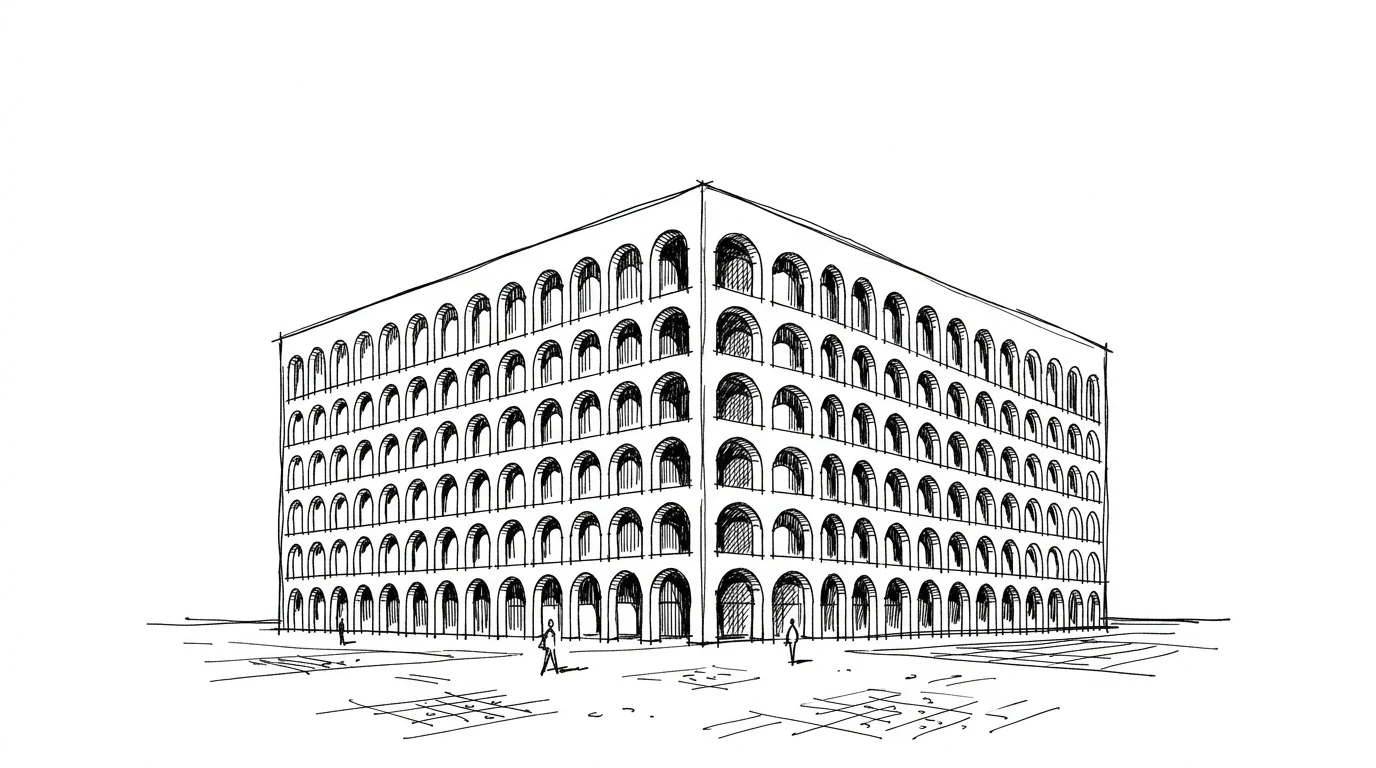
All the great regimes of the 20th century used architecture as a tool of legitimization and propaganda. This is nothing new — the architecture of power is as old as power itself: the Egyptian pyramids, the Athenian temples, the Colosseum, the medieval cathedrals, Versailles. Power uses architecture to say: we are here, we are permanent, we are great. The 20th century did not invent this use — it intensified it, systematized it, documented it.
The architecture of the Third Reich (1933–1945) — designed primarily by Albert Speer and Paul Ludwig Troost — is the most studied of the 20th century's totalitarian architectures. The model is imperial Roman neoclassicism: enormous Doric columns, marble, rigorous symmetry, monumental scale. Hitler had studied architecture as a self-taught amateur and had precise ideas about what he wanted. He wanted an architecture that would last for millions of years — like Roman ruins — and that would make clear to future generations the greatness of the Third Reich. Speer calls this idea the "theory of ruin value": a building is designed already thinking about how it will look as a ruin a thousand years from now.
The three models of the 20th century
Nazism is not the only regime to use architecture systematically. Italian Fascism — with the rationalism of Terragni and the monumentalism of Marcello Piacentini — produced a dualistic architecture: modernist in functional buildings (post offices, stations), monumental in representative buildings (ministries, squares). Rome's EUR district (1938 — the Rome Universal Exposition, never held because of the war) is the most complete example: a district of white marble with arches, colonnades, domes — the "Square Colosseum" (Palazzo della Civiltà Italiana) is its most famous image.
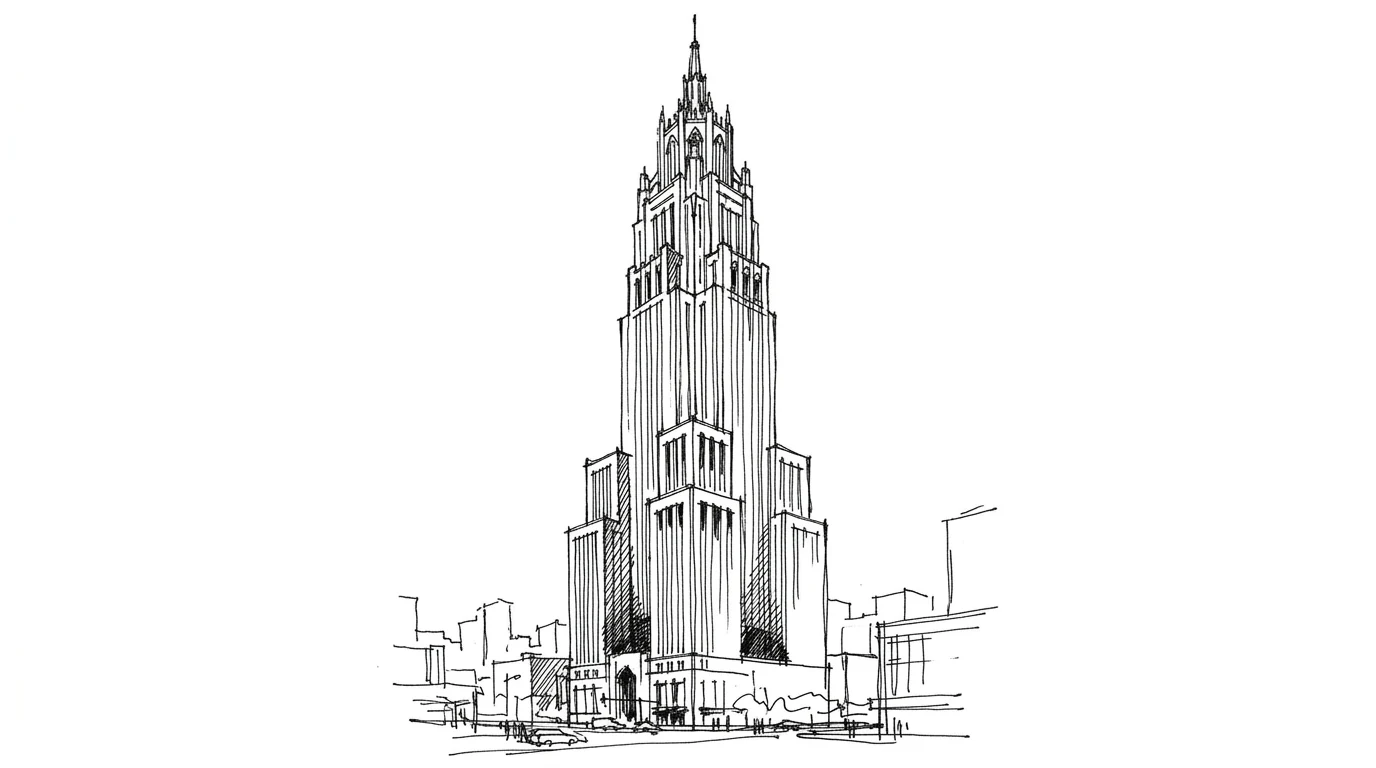
Soviet Stalinism produced "Socialist Realism" — ornate, classical architecture, "comprehensible to the people" — which Stalin imposed after liquidating the avant-garde constructivism of the 1920s. Moscow's "Seven Sisters" (1947–1953) — seven neo-Gothic Stalinist skyscrapers with star-shaped plans and spires — still dominate Moscow's urban landscape today. They were conceived as a response to American skyscrapers: socialism can build as tall as capitalism, and more beautifully.
Ceaușescu's Palace of the Parliament: absurdity taken to the extreme
Bucharest's House of the People — today the Palace of the Parliament — is the extreme case: the largest and most expensive administrative building ever built, second only to the Pentagon by volume. Ceaușescu had it built between 1984 and 1997 (completed after his death) using strictly Romanian materials — Ruschița marble, oak wood, Romanian Bohemian crystal — mobilizing 20,000 workers and 700 architects. The dimensions are absurd: 12 floors above ground, 8 below (including a bunker for nuclear survival), 1,100 rooms, 3,000 m² of carpets, 35,000 m³ of marble. To build it, Ceaușescu demolished a quarter of Bucharest's historic center — a church, monasteries, houses, entire neighborhoods — in 1984–1985.
Romania after 1989 does not know what to do with the building. It is too large to demolish (it would cost billions), too large to fill. The Romanian Parliament uses less than 30% of the space. The rest remains empty, or is used for events, or is simply abandoned. It is the monument of totalitarian megalomania turned into an unsolvable practical problem — a building that cannot be used, cannot be demolished, cannot be ignored. It is Europe's most embarrassing architectural legacy.
The hard question: beauty and morality
The question architectural historians cannot resolve: can totalitarian architecture produce beautiful objects despite its ideological context? The EUR's Square Colosseum is one of the most photographed buildings in Rome — coherent formal logic, high construction quality, quality urban space. It is a building of the Fascist regime, built to glorify the Roman Empire. It is also a remarkable architectural object.
Aesthetic judgment and moral judgment do not always overlap. Terragni's Casa del Fascio is beautiful — funded by the Fascist party. The EUR is architecturally coherent — a monument to Mussolini's imperialism. The ability to make good architecture is not correlated with the political correctness of the client. This does not mean the context can be ignored — it means both evaluations must be held simultaneously, without letting one cancel out the other. The history of architecture demands this uncomfortable duality. And post-communist Bucharest, with its empty 86,000 m² palace, reminds us that the question is not only theoretical: it is a question of who pays the bills.