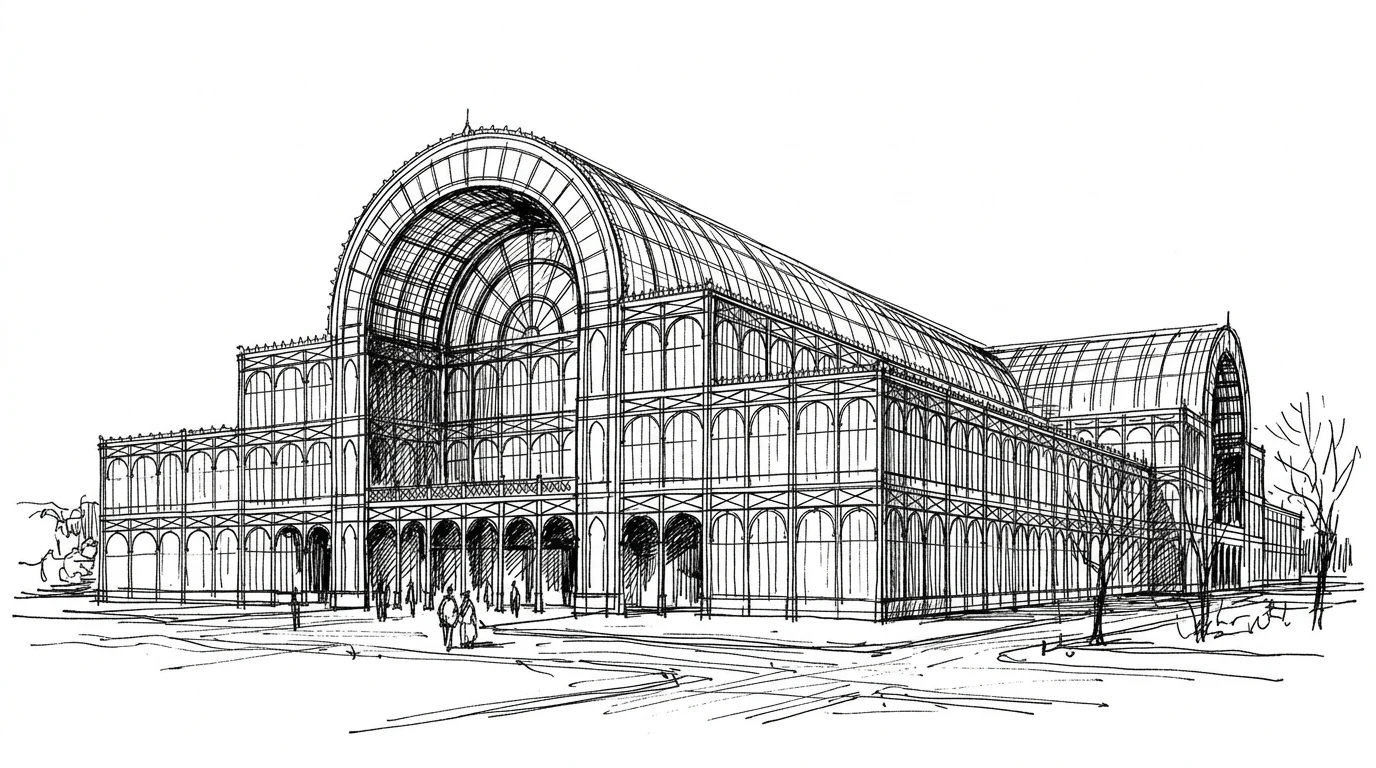
London's Crystal Palace (1851) is one of the most important buildings in the history of modern architecture — and almost no one knows it, because it no longer exists. It burned down in 1936 at its second location in Sydenham, South London, where it had been rebuilt after the 1851 Expo. Joseph Paxton — a gardener by trade, not an architect — designed it using the construction system he had developed for the Duke of Devonshire's botanical greenhouses: cast-iron elements prefabricated in a foundry, assembled on site like a giant Meccano set, clad in sheets of glass. No concrete. No stone. Iron and glass.
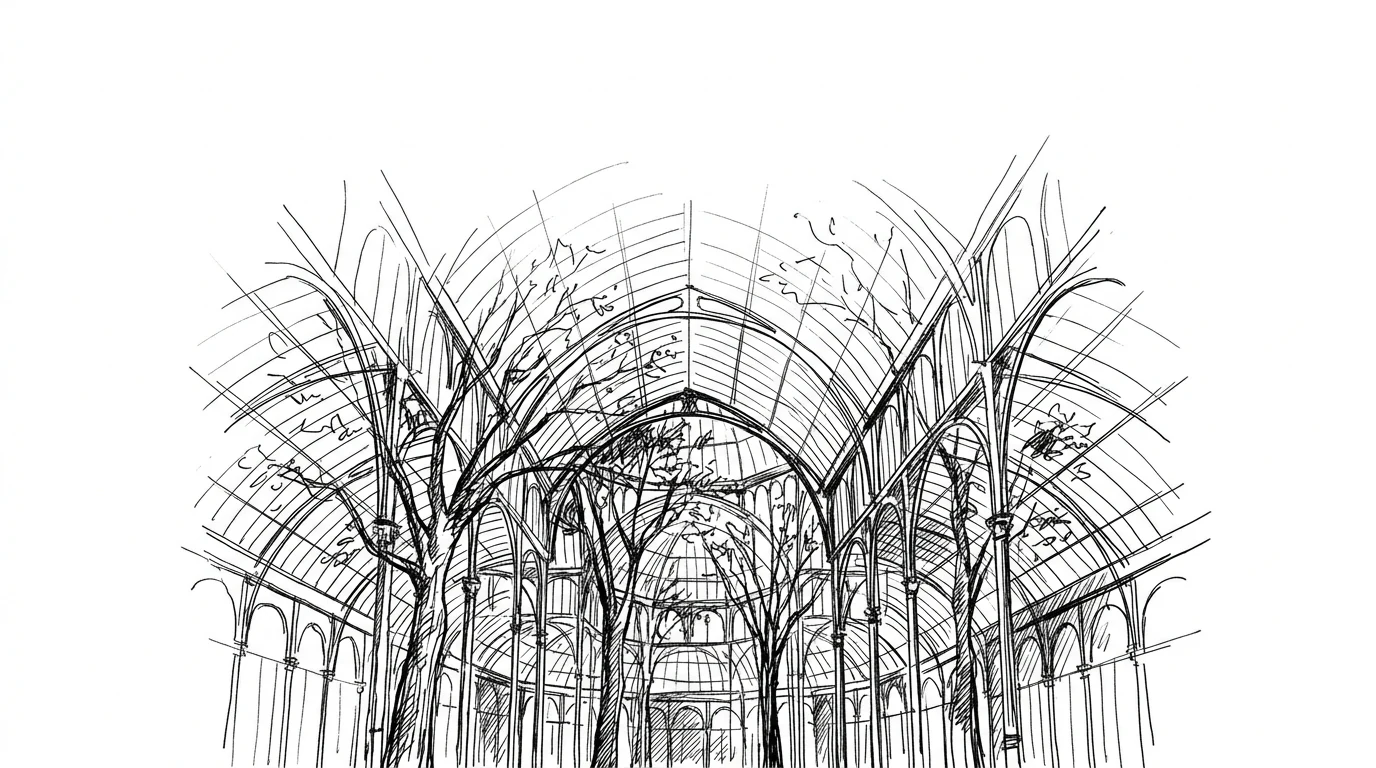
The Crystal Palace changed architecture because it proved that a building of enormous size could be built in a very short time (six months) using a system of industrial prefabrication. It's not a theoretical demonstration — it's a fact. The 563 metres of length, the height sufficient to enclose Hyde Park's great elm trees without cutting them down, the natural light illuminating the entire interior through the glass: all of this had been considered impossible until six months before. After the Crystal Palace, it no longer was.
Expos as laboratories
Every Universal Exhibition has produced at least one building or project that changed the history of architecture. The Eiffel Tower in Paris (1889) — built as a temporary structure for the Expo, saved from demolition in 1909 thanks to its use as a radio antenna — demonstrates the structural possibilities of iron at large scale. Mies van der Rohe's Barcelona Pavilion (1929) — built for the Expo, demolished in 1930, rebuilt in 1986 — is the manifesto of modern architecture: free plan, fine materials, flowing space. Buckminster Fuller's geodesic dome in Montreal (1967). Frei Otto's tensile-structure city in Munich (1972 — not an Expo but the Olympics, though the same principle applies).
The mechanism is always the same: the Expo allows temporary structures to be built with exceptional budgets and without the regulations that govern permanent buildings. Structures can be tested that would never be approved in any city. Materials not yet codified can be used. Buildings can be constructed without worrying about decade-long maintenance. The Expo is the laboratory where architecture tries things out before bringing them into the real city.
The Expo as a problem
World Expos have a dark side that is rarely discussed. Every Expo requires building a large district of pavilions — and these pavilions are rarely reused after closing. The Milan Expo 2015, spread over 110 hectares, produced structures that largely sat unused for years after closing. The Dubai Expo 2020 (held in 2021) built 192 national pavilions, most of which will be demolished. The "legacy" of Expos — the post-event reuse of the site and structures — is the unresolved problem.
But let's return to the fundamental question. Are Expos still necessary? In the internet era, you no longer need a physical event to see what the industries of 190 countries produce. Expos have lost their function as a commercial showcase. What remains — architectural experimentation, cultural exchange, the physical experience of spaces — is still valuable. Or at least, valuable enough to justify the environmental and financial impact? The answer varies depending on who you ask. Designers say yes. Urban economists say no. History says: it depends on the Expo.