Guy Debord — French theorist, filmmaker, drinker, polemicist — was born in 1931 in Paris and died in 1994 in Champot, in the Auvergne, by a gunshot (suicide). In between, he founded the Situationist International, wrote "La Société du spectacle" (1967) — the most-cited text of 1968 — and made six films. His influence on architecture is not direct: Debord did not design buildings. But his ideas about the city — about the dérive, about psychogeography, about the "spectacle" — changed the way a generation of architects and urban planners think about urban space.
The key concept of Situationism is the "dérive" — a technique of urban exploration based on letting oneself be carried along by the "psychogeographical currents" of the city. One does not go from A to B: the urban environment is left to guide the movement. Some squares attract — one stops. Some streets repel — one changes direction. After hours of drifting, one has a "psychogeographical map" of the city — very different from the official map. A map of paths, of the way public space shapes behaviour.
Psychogeography
Situationist psychogeography is not a scientific discipline — it is a critical method. It holds that urban space is not neutral: every space produces precise psychological effects. The space of consumption (the shopping mall, the shopping street) produces anxiety and desire. The space of power (the palace, the town hall square) produces subjection. Residual space (the alley, the abandoned courtyard) produces freedom. The traditional city had these residual spaces — places that were unplanned, unsurveilled, uneconomised. The rationalised modern city eliminates them. Situationism defends the voids.
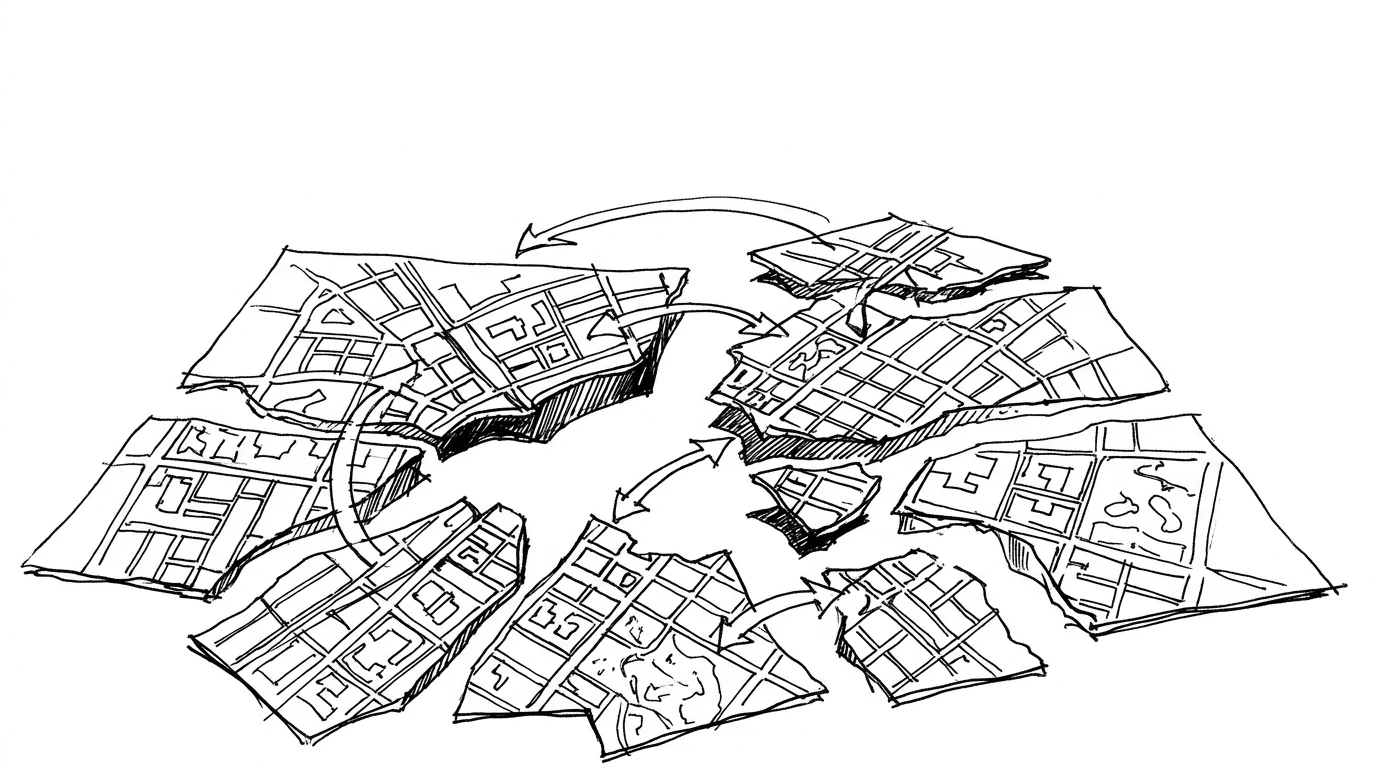
Situationism's most famous urban project is the "Naked City" by Debord and Asger Jorn (1957) — a map of Paris in which the neighbourhoods have been cut out and reassembled according to psychogeographical affinities, with red arrows marking the "corridors" of passage between one emotional area and another. It is not a transport map — it is a map of atmospheres. Le Marais is close to Belleville not geographically but emotionally. It is not a science — it is geographical poetry. But it anticipated by fifty years the debate on "place-making" and the sensory quality of public spaces.
New Babylon: the designed Situationist city
Situationism is not only critique — it also produces a project. Constant Nieuwenhuys (1920–2005), a Dutch painter and member of the Situationist International until 1960, worked between 1956 and 1974 on "New Babylon" — a model of an alternative city designed as a continuous metropolitan structure suspended above the existing ground. New Babylon is a network of interconnected megastructural platforms covering the territory with no centre: there are no fixed streets, no obligatory routes. The interior spaces — lit, climate-controlled, infinitely reconfigurable — transform according to the will of their nomadic inhabitants. It is permanent dérive institutionalised as urban form.
New Babylon is impossible to build — it already was in the 1960s, and it is even more so today. But as a theoretical critique of functionalist urbanism (of the Modern Movement, of Le Corbusier, of the master plan that divides the city into zones separated by function), it is precise and brutal: if the modern city separates work, rest and leisure, connecting them only by streets travelled by cars, New Babylon proposes drift as urban structure — a city where movement is the end, not the means. Ivan Chtcheglov, a twenty-year-old student, had already written in 1953 (in a text published by the SI as "Formulaire pour un urbanisme nouveau") that "the future city" must be continuous, labyrinthine, endlessly walkable. New Babylon is the graphic answer to that text.
1968 and its influence on architecture
In May 1968, the walls of the Sorbonne and of French universities were covered with Situationist slogans: "Sous les pavés, la plage" (under the paving stones, the beach), "Ne travaillez jamais" (never work — a phrase written by Debord in 1953), "L'imagination prend le pouvoir" (imagination takes power). The Situationists did not lead 1968 — they numbered barely a handful across six countries when it broke out — but their vocabulary was everywhere. "Dérive" became student uprising. "Détournement" became political collage on the walls. The critique of "spectacle" became critique of mass capitalism.
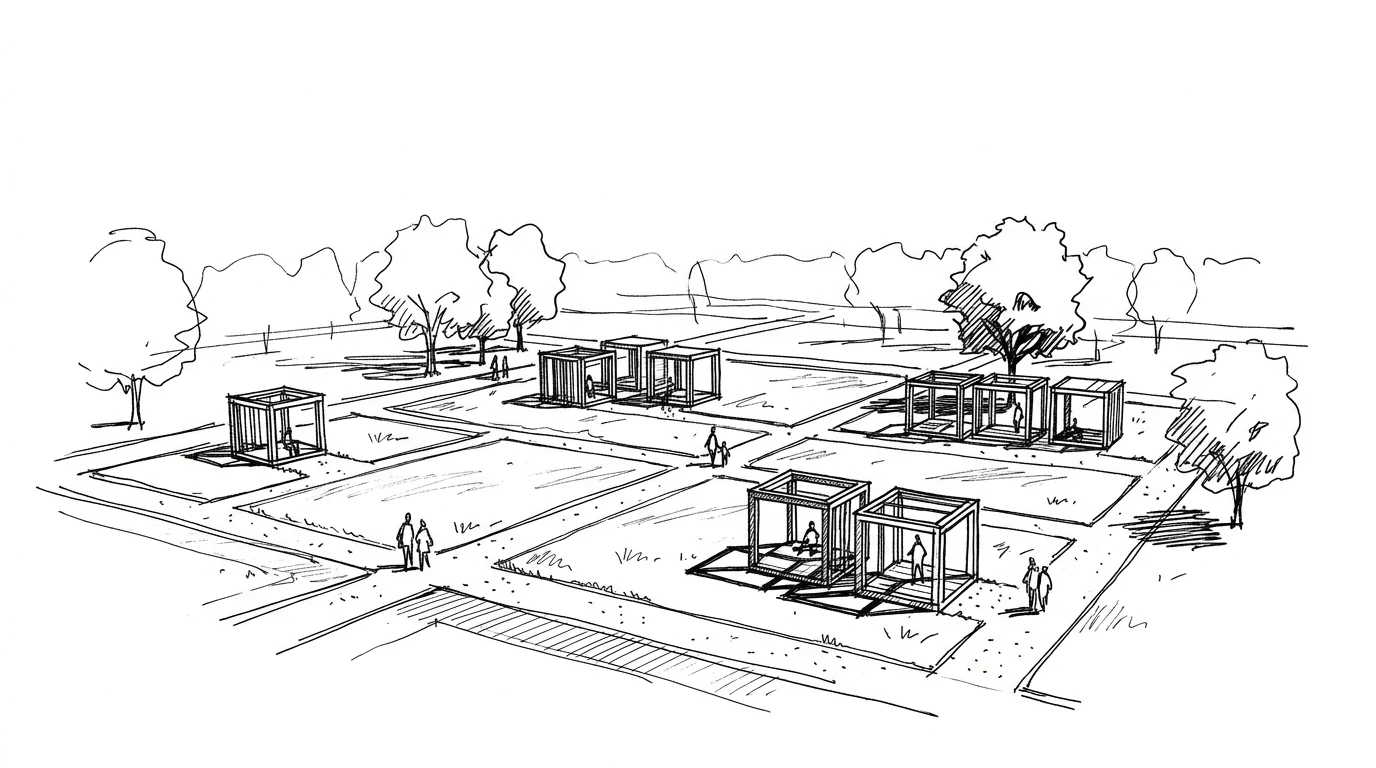
The influence on architecture is indirect but real. Bernard Tschumi — Swiss, professor at Columbia, architect of the Parc de la Villette in Paris (1983) — is the theorist who most explicitly incorporated Situationism into architectural thought. The "Folies" of the Parc de la Villette — red points with no predetermined function, distributed across a grid in the park — are architectural objects without a fixed programme: each can be transformed, occupied, used differently. This is not architecture that determines behaviour: it is architecture that leaves open the possibility of unforeseen behaviour. It is Debord's "constructed situation" translated into built architecture. Situationism lost the political battle. It won, at least in part, the theoretical one.
The contemporary legacy
Situationism officially ends in 1972, when the International dissolves after years of internal feuds and systematic expulsions (Debord expels almost everyone, in the end). But its ideas survive in different forms. Walter Benjamin's "flâneur" — the aimless urban wanderer — is a forerunner. Parkour, from the 2000s onward — crossing the city using urban elements in unintended ways — is a descendant. The critique of the surveilled "smart city" — the city fitted with sensors and algorithms that eliminate chance and the informal — often uses Situationist arguments without citing them.
The question posed by Situationism — what is lost when the city is completely rationalised? — is still open. Jane Jacobs, who never cited Debord, gives the same answer from the opposite direction: life is lost. Cities work because of their imperfections, their dark alleys, their mixed uses, their unplanned interstitial spaces. Le Corbusier wants to eliminate them. Debord wants to defend them. In this sense, Situationism is the most coherent critique of modern urbanism that the twentieth century produced — even though it was formulated by a handful of artists and theorists who met in Parisian cafés and despised one another.