Charles-Édouard Jeanneret — known as Le Corbusier from 1920 on — was born in 1887 in La Chaux-de-Fonds, Switzerland, and died in 1965 in Roquebrune-Cap-Martin, France, drowned while swimming in the Mediterranean. In between: fifty years of architecture, urban planning, theory, propaganda. Le Corbusier is not just an architect — he is a cultural phenomenon. His influence on twentieth-century architecture is enormous — and almost no one agrees on how to assess it.
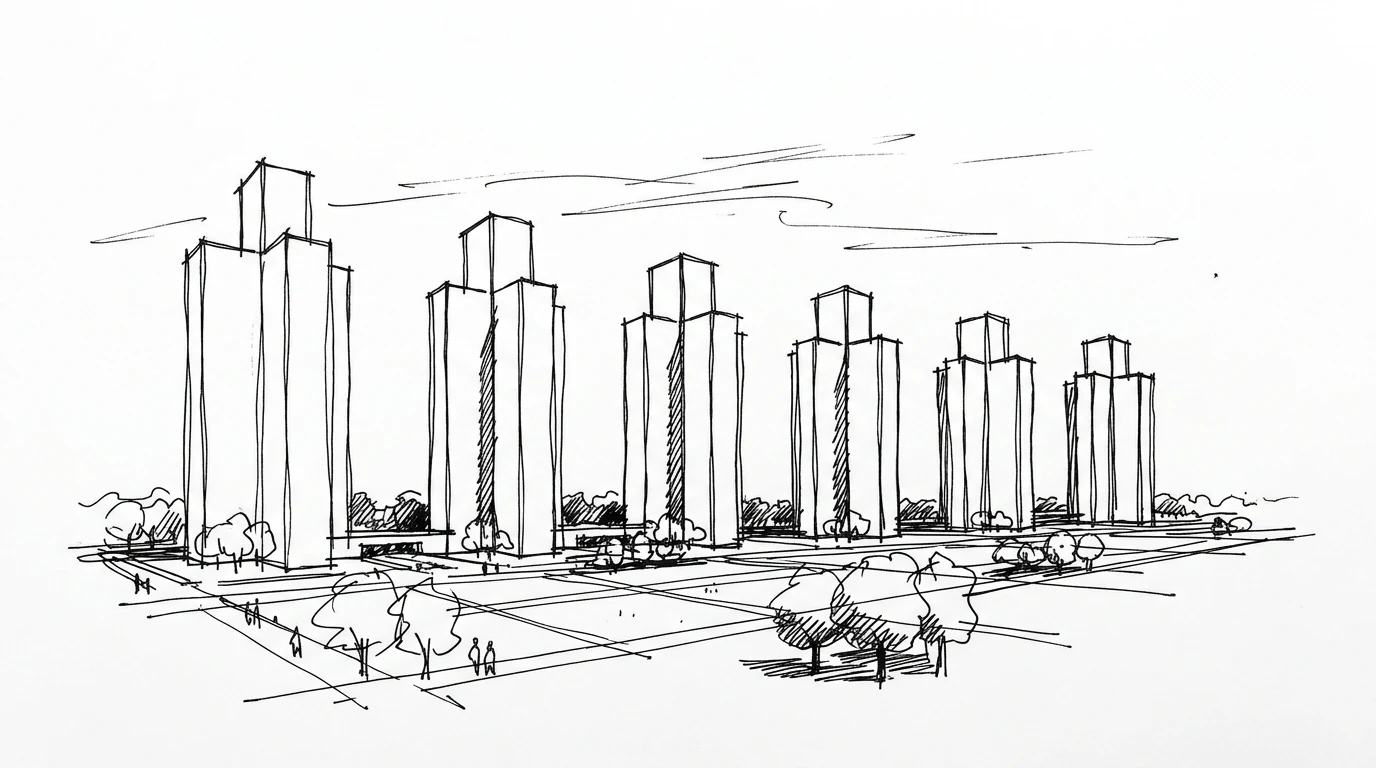
The "Plan Voisin" of 1925 is his most radical — and most controversial — urban planning project. The title comes from the name of a carmaker (Voisin) who finances the presentation. The plan: demolish almost the entire historic center of Paris north of the Seine — 240 hectares, including the medieval Marais — and replace it with 18 "cruciform" skyscrapers of 60 floors, arranged on a geometric grid, with the ground freed up as one continuous park. Housing density would be very high, but concentrated vertically. The ground would be green. The streets would be highways. Service areas (shops, schools, etc.) would sit on the lower floors of the towers.
The "Ville Radieuse" principle
The "Plan Voisin" is the application of the general principle that Le Corbusier calls the "Ville Radieuse" (radiant city, 1930) — the optimal modern city. The principle is simple: separate the functions. The traditional city mixes housing, shops, offices, factories, streets — all overlapping and confused. The Ville Radieuse separates everything: residential zones, work zones, service zones, green zones, traffic zones. Each function has its own optimal space. The city is a machine — and like any machine, it works better when its parts do only what they were designed to do.
And here we need to be precise: Le Corbusier's logic is coherent and not stupid. Nineteenth-century cities were unhealthy, overcrowded, chaotic. Separating functions, giving air and light to every apartment, accessible greenery — these are legitimate goals. The problem is not the end: it's the method. Demolishing Paris to build the rational city is like cutting off the head to cure a toothache. Le Corbusier's "machine for living in" ignores everything that makes cities livable beyond hygiene: history, complexity, chance, accumulation.
Chandigarh and the built works
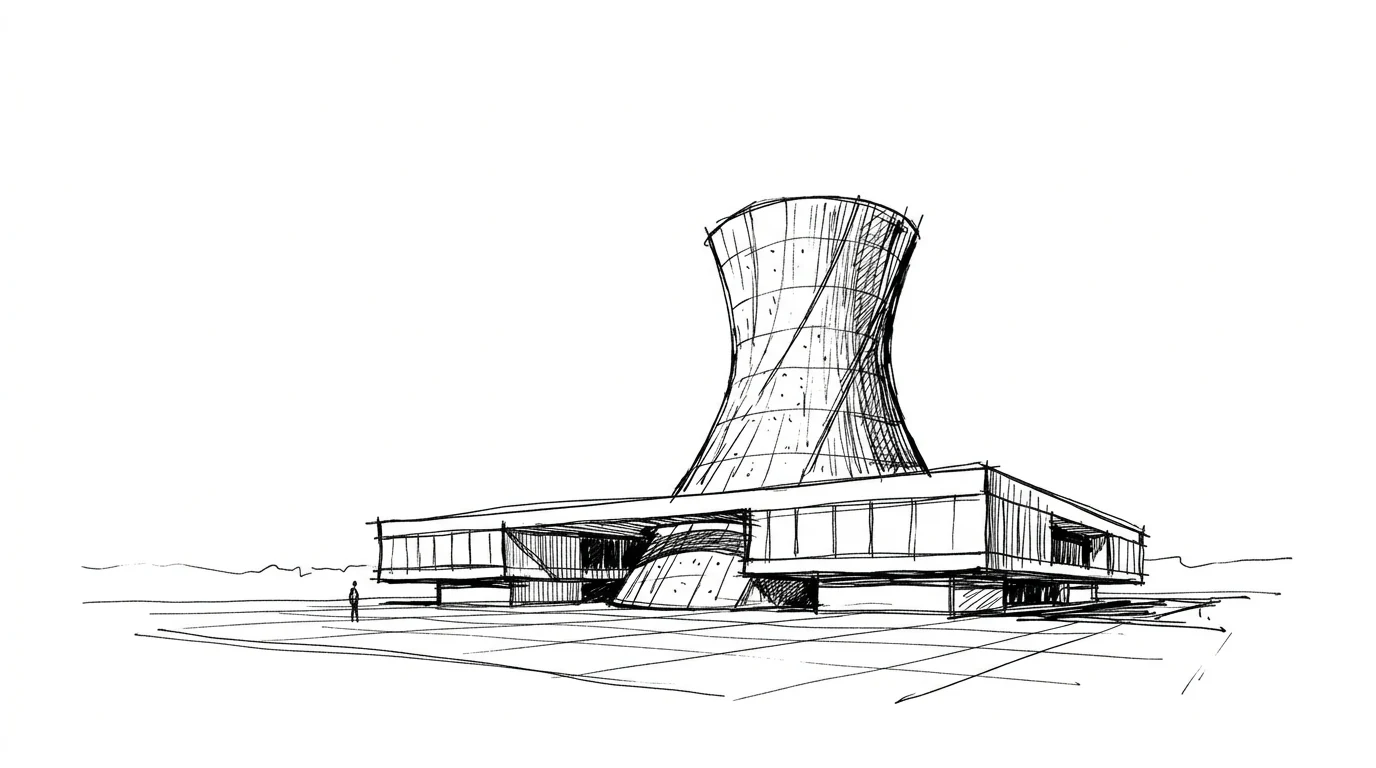
The plan for Paris is never carried out — for obvious reasons. But Le Corbusier realizes his urban planning ideas elsewhere. Chandigarh (1953), the new capital of Indian Punjab after the 1947 partition, is his most famous built city. The layout is an orthogonal grid with numbered sectors, separate functional zones, and the Capitol Complex (with the Legislative Assembly, Secretariat, and High Court) at the top as the city's "head." The result is functional but cold — the distances are huge, street life almost nonexistent, the great institutional buildings isolated in greenery.
The most interesting thing about Le Corbusier is not what he built — it's what he inspired. The great European peripheries of 1950–1970 — the French "banlieues," the German "Großsiedlungen," the British "new towns," Italy's INA-Casa housing estates — draw, in different and sometimes unwitting ways, on the Corbusian idea of separating functions and building vertically while leaving greenery around. The result is often the bleak periphery we know today — not because the idea was necessarily wrong, but because it was applied without the conditions Le Corbusier considered essential: quality public space, services, sufficient density. Le Corbusier's fault is not the idea — it's that the idea was only viable under conditions that no social housing developer had the resources to guarantee.