In 2000, Wang Shu learned that a village on the outskirts of Hangzhou was about to be demolished to make way for a property development. He organised a group of students and workers to collect the bricks, the clay tiles, the stones of the walls. He came back with enough material to clad a surface of thousands of square metres. Then he waited ten years before using it.
Wang Shu was born in Urumqi in 1963. He studied architecture in Nanjing. In 1997 he founded, with his wife Lu Wenyu, Amateur Architecture Studio — the name is deliberately provocative in a context where Chinese architecture was becoming increasingly professionalised, standardised, tied to large international firms. “Amateur” means not submitting to the constraints of the market and mass production; it means being able to afford to experiment, to make mistakes, to start again.
The Hangzhou Academy of Arts
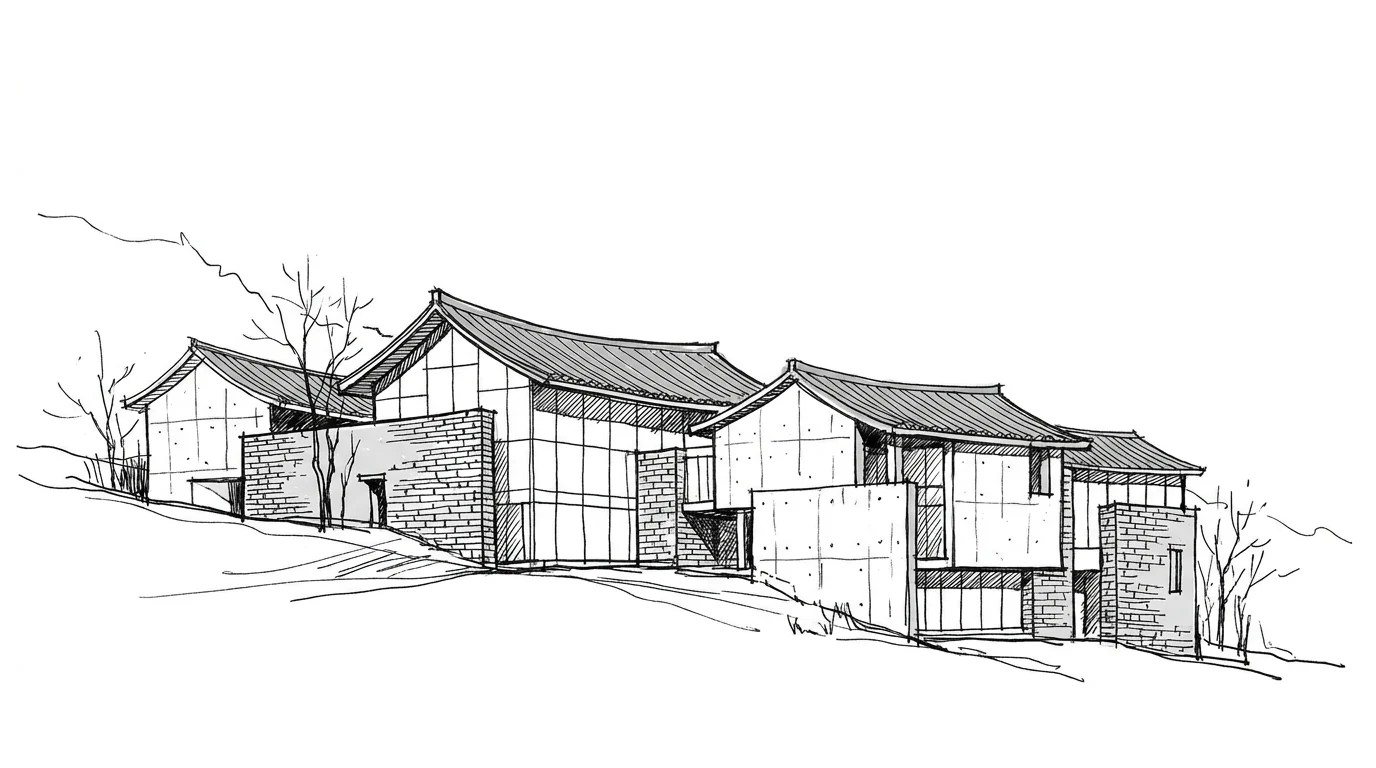
The Xiangshan campus of the China Academy of Art in Hangzhou (first phase 2004, second phase 2007) is Wang Shu's most ambitious work. Sixteen buildings arranged along the side of a hill, oriented so as not to block the view of the mountain from below and of the lake from the top. The materials come from two sources: reinforced concrete for the structure, and the salvaged materials — millions of bricks and tiles — for the external surfaces.
The result is one of the most unusual university campuses in the world: the buildings seem aged, as if they had been built centuries ago and restored. Surfaces of old brick alternate with contemporary glass windows, raw concrete structures, curved roofs of grey tiles. It is not historical pastiche: it is a deliberate temporal stratification, which makes old and new coexist without trying to make them uniform.
The Ningbo History Museum
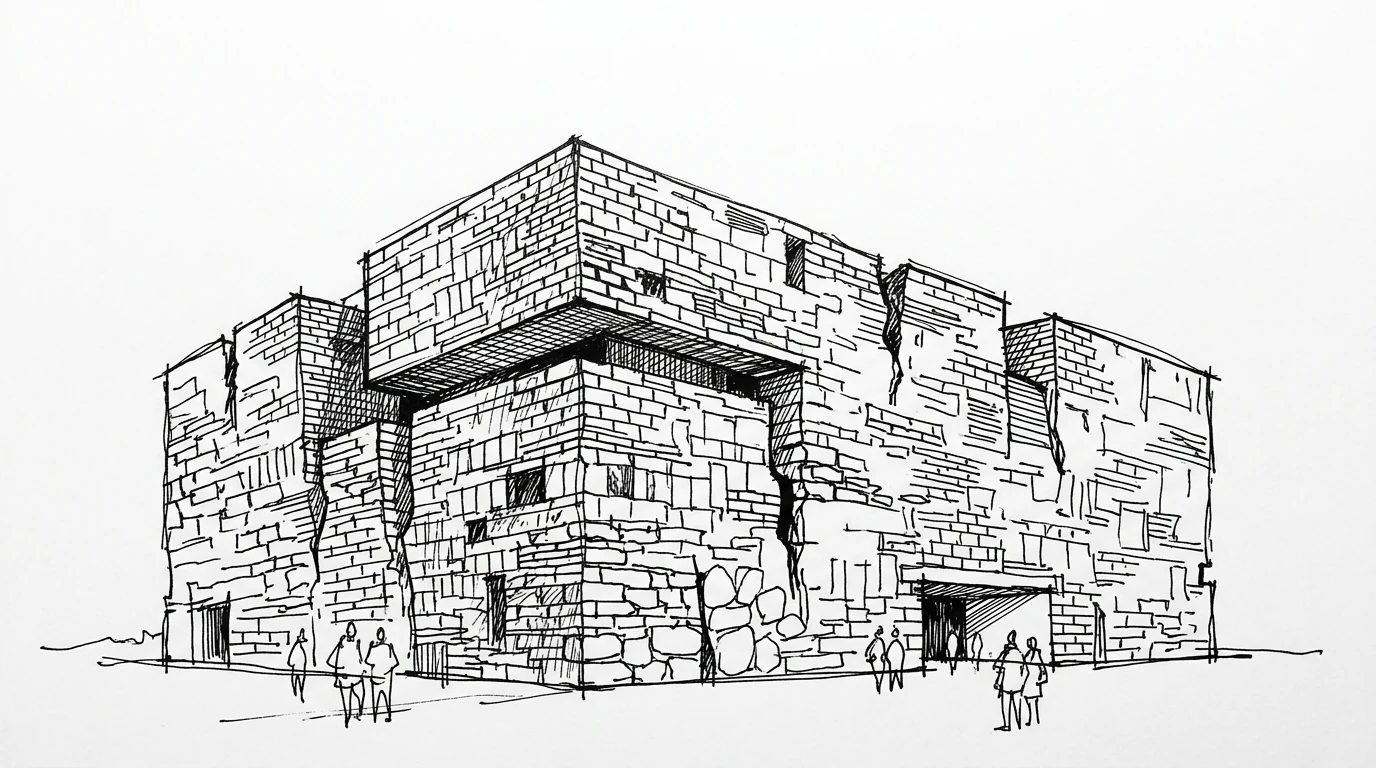
The Ningbo History Museum (2008) is the building that made Wang Shu known outside China. The main block — a 24-metre-high monolith with irregular surfaces of bricks from different eras — looks like a fragment of a medieval city enlarged and transformed into an architectural volume. The bricks, tiles and stones come from 20 demolished villages in the Ningbo countryside during the urbanisation process of the 2000s.
The most common criticism of Wang Shu is that recycling the materials of demolitions makes architecturally presentable a process — the forced demolition of Chinese villages to make room for cities — that is socially violent. Translated: you are using the material of what was destroyed to make beautiful architecture. Wang Shu replies that the opposite — building new buildings with new materials and forgetting the demolitions — would be even worse. Architecture can at least bear witness to what was demolished.
The Wenzheng Library and the apprenticeship on site
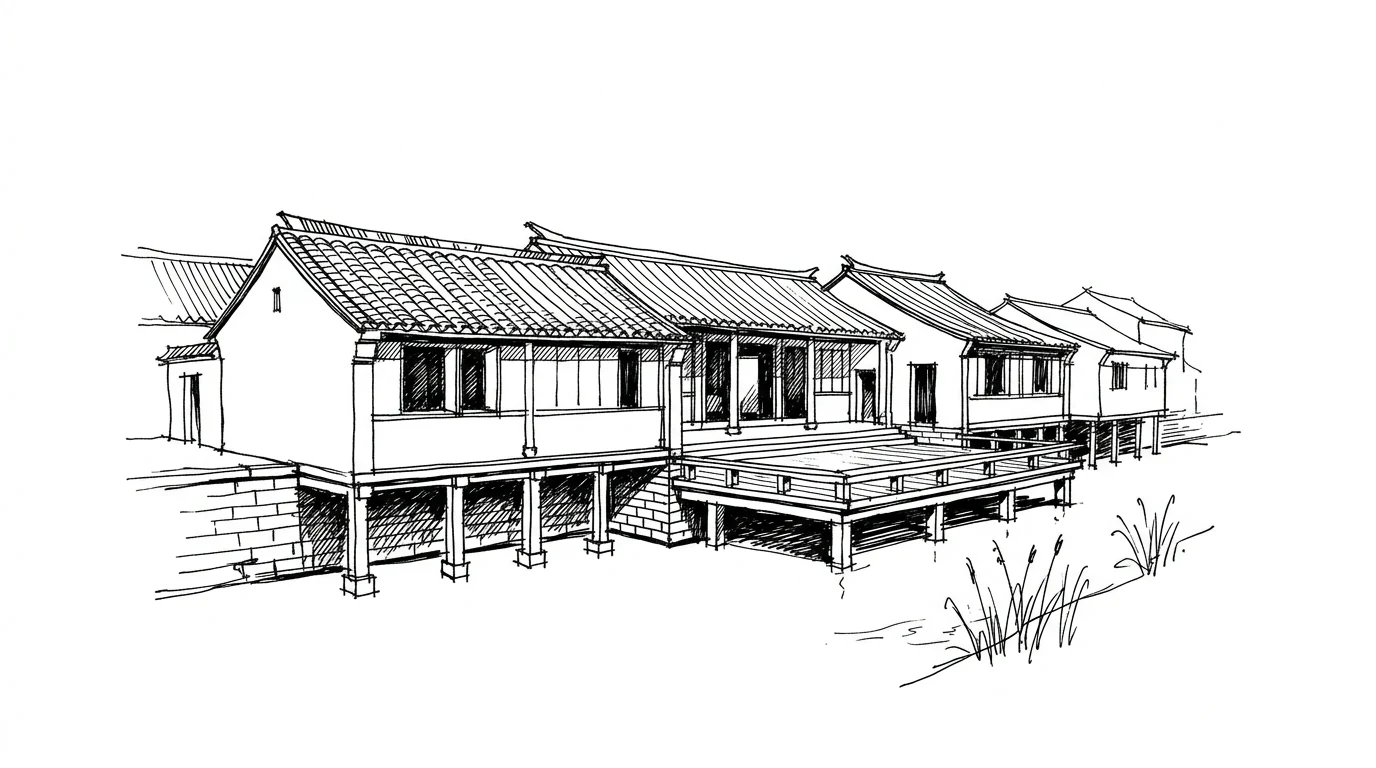
Before the Xiangshan campus, Wang Shu built the Wenzheng Library in Suzhou (1999-2000) — his first major public work. The library is a low building on the water: half of the building is above the canal, half below, with a terrace on piers that takes the visitor out over the water. The materials are wood and local brick. The effect is of an architecture that belongs to no precise style — it is not traditional, not modernist, not historicist. It is an attempt to find a language that emerges from the materials and topography of the place instead of being imported from an international manual.
Wang Shu spent years on building sites learning from masons: how to lay an ancient brick without breaking it, how to mix a mortar compatible with a hundred-year-old material, how to treat a terracotta tile to prevent leaks without waterproofing it with products that denature it. It is not nostalgia — it is technique. Salvaged materials pose real construction problems that university does not teach. Wang Shu learned them in the field, working with local craftsmen who still have these skills — and knows that in a generation these skills could be lost for good.
Amateur Architecture Studio
Amateur Architecture Studio, founded by Wang Shu and Lu Wenyu in 1997, is a studio with fewer than thirty employees — small by the standards of the Chinese property market, which produces buildings of enormous scale through industrialised processes. Lu Wenyu is not a co-founder in name only: she is an architect fully involved in the design of every building, with a particular sensitivity for material detail and landscape. The name “amateur” is programmatic: in a context in which Chinese architecture of the 1990s and 2000s was dominated by large international practices (Koolhaas, Foster, Hadid — all with major commissions in China), Amateur Architecture Studio deliberately bets on craftsmanship, on slowness, on the refusal of growth as an objective.
Wang Shu has systematically refused to grow beyond a certain size, even after the 2012 Pritzker Prize — the first awarded to a Chinese architect. The reason is practical: a large studio cannot afford to collect bricks from demolished villages, spend years on building sites, involve local craftsmen for techniques requiring months of preparation. A large studio works with standardised materials, industrial processes, compressed design times. Staying small is the condition for remaining free to choose materials and methods. It is a political gesture as well as a design one.