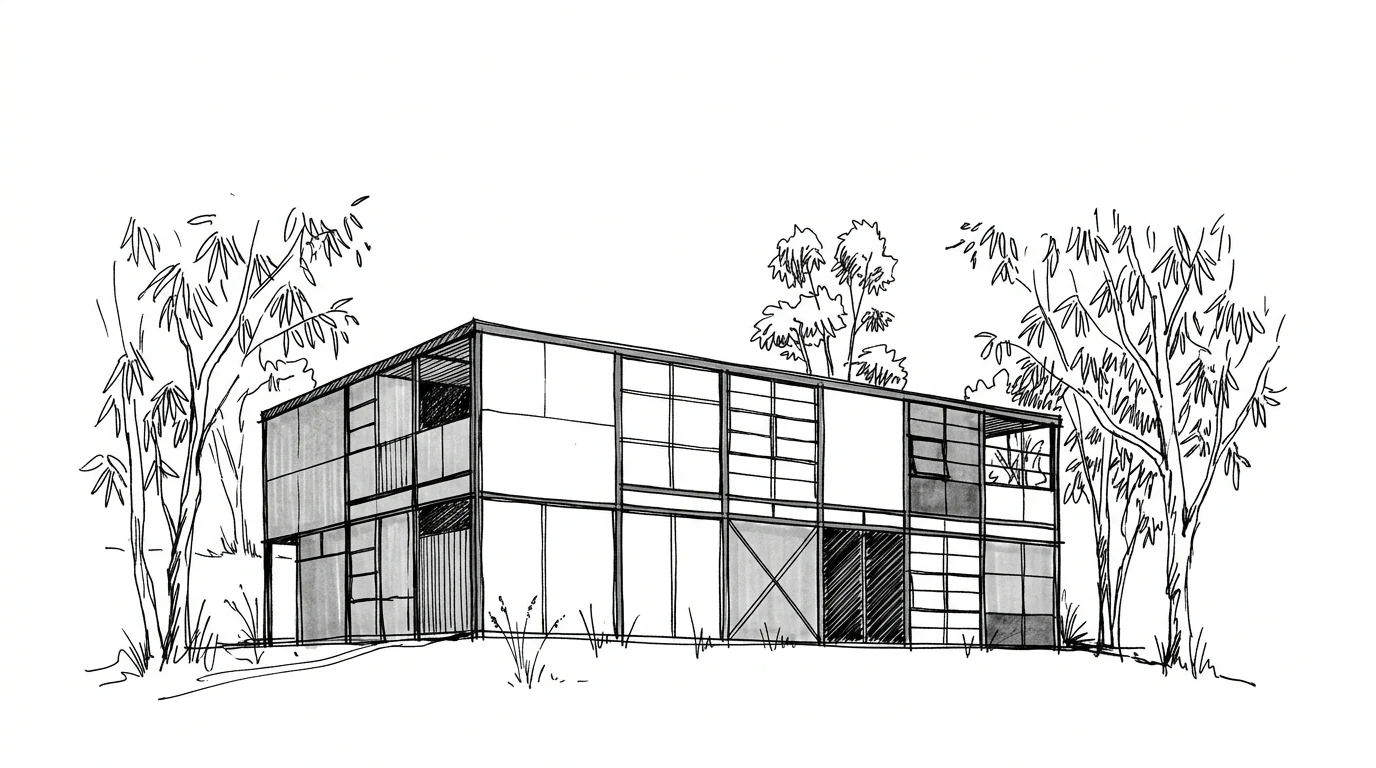
Charles Eames began as an architect. He studied at Washington University in St. Louis, worked for a few years in Eliel Saarinen's office at Cranbrook, and then met Ray Kaiser — a painter, designer, pupil of Hans Hofmann. They married in 1941 and together built one of the most prolific creative partnerships of the twentieth century. They did not design large public buildings: they designed chairs, tables, toys, films, exhibitions, exhibits, and their own house. All with the same method: research, prototype, verification, iteration.
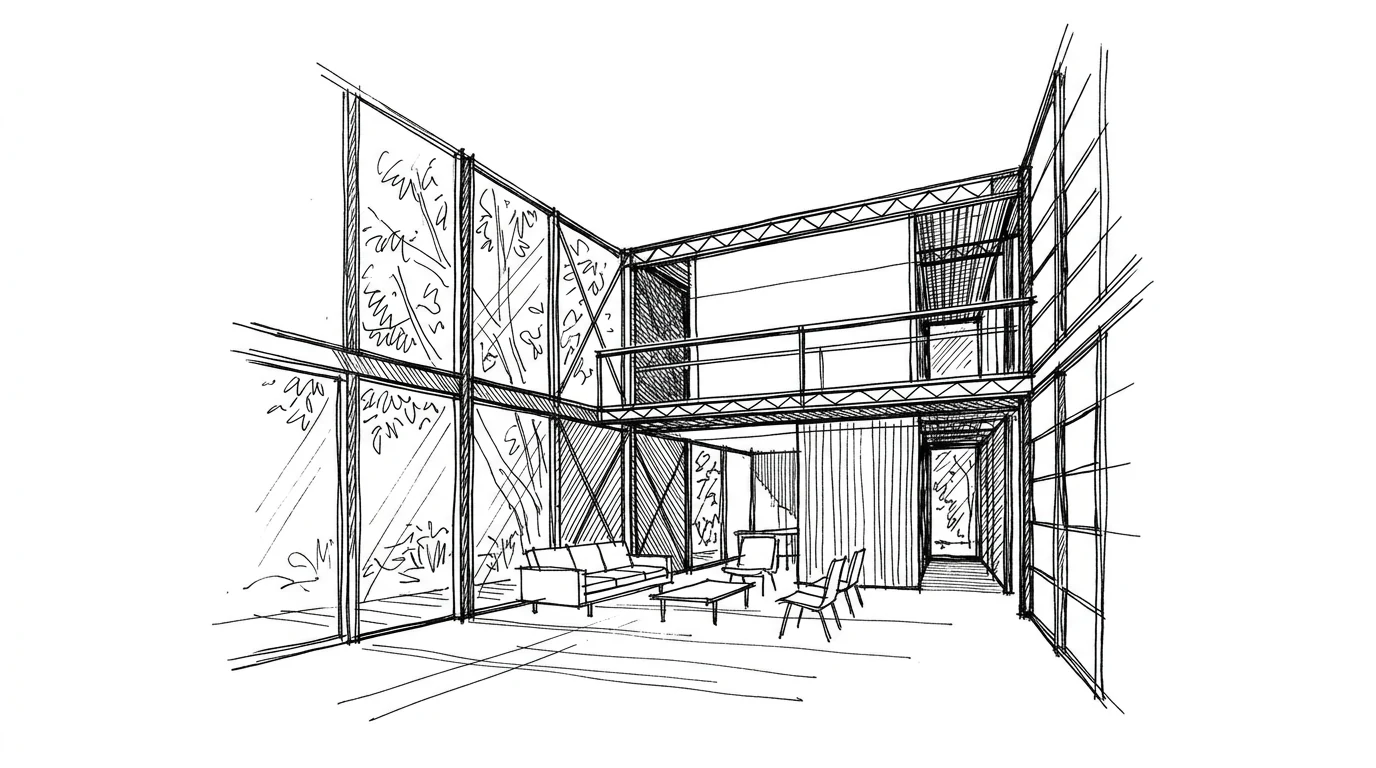
The Eames House (Case Study House #8) was built in 1949 under the Case Study Houses programme of John Entenza, editor of Arts & Architecture, who had commissioned a group of architects to design affordable, modern houses for postwar America. The Eameses used industry-standard elements for their own house: catalogue steel beams, glass panels, coloured fibre-cement panels. The cost was lower than that of an equivalent brick house. The result — four façades of glass and coloured panels surrounded by eucalyptus trees — looks like a Mondrian in three dimensions.
The chair as an engineering problem
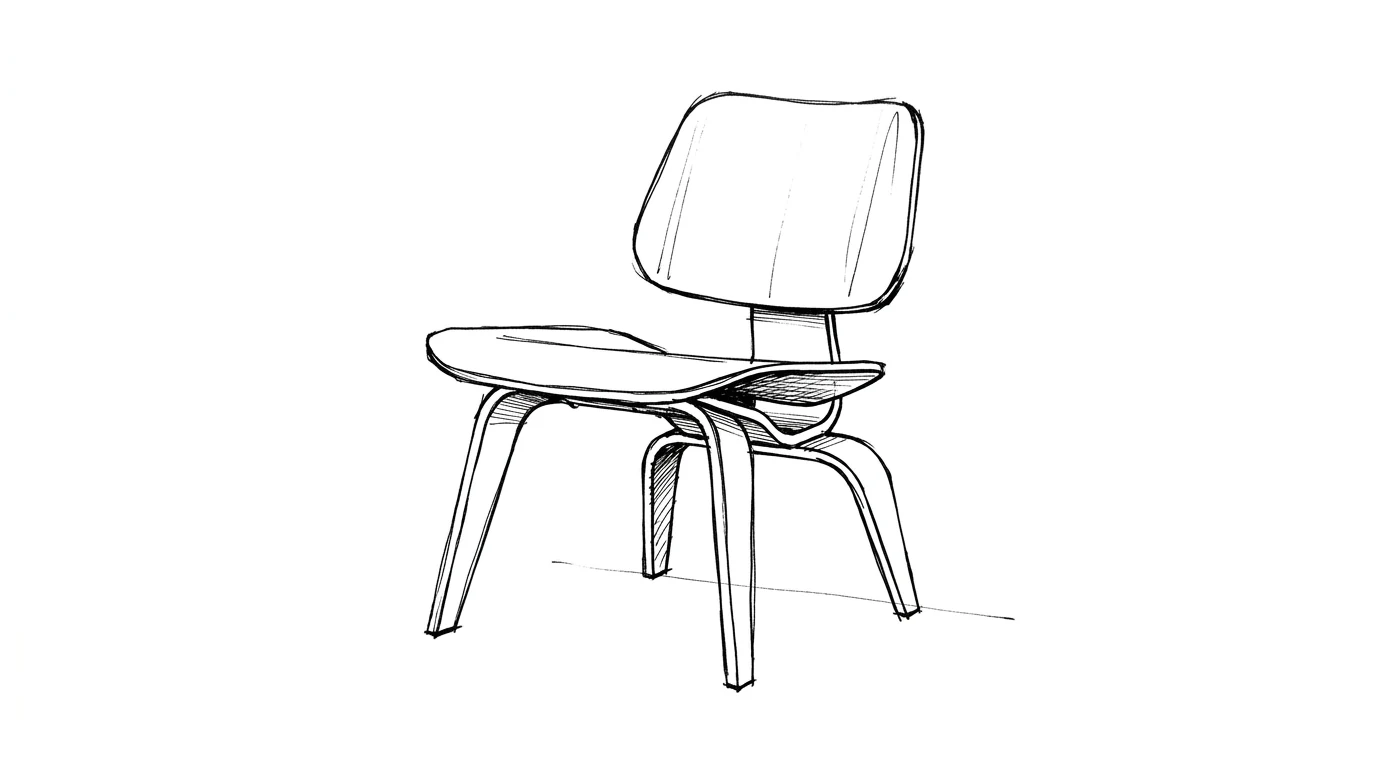
In 1940 Charles Eames and Eero Saarinen won the MoMA competition “Organic Design in Home Furnishings” with a moulded plywood chair — technically impossible to produce in series with the methods of the time. The process of finding a way to produce it in series became the project of the following ten years. In 1950 they produced the DCW (Dining Chair Wood) and the LCW (Lounge Chair Wood): birch plywood moulded in double curvature, shaped wooden legs, no visible bolts. It is the first industrially produced double-curvature chair.
The process is exactly that of design as research: you do not draw the “beautiful” chair and then find a way to produce it. You study the problem — the chair must be comfortable, cheap, producible in series, beautiful — and look for the form that solves all these constraints at once. The double curvature is not decorative: it is the form that gives structural rigidity to plywood without adding material.
Design as a meeting point
Charles Eames has a definition of design worth quoting: “Design is a plan for arranging elements in such a way as to best accomplish a particular purpose.” Not “making beautiful things”. Not “solving problems”. “Accomplishing a purpose”: which is something more precise than “making something work” and more practical than “making beautiful things”. The purpose includes function, includes aesthetics, includes communication, includes context.
This idea — that design is fundamentally an act of communicating an intention through form — is what ties the Eameses' chairs, films, exhibitions and house into a coherent body of work despite the diversity of media and problems. They are all attempts to accomplish a purpose through the optimal arrangement of available elements. The method is the same; the materials and scales change.
Powers of Ten: design as scientific communication
In 1977, Charles and Ray Eames produced the film “Powers of Ten” — nine minutes that start from a picnic in Chicago and zoom outward to the limit of the observable universe (10^24 metres), then return toward the atomic nucleus (10^-16 metres). The film was an educational commission from IBM. It is not their only film: they made over 125 films during their career — educational shorts on subjects such as mathematics, design, architecture, the history of science.
Powers of Ten matters not as a film product but as a model of communication: it takes an abstract scientific concept (scale) and makes it visually comprehensible to anyone. It is the same approach as the chairs (translating a technical problem into a comprehensible, usable form) and the house (translating the principles of modernism into an inhabited, lived space). The Eameses do not divide work into “art”, “design”, “communication”, “architecture”: for them it is always the same question — how do you translate a complex idea into a form that people can understand, use, inhabit?
Influence on the Italian school and the European comparison
The Eameses have been little studied in Italy, although they deeply influenced postwar Italian design — Castiglioni, Magistretti and Sottsass knew their work. The difference is that postwar Italian design was strongly tied to quality craftsmanship, small series, improved traditional manufacture. The Eameses were interested in mass industrial production — democratic access to good design through industry. These are not irreconcilable attitudes, but they produced two different design cultures: the Italian — luxury, craft-based, for the few — and the American — industrial, democratic, for the many. The Eames Lounge Chair (1956) is beautiful and expensive, despite industrial production. The democracy of design turns out, in the end, to be harder to achieve than it promised.