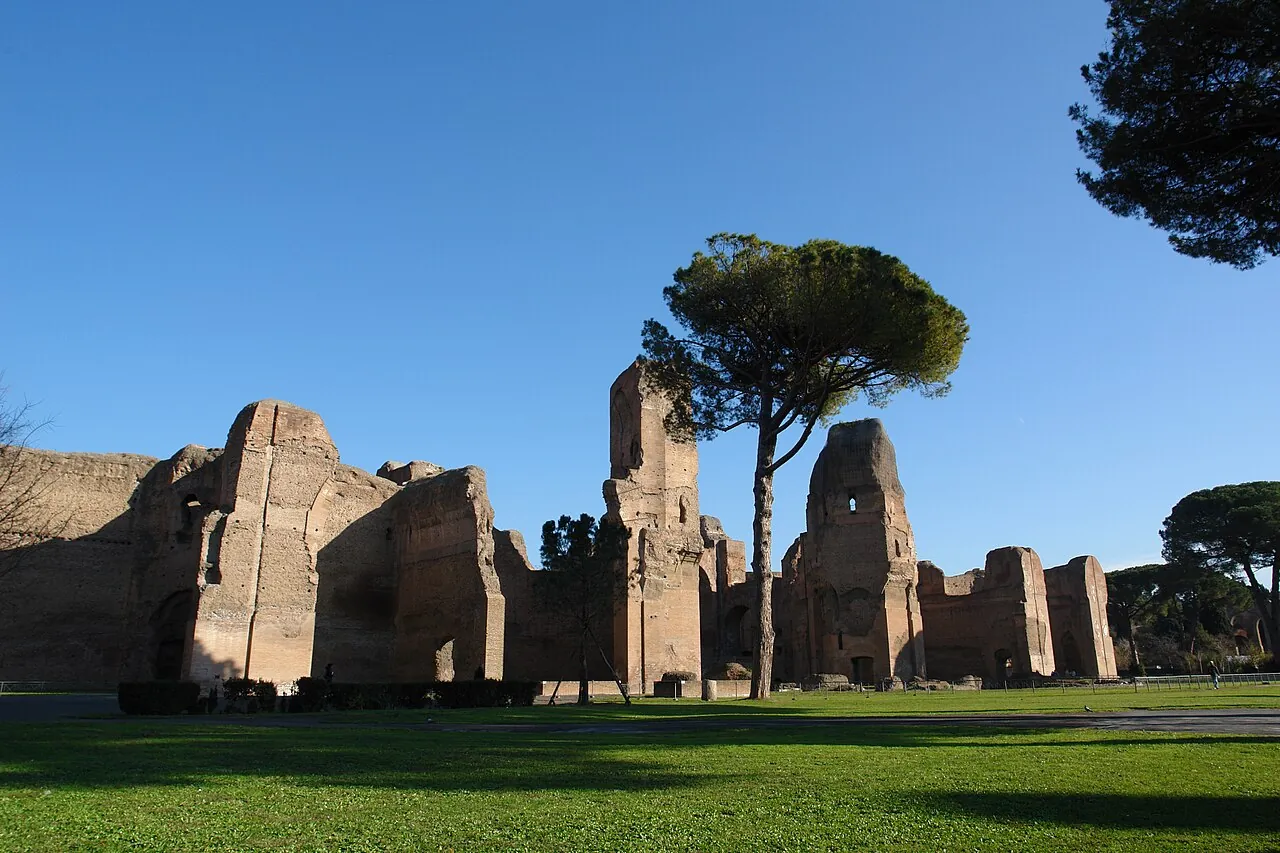
The Roman baths are not a luxury for the wealthy. They are mass public infrastructure, politically motivated. The emperor who builds large, accessible baths buys consent — the Romans knew it and said so explicitly. Juvenal, in the 2nd century CE, wrote the most famous phrase in the history of popular politics: panem et circenses — bread and circuses. He could have added the baths. The trilogy of the emperor who wants to stay in power is: free food, free spectacles, nearly free baths.
The problem is simple: Rome in the 2nd century CE has a million inhabitants (perhaps more). It has no system of private baths: the insulae where the majority of the population lives have no running water, no heating, no private latrines. The baths perform an essential hygienic function — they allow the population to wash. But they also perform a social function: they are the place where different social classes physically meet in the same space. Senators and plebeians use the same baths (sometimes at different times, but often in the same space).
The technological system
The Roman baths are a sophisticated technological system. The heating of the rooms uses the suspensurae: the floor is raised on conical bricks, and hot air produced by underground furnaces circulates beneath the floor and within the cavities of the walls, heating the rooms. The system is called the hypocaust. It works like underfloor heating ante litteram — the hot air circulates, the floor warms the soles of the feet, the rooms reach temperatures of 40–50°C in the laconicum (dry sauna).
Water is brought to the baths by the aqueducts — Rome in the 2nd century CE has 11 aqueducts that bring about a million cubic meters of water into the city each day. A significant portion of this water goes to the baths. The internal hydraulic management — storage basins, piping, drainage systems — is engineeringly complex and requires continuous maintenance.
The symmetrical plan
The plan of the Roman imperial baths follows a precise, replicated scheme: a central axis of symmetry, with the three main rooms (frigidarium, tepidarium, caldarium) arranged in sequence along the axis. The rooms are covered by large cross vaults — the frigidarium of the Baths of Caracalla has a cross vault of 55 × 24 meters, supported by brick piers with no intermediate columns. It is a space on an urban scale.
And here one must be precise: the Roman baths have influenced modern architecture far more than is generally recognized. Grand Central Station in New York (1913) has the same spatial typology as a Roman bath — a tall central hall with overhead light, served by side spaces, with crossing flows of people. McKim, Mead & White, the architects of Pennsylvania Station in New York (1910, demolished in 1963), explicitly declared they were inspired by the Baths of Caracalla. New York's Penn Station was practically a copy of the Roman baths in steel and granite.
The baths today: Santa Maria degli Angeli
The Baths of Diocletian in Rome (305 CE) are the largest ever built in antiquity — they could accommodate 3,000 people. They no longer exist in their original form. But their central hall — the frigidarium — still exists, transformed in 1561 by Michelangelo into the church of Santa Maria degli Angeli. Michelangelo does not demolish the Roman walls: he works inside them, preserving the eight original red granite columns (14 meters tall), opening windows where there were none. The result is a church with anomalous proportions — too wide relative to its length, with side aisles that are too short — because the Roman space does not match Christian liturgy. But the baths are still there, beneath the church.