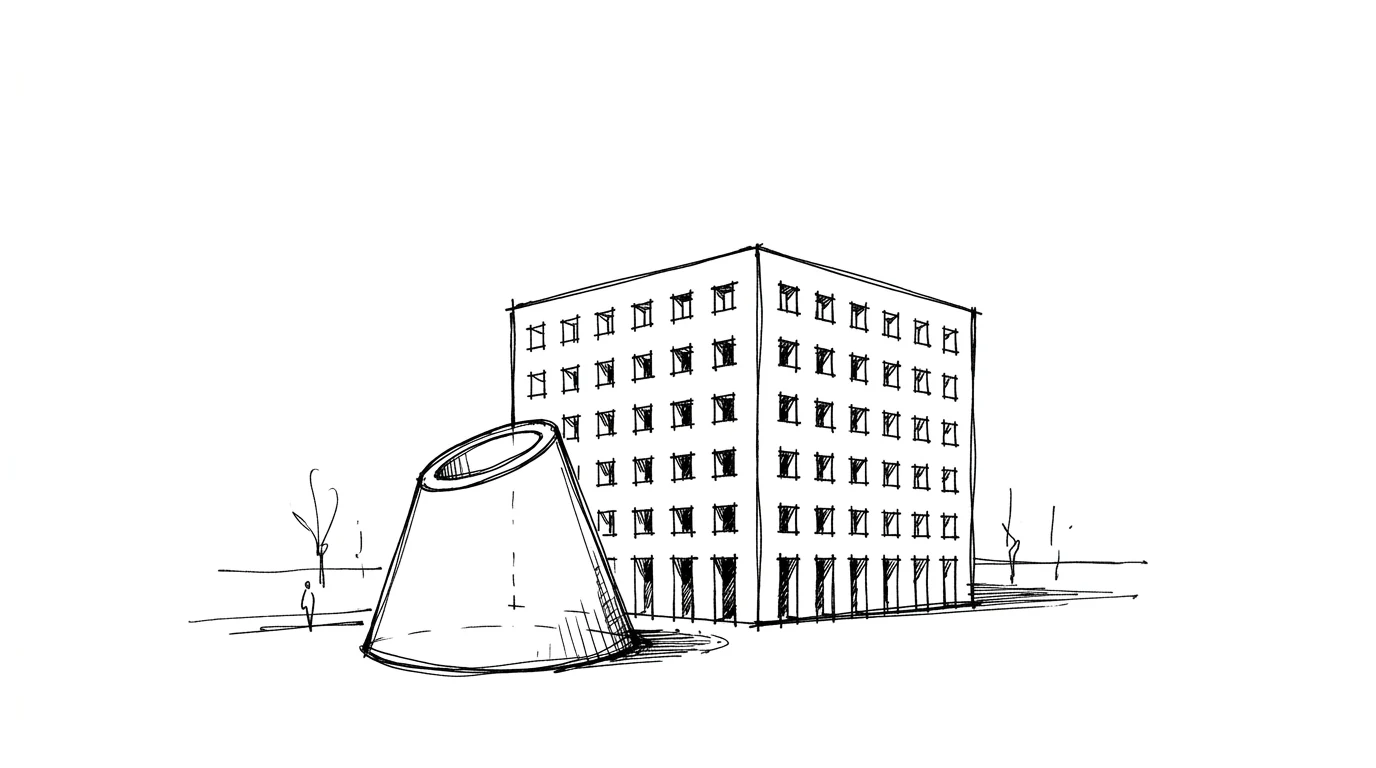
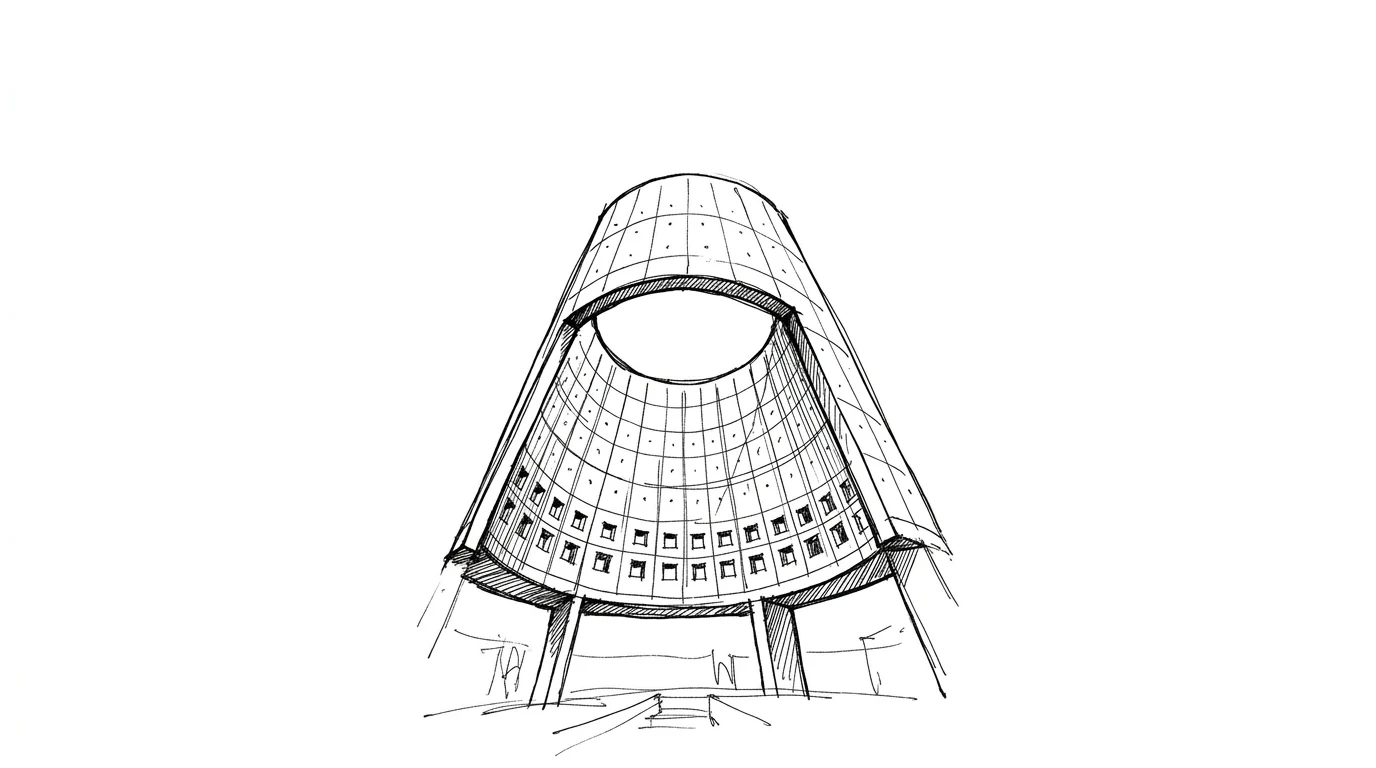
In 1971, Aldo Rossi entered, with Gianni Braghieri, the competition for the Modena cemetery. The project he presented was a cube of red concrete with regular square windows, surrounded by parallel ossuary-like buildings, with a truncated cone in the middle — a structure with no roof, open to the sky, that lights the crypt. The project won the competition, but construction proceeded in parts from the late 1970s, was inaugurated in 1987 and was never completed: the cone, in particular, remained on paper. It provoked violent reactions: some found it terrifying, alluding to Nazi crematoria (a reference Rossi never confirmed but did not rule out), others found it the most honest funerary project of the twentieth century — because it places death at the centre without decorative euphemisms.
Aldo Rossi was born in 1931 in Milan, studied architecture at the Politecnico, and in the early 1960s began working as a critic and theorist before he worked as a designer. He wrote for the magazine Casabella, read French and German urban sociology, Lévi-Strauss, phenomenology. When he published The Architecture of the City in 1966, he was thirty-five and had almost nothing built. The book became the manifesto of a generation.
The Architecture of the City
Rossi's text starts from a critique of urban functionalism: the idea that the city can be explained and designed on the basis of its functions — housing, work, circulation, leisure — is wrong. Cities are not reducible to their functions: cities are memory. Buildings remain over time, functions change — a palace that was a residence becomes an office, then a museum, then residences again. Form outlives function. This means form has an autonomous value, not derived from function — and this value is the value of collective memory.
Rossi's key concept is the “urban artefact”: an element of the city — a square, a palace, a monument — that has acquired over time a density of meanings that makes it irreducible to any functional explanation. The Colosseum in Rome is an urban artefact: it has not been used for its original functions for fifteen centuries, but it continues to be the centre of Rome's urban identity. Its form is its function.
The Teatro del Mondo
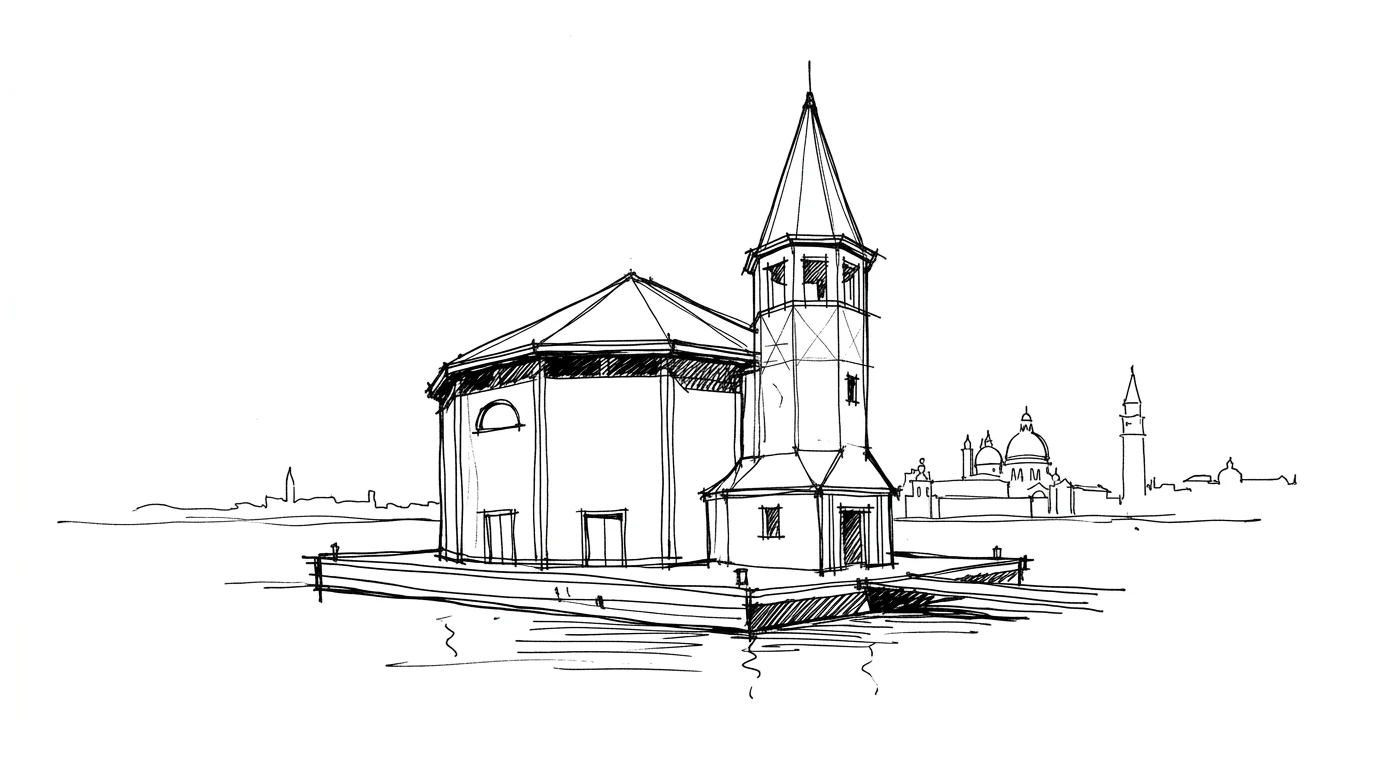
In 1979, for the Venice Biennale, Rossi built the Teatro del Mondo — a temporary wooden structure that floats in the lagoon on a barge, moored in front of the Punta della Dogana. It has the form of an octagonal turret with a pointed roof, like a sixteenth-century building stripped to the bone. Inside: a small theatre with few seats. Outside: a silhouette that converses with the bell tower of San Giorgio Maggiore and the domes of the Salute.
The Teatro del Mondo is the project in which Rossi's theoretical ideas about architecture as collective memory become form: a building that quotes the history of Venice — the floating theatres of the eighteenth century, the water-festival machines of the Renaissance — without imitating them, without being historicist. It is an abstract quotation: it takes the essential form, the tower with the spire, and builds it in an avowedly temporary and light way. After the Biennale, the Teatro was towed across the Adriatic to Dubrovnik for a theatre festival, and dismantled in 1981.
Form as type
The concept of “type” — architectural typology — is central to Rossi's thought and had an enormous influence on architectural theory in the 1970s and 1980s. A type is not a model to copy: it is a deep structure, an elementary form that repeats across eras and cultures because it responds to fundamental needs. The courtyard house, the basilica, the semicircular theatre: these are types. It does not matter how they are built or in what material — the typological structure remains.
His interest in typology led Rossi to use elementary forms in his own architecture — the cube, the cylinder, the cone, the triangle — as compositional elements. His buildings are always recognisable: flat surfaces, square or circular windows regularly distributed, primary volumes. It is an abstraction that is sometimes cold, sometimes moving — depending on how far the context manages to charge the forms with meaning.
Pritzker and the controversies
Aldo Rossi won the Pritzker Prize in 1990 — the first Italian to receive it. At the ceremony, the jury cited him for “the ability to unite theory and practice in a coherent vision of architecture”. But in the following years his commercial output — especially in the United States, where he worked a great deal after 1985 — was criticised for being repetitive, for mechanically applying a formal vocabulary without adapting it to contexts. The same forms — the square, the cylinder, the spire — used for a cemetery in Modena, for a residential complex in Berlin, for a hotel in Fukuoka, for a building in New York produce very different results in terms of quality and coherence.
The problem is simple: a strong theory does not guarantee strong practice. Rossi had developed one of the most coherent and original systems of architectural thought of the twentieth century. When that system is applied quickly and in quantity, without the critical intensity with which it was built, it produces mediocre architecture with theoretical pretensions. It is the fate of many great theorists who are also prolific practitioners.